CRM SOFTWARE
Banking CRM: the complete guide to features, workflows & 10 best CRM platforms

By Ganesh Ravi Shankar
Last updated on Aug 3, 2026
Explore the blog to learn how banking CRM helps you centralize customer data, automate workflows, and grow customer relationships.

The banking CRM market is experiencing explosive growth, from $9.5 billion in 2021 to a projected $39.2 billion by 2031, as financial institutions recognize the critical need for unified customer data management across all touchpoints. Banking CRM software gives you 360-degree visibility of every client interaction and helps you build stronger relationships while spotting new opportunities.
This piece covers everything in CRM software for banking. You'll discover key features and AI capabilities, plus the 10 best CRM platforms to revolutionize your operations.
Key takeaways
- Retention drives profitability: Acquiring new banking customers costs 5-7x more than retaining existing ones, with retained customers generating up to 300% more lifetime revenue.
- AI transforms relationship management: Predictive analytics can boost lead conversion rates by 30% and identify at-risk customers up to 90 days in advance, enabling proactive retention strategies.
- Integration is non-negotiable: Real-time, bi-directional integration with your core banking system predicts frontline adoption better than any other factor. Validate compatibility before purchase.
- Automation delivers measurable ROI: Digital onboarding reduces manual processing time by 80% and cuts customer acquisition costs by 70%, while cross-selling to existing customers delivers 10x higher ROI than new customer marketing.
- Implementation success requires planning: Up to 70% of CRM implementations fail due to misaligned objectives and poor preparation; define SMART goals, secure C-suite commitment, and invest in role-based training.
What is CRM in banking?
Banking CRM (customer relationship management) is a specialized software system designed to manage customer relationships within banks and financial institutions.
Banking CRM centralizes customer data from multiple channels into a single platform, unlike generic CRM tools, and gives you a complete view of each client's financial profile. This view includes personal details, account history, transaction history, communication priorities, and behavioral patterns.
How banks use CRM software today
Banks use CRM software to centralize customer data, automate workflows, improve customer engagement, and maintain regulatory compliance across every stage of the customer lifecycle.
1. Create a unified customer view
A banking CRM combines customer information from branches, digital banking, call centers, and marketing channels into a single profile. This gives relationship managers complete visibility into customer interactions, products, and service history.
2. Automate sales and customer engagement
Banks use CRM to manage leads, track opportunities, automate follow-ups, and deliver personalized product recommendations. Marketing teams can also run targeted campaigns based on customer behavior and financial needs.
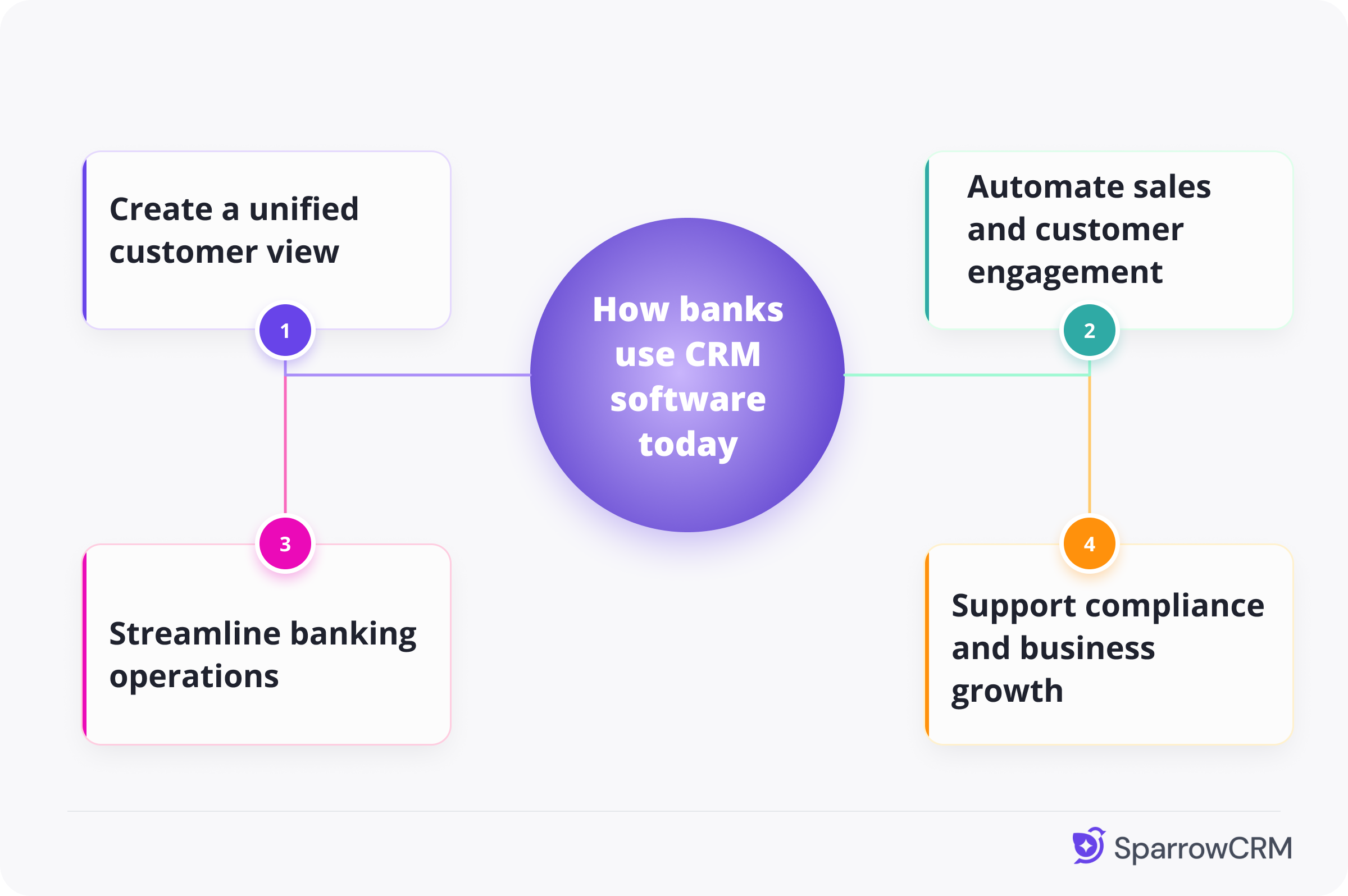
3. Streamline banking operations
CRM automates customer onboarding, loan processing, document collection, approval workflows, and task management. This reduces manual work while improving operational efficiency across departments.
4. Support compliance and business growth
Banks rely on CRM to maintain audit trails, manage KYC documentation, monitor customer activity, and generate real-time reports. AI-powered insights also help identify cross-sell opportunities and predict customer churn.
Key benefits of banking CRM
1. Improved customer retention
Acquiring new banking customers costs between five and seven times more than retaining existing ones. Banking CRM software addresses retention by providing complete visibility into customer behavior and interaction history. You can identify customers at risk of leaving before they switch banks.
The system analyzes spending patterns, account activity, and engagement levels to flag potential churn. Banks that use CRM-powered retention strategies see 15-25% reductions in churn rates.
2. Increased revenue and cross-selling
Cross-selling to existing customers delivers ROI 10X higher than new customer marketing. This efficiency stems from established trust and existing relationships. Banks identify cross-selling and upselling opportunities through customer data analysis, which increases profits without extensive acquisition campaigns.
Studies show cross-selling can increase revenue by 20%. According to Finance Online, CRM increases conversion rates up to 300% by optimizing communication and sales processes through their CRM system. The platform surfaces relevant offers at the right moment based on transaction history, product usage, and life events.
3. Simplified operations and compliance
Banks can track loan application progress and ensure timely follow-ups and consistent service. Digital documentation replaces pen and paper for applications and client onboarding. This saves time and resources while reducing manual errors.
CRM platforms integrate compliance tools into daily operations. The software helps get and register customer consent for data storage and communication. It creates audit trails and maintains records that satisfy regulatory requirements. This automation saves your team considerable time while offering complete reliability in compliance tasks.
💡 Did You Know?
Banks that personalize customer interactions can increase revenue by up to 15% while reducing acquisition costs by as much as 50%, according to McKinsey. A banking CRM makes this possible by consolidating customer data, tracking interactions, and helping relationship managers recommend relevant products at the right time.
Essential features in banking CRM software
1. Centralized customer data management
Banking CRM platforms create a single source of truth. They integrate data from core banking systems, loan origination software, online banking, and third-party applications.
This unified profile combines every account, interaction, and relationship information in real-time. A customer makes a loan payment or clicks an email offer, and the information reflects immediately for everyone to see. Frontline staff get complete visibility into customer relationships and activity through the system.
2. Workflow automation tools
CRM automation improves efficiency. It eliminates manual follow-ups, with tasks like appointment reminders and welcome emails handled automatically. System-generated alerts ensure that key steps are not overlooked or delayed, which reduces task errors. This frees up advisor time and allows staff to dedicate more attention to complex client needs and relationship-building.
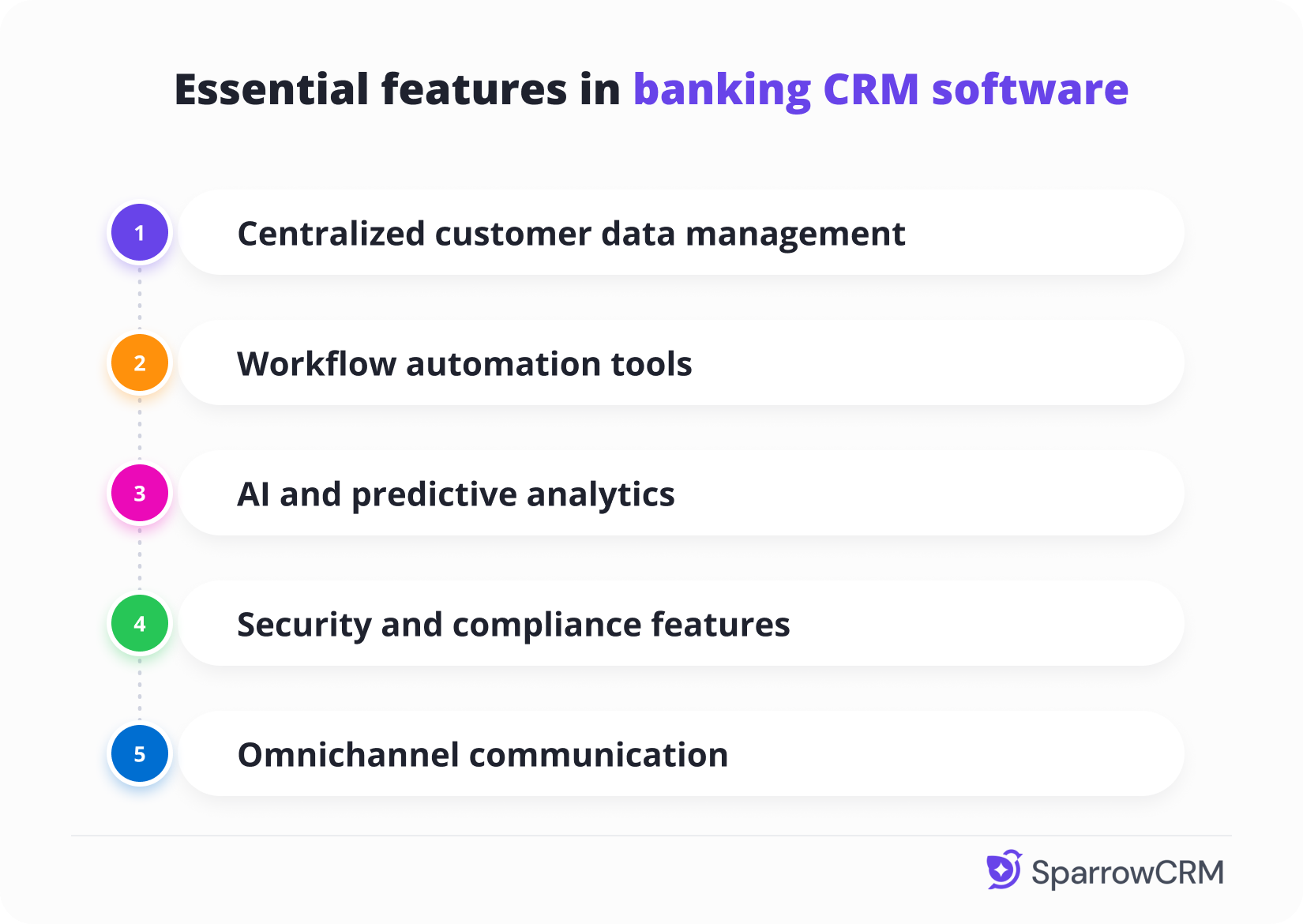
3. AI and predictive analytics
Machine learning algorithms analyze transaction histories, demographic data, and behavioral signals. They identify patterns that predict future customer actions. This allows you to offer tailored products at the right moment, which improves customer engagement and loyalty. Predictive AI allows banks to extend credit responsibly while maintaining rigorous risk controls.
4. Security and compliance features
CRMs help banks meet regulatory requirements. They automatically record interactions, control user access, and keep sensitive data protected. Every interaction and update is logged for compliance and review. Role-based permissions and encryption keep client information protected at every level.
5. Omnichannel communication
Modern CRMs integrate across all touchpoints to maintain a consistent and tailored experience, whatever the channel. Every interaction is logged and used to improve future engagement. You can recognize customers instantly, whatever their connection method. You retain context like last app sessions and pending transactions while connecting front-end interactions with back-office processes.
The platform triggers outreach across SMS, email, app notifications, and voice when behavioral signals just need action. Replies route to self-service flows, bots, or live experts based on intent and customer value.
Your First 3 CRM Seats Are Free

Top use cases in banking CRM
1. Lead management and sales pipeline
CRM platforms change how banks manage prospects from original contact through conversion. Visual pipeline views show exactly where each lead sits in the sales process and eliminate guesswork about deal status. You track opportunities through customizable stages that match your institution's workflow, whether that's prospecting, qualification, proposal, or contract negotiation.
2. Customer onboarding automation
Onboarding software automates identity verification, compliance screening, document collection, and account creation into one workflow. The main goal centers on turning processes that take days into ones that complete in minutes. Banks with efficient onboarding see 85% higher customer retention rates compared to those using manual processes.
3. Loan origination and processing
CRM systems streamline lending from application to fulfillment by connecting secured and unsecured lending on one platform. Pre-built templates turn complex application processes into guided experiences. Automated approval processes and document management improve product recommendations based on customer needs and priorities.
The platform pulls live credit qualification data through native integrations with providers like Equifax into underwriting workflows. This reduces manual work, cuts approval times, and delivers faster, more transparent experiences. Lenders track loan pipeline management through visual views, automated status updates, and alerts for critical milestones.
4. Relationship management for high-value clients
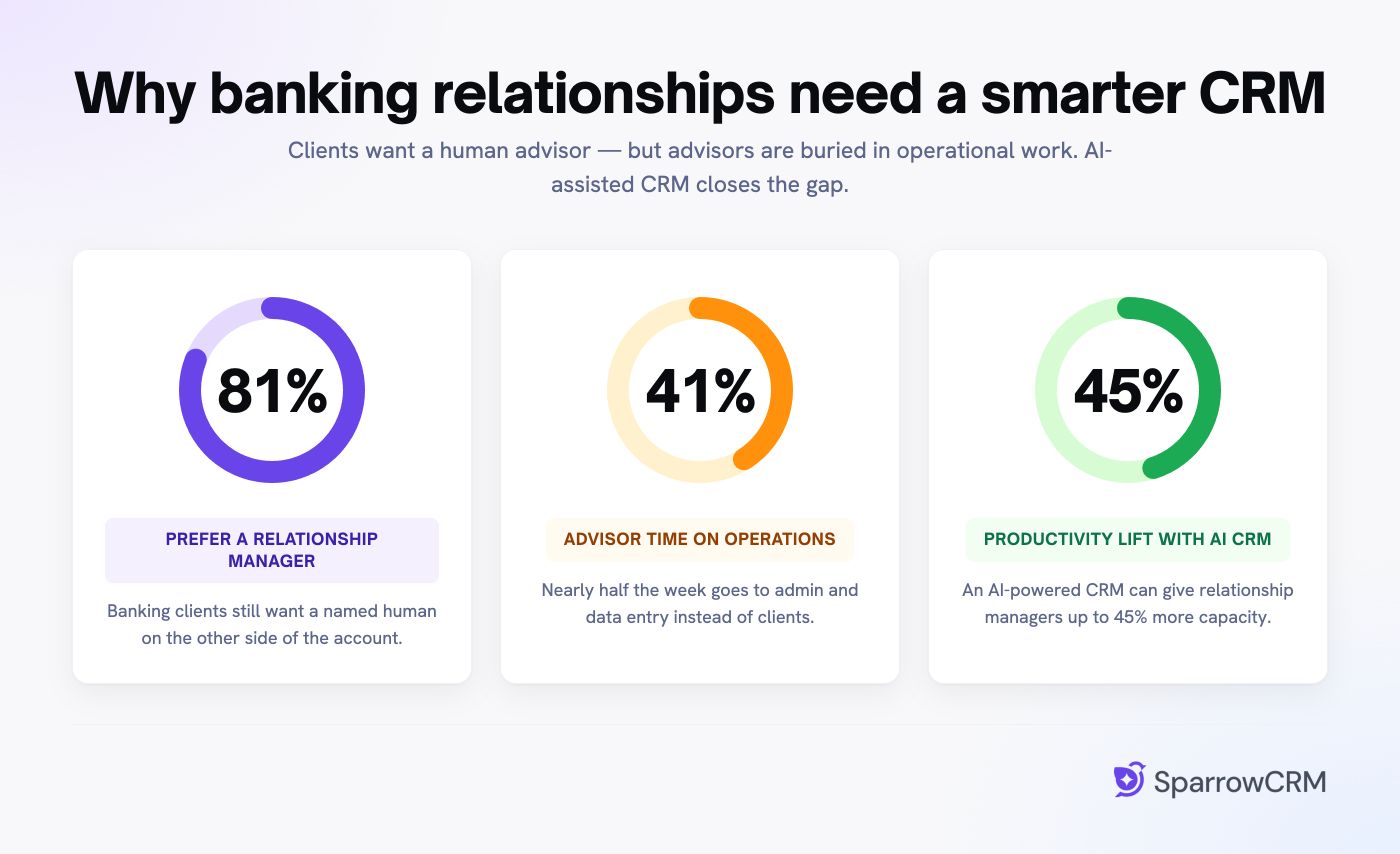
Research shows 81% of banking clients prefer their relationship manager as their main point of contact. Yet 41% of advisors' time gets consumed by operational tasks instead of client-facing work. AI-driven productivity gains can boost RM output by up to 45%.
CRM platforms provide RMs with unified workspaces that bring together client activity, document vaults, and portfolio tracking in one place. Relationship health indicators, including engagement frequency and progress toward financial goals, integrate into daily workflows.
AI in banking CRM
1. Predictive lead scoring
Machine learning models analyze historical CRM data to calculate conversion probability for each lead. The system gets into website behavior, email interactions, past deals, and purchase history to identify patterns showing high intent. Actual data rather than assumptions forms the basis for prioritizing leads, and predictive scoring removes guesswork.
Your organization needs at least 40 qualified and 40 disqualified leads from the selected timeframe to train a model that works. The system gets scores (typically 0-100) that reflect how likely each lead is to convert. Strong buying signals ready for sales outreach come with high scores (80-100), while medium scores (50-79) show prospects needing more nurturing. New data arrives, and models automatically update every six to 24 hours.
2. Customer churn prediction
AI detects patterns in cash balances, transactions, and behavioral data to predict which customers will leave. One multinational bank correctly predicted balance attrition with up to 90 days of warning and got USD 60-80 million in annual economic benefit from saved balances and targeted interventions.
3. AI-assisted relationship management
AI tools help relationship managers prepare for client meetings by surfacing client-specific insights, recent transactions, earnings data, and product usage trends.
The technology combines deal, market, and behavioral data to build tailored outreach campaigns that appeal to client needs. Generative AI delivers 22-30% productivity uplift for roles centered on understanding client needs and personalizing interactions.
4. AI-powered next-best-action recommendations
Next-best-action systems combine predictive AI models with business rules to recommend the single most relevant action for each customer at each moment. Decisions are statistically smart and compliance-safe for regulated banking with this hybrid approach.
📊 Market Snapshot
CRM is the most widely adopted marketing technology in banking, with 48% of bank marketers already using it and another 24% planning to invest within the next year. Banks rely on CRM to centralize customer data, automate workflows, and deliver personalized customer experiences.
– American Bankers Association, Bank Marketing Survey
Top 10 CRM for banks
Selecting the right CRM for your bank requires understanding how each platform addresses specific banking workflows. The following platforms bring specialized capabilities designed for financial institutions.
1. Monday CRM
Source: monday.com
Overview
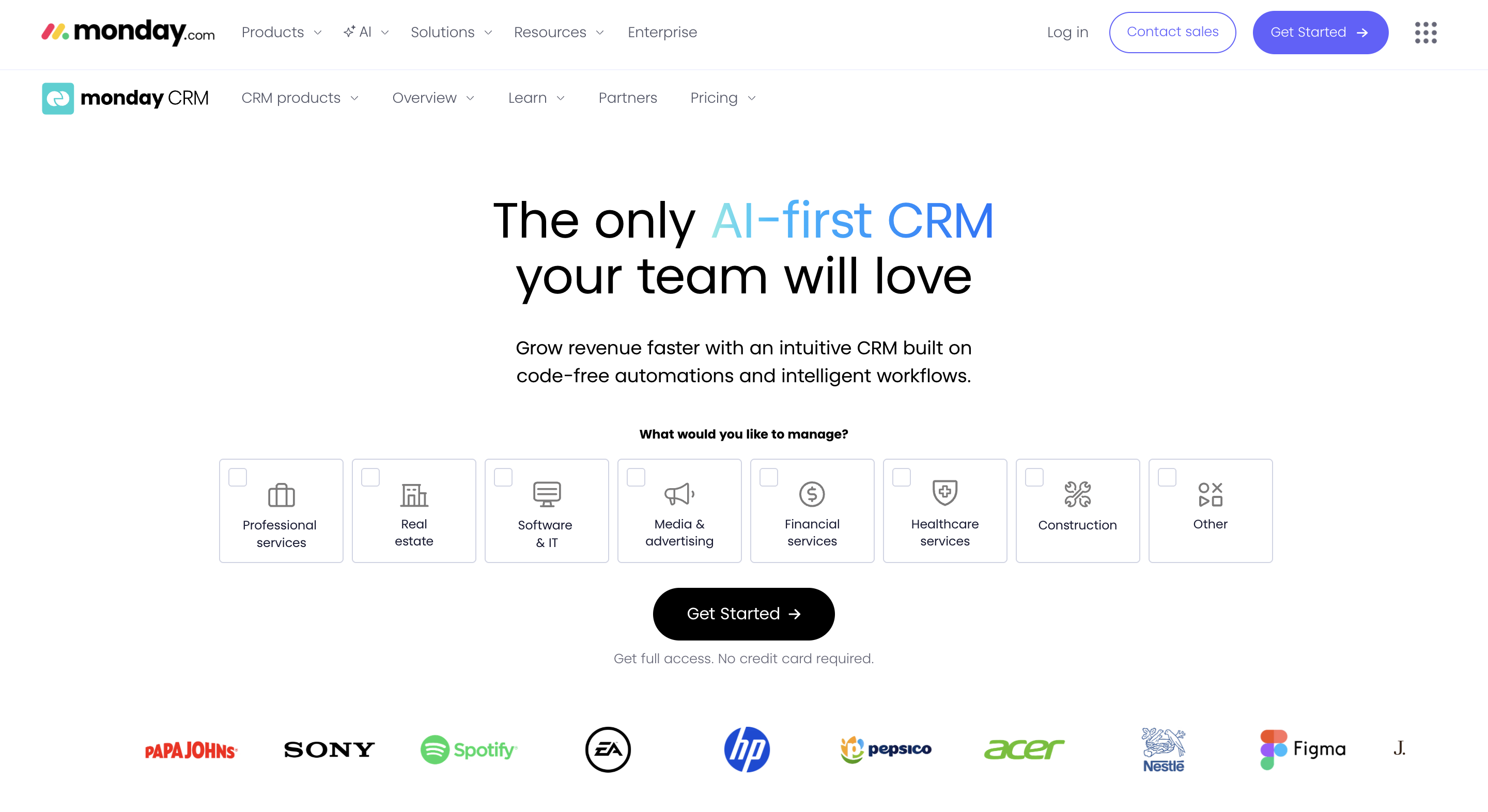
monday CRM is a flexible CRM platform that adapts to different banking workflows without requiring extensive technical setup. Banks can customize pipelines, automate repetitive tasks, and use built-in AI features to manage customer relationships more efficiently. The platform supports both customer acquisition and post-sales engagement from a single workspace.
Key features
- Customizable sales and customer management workflows
- AI meeting notes, deal summaries, and prioritization
- AI sales agents for lead qualification and scheduling
- Workflow automation with no-code configuration
- Reporting dashboards and integrations with business tools
Pricing
Starts at $36 per month (minimum of three users).
2. Salesforce Financial Services Cloud
Source: salesforce.com
Overview
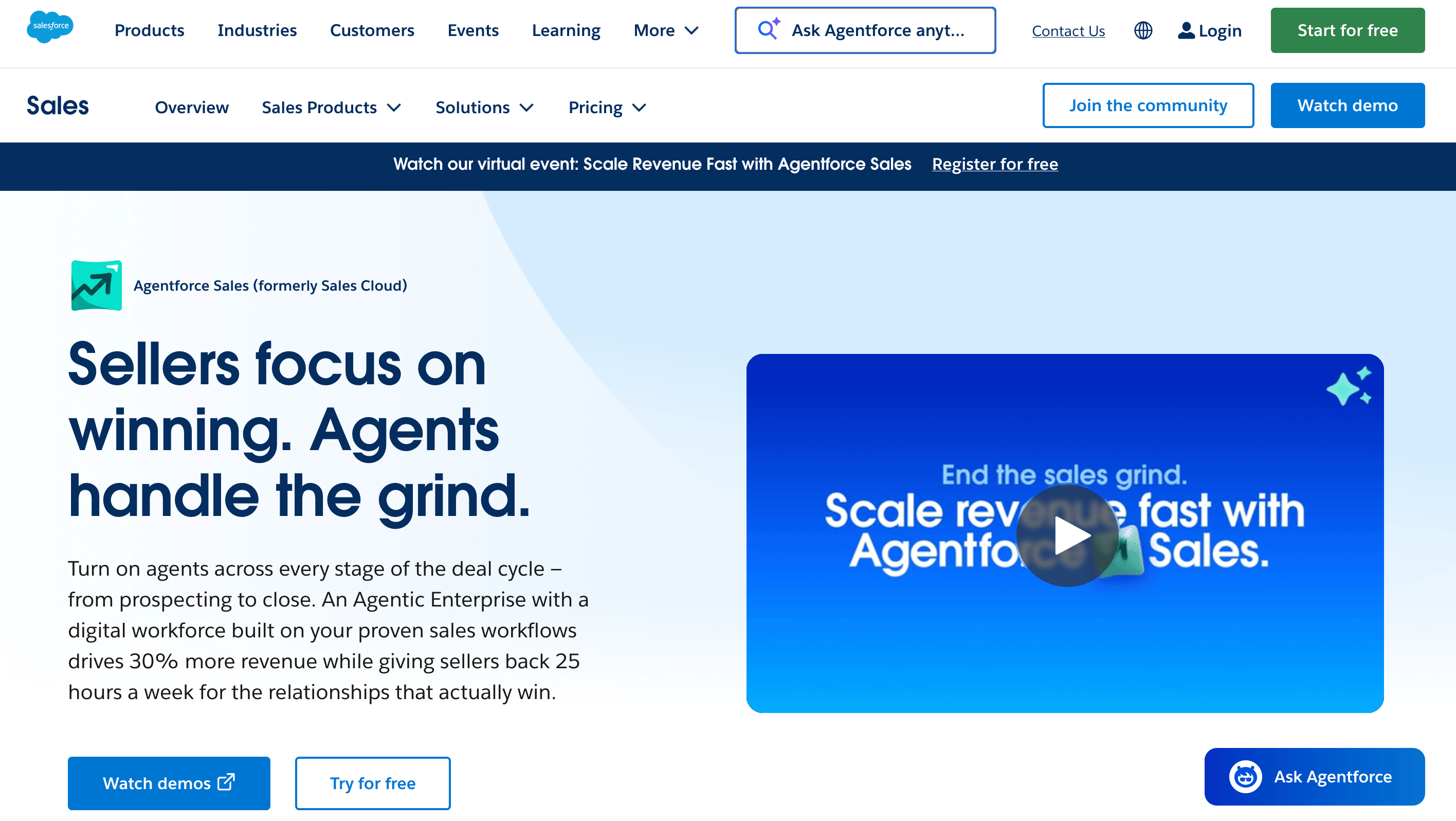
Salesforce Financial Services Cloud is an industry-specific CRM built for banks, wealth management firms, and insurance providers. It centralizes customer information across multiple financial systems, enabling relationship managers to deliver personalized experiences while meeting compliance requirements.
Key features
- Customer 360 view across financial products
- AI-powered recommendations and automation
- Banking-specific data model
- Prebuilt integrations with core financial systems
- Relationship management and compliance tools
Pricing
Custom pricing. Contact Salesforce for a quote.
3. Creatio
Source: creatio.com
Overview
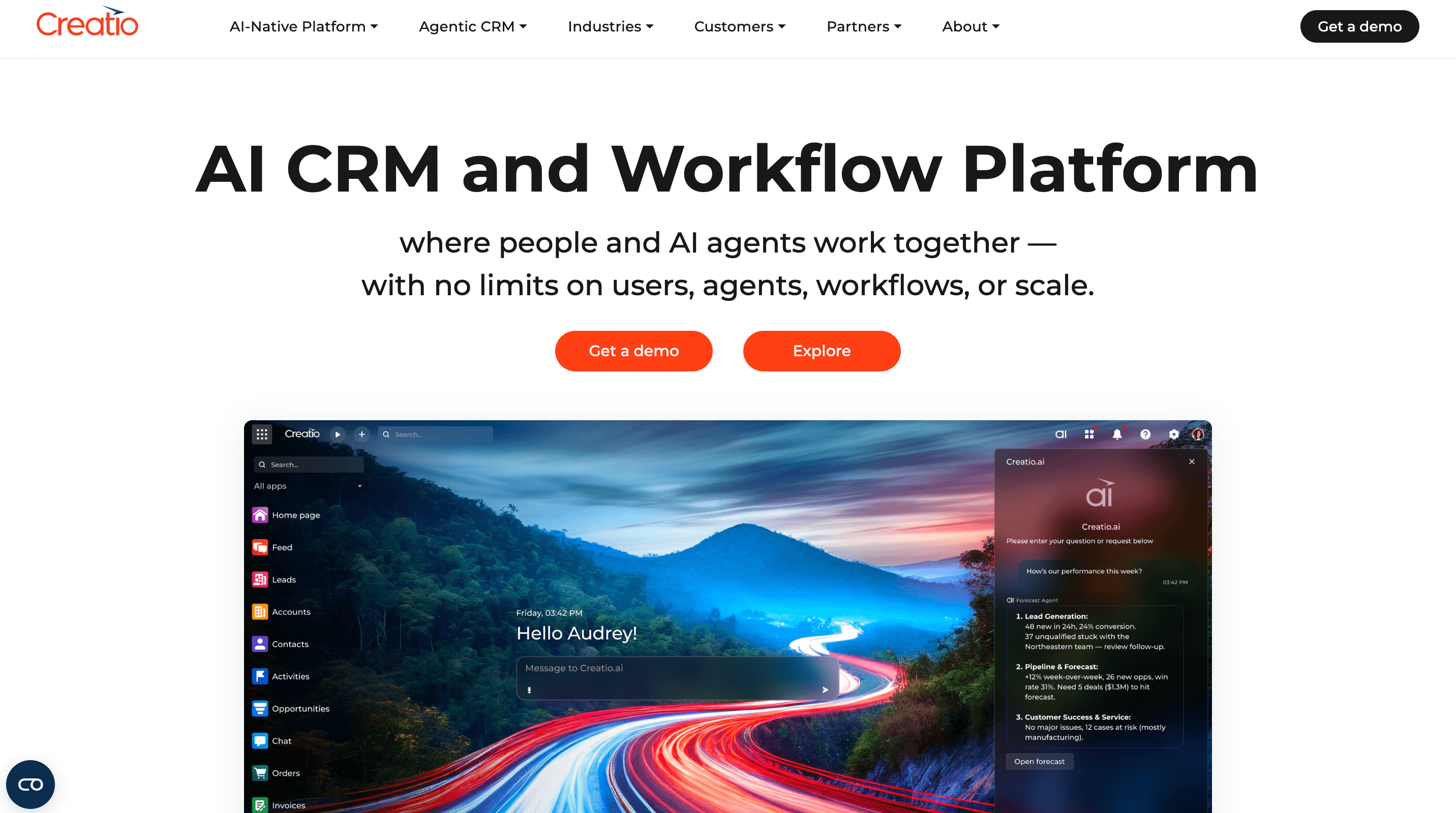
Creatio is a no-code CRM designed to automate banking operations with AI-powered workflows. It helps financial institutions streamline customer onboarding, loan origination, case management, and compliance processes while integrating with existing enterprise applications.
Key features
- No-code workflow automation
- AI agents for banking operations
- Loan origination and onboarding automation
- Case management with audit trails
- Microsoft Outlook and Teams integration
Pricing
Growth: Starts at $40/user/month
CRM products (Sales, Marketing, and Service) are available as add-ons. New customers are subject to a minimum annual purchase of $10,000 with a standard three-year contract.
4. SparrowCRM
Overview
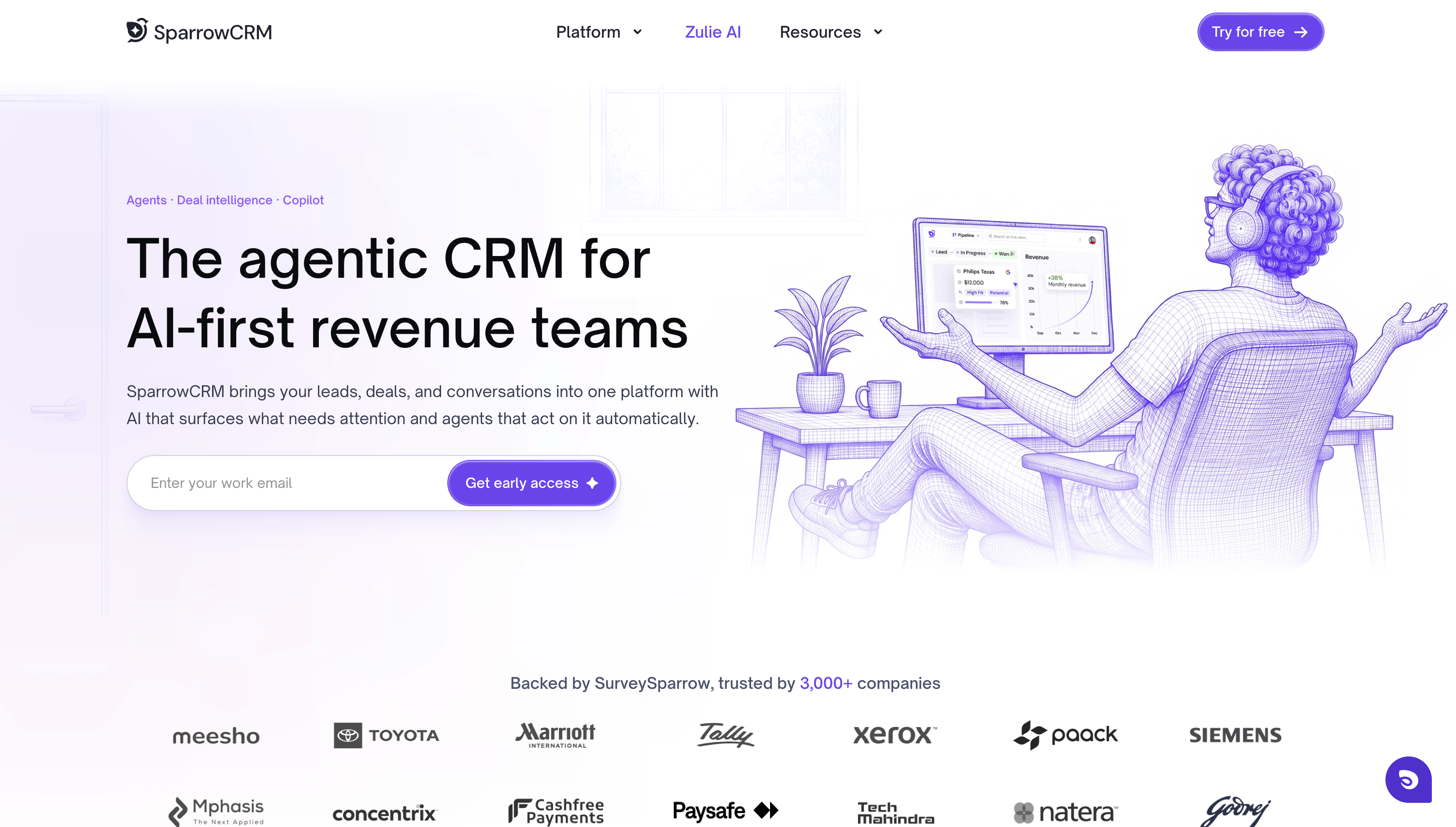
SparrowCRM is an AI-native CRM that helps banks and credit unions automate customer engagement and strengthen long-term relationships. The platform combines sales pipeline management, workflow automation, and AI-powered insights to support customer acquisition, onboarding, and cross-selling.
Key features
- AI-powered customer relationship management
- Automated customer journeys
- Lead and opportunity management
- Workflow automation
- Analytics and engagement tracking
Pricing
SparrowCRM offers four pricing plans to support teams of different sizes:
- Free: $0/user/month (up to 3 seats)
- Growth: $19/user/month
- Pro: $49/user/month
- Enterprise: Custom pricing
The Free plan includes AI scoring for deals, contacts, and meetings, while higher tiers unlock features such as AI call notetaking, buying intent signals, conversation intelligence, unlimited AI-generated reports, and enterprise-grade API access.
Free CRM with AI Copilot Included
5. HubSpot CRM
Source:hubspot.com
Overview
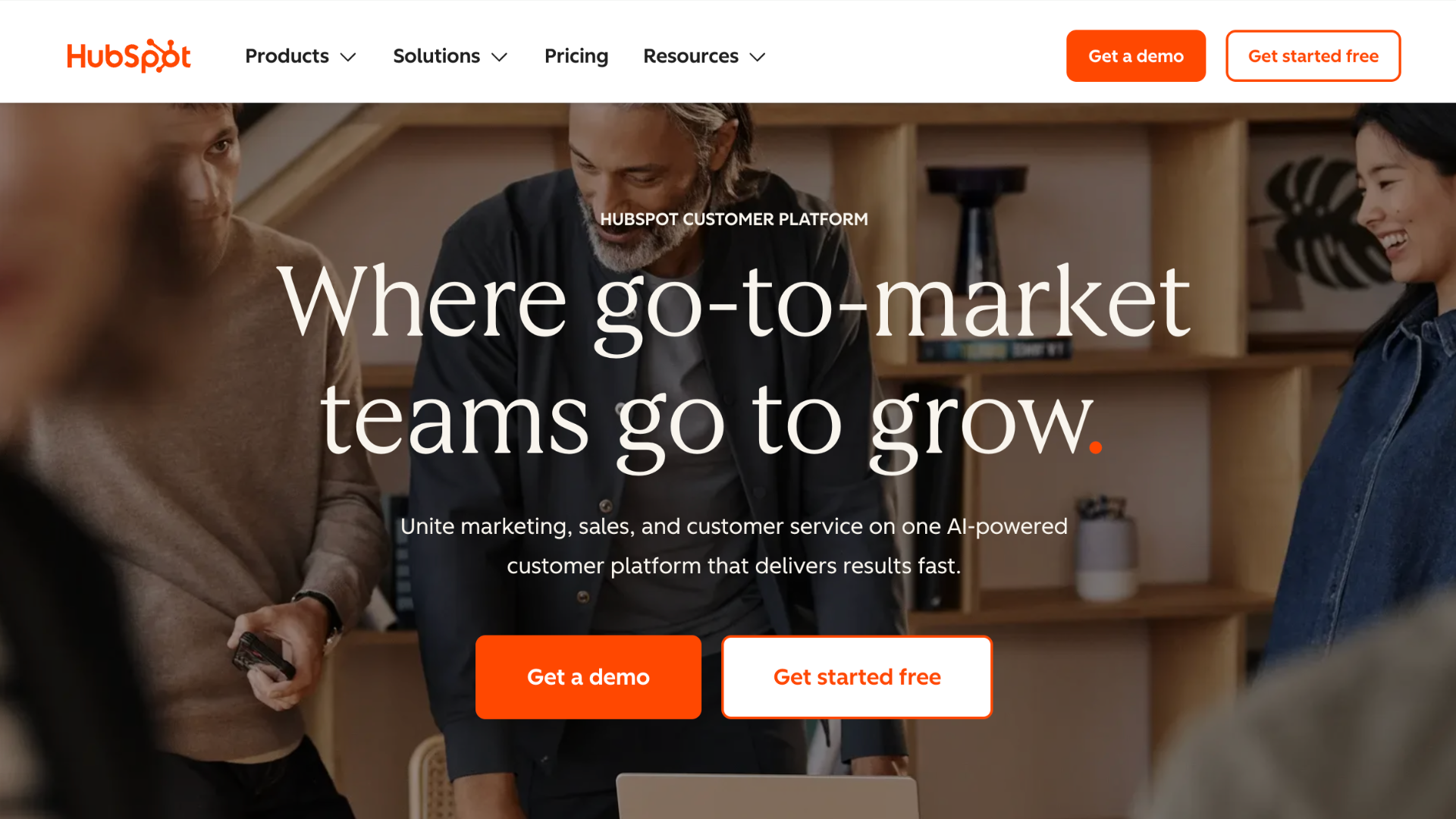
HubSpot CRM enables banks to manage customer interactions across marketing, sales, and service from a unified platform. It provides complete visibility into the customer journey while offering automation and AI tools to improve engagement and operational efficiency.
Key features
- Customer 360 timeline
- Marketing and sales automation
- AI-powered CRM tools
- Reporting and attribution analytics
- Integrations with major banking platforms
Pricing
Free CRM available. Paid plans start at $20 per seat/month (pricing varies by Hub).
6. Oracle NetSuite CRM
Source: netsuite.com
Overview
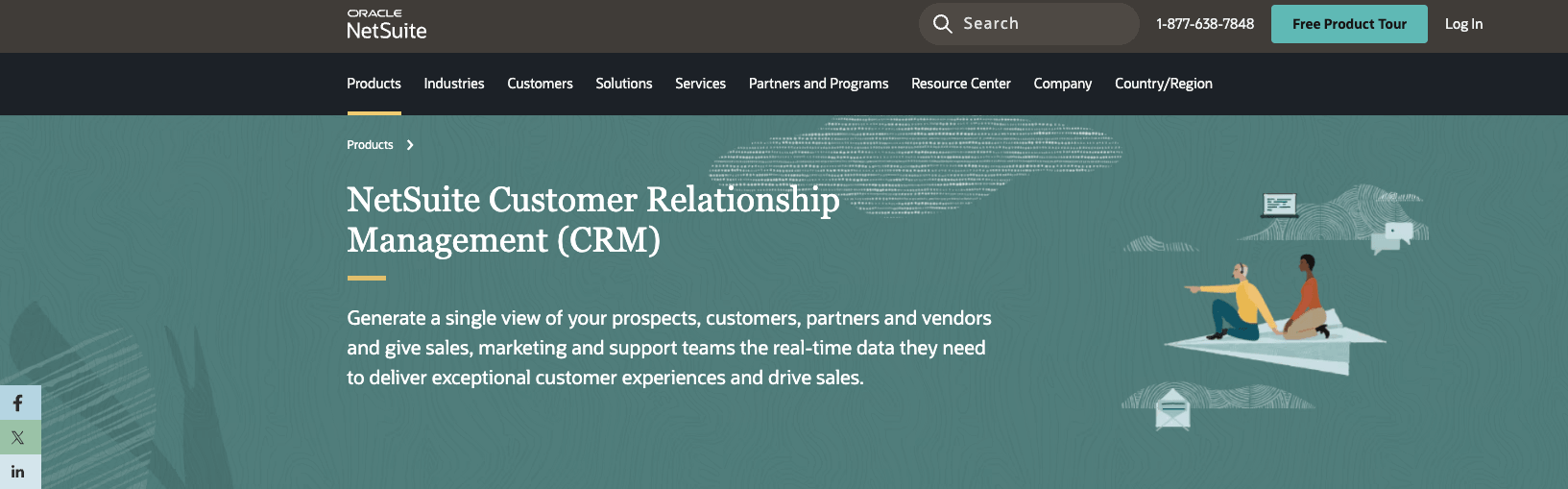
Oracle NetSuite CRM is a cloud-based platform that manages the entire customer lifecycle, from lead generation to post-sale support. Financial institutions can centralize customer data, monitor sales performance, and improve forecasting through a single platform.
Key features
- Customer 360 dashboard
- Sales forecasting and pipeline management
- Quote-to-order automation
- Customer support management
- Financial reporting and analytics
Pricing
Custom pricing available from Oracle.
7. Microsoft Dynamics 365
Source:microsoft.com
Overview
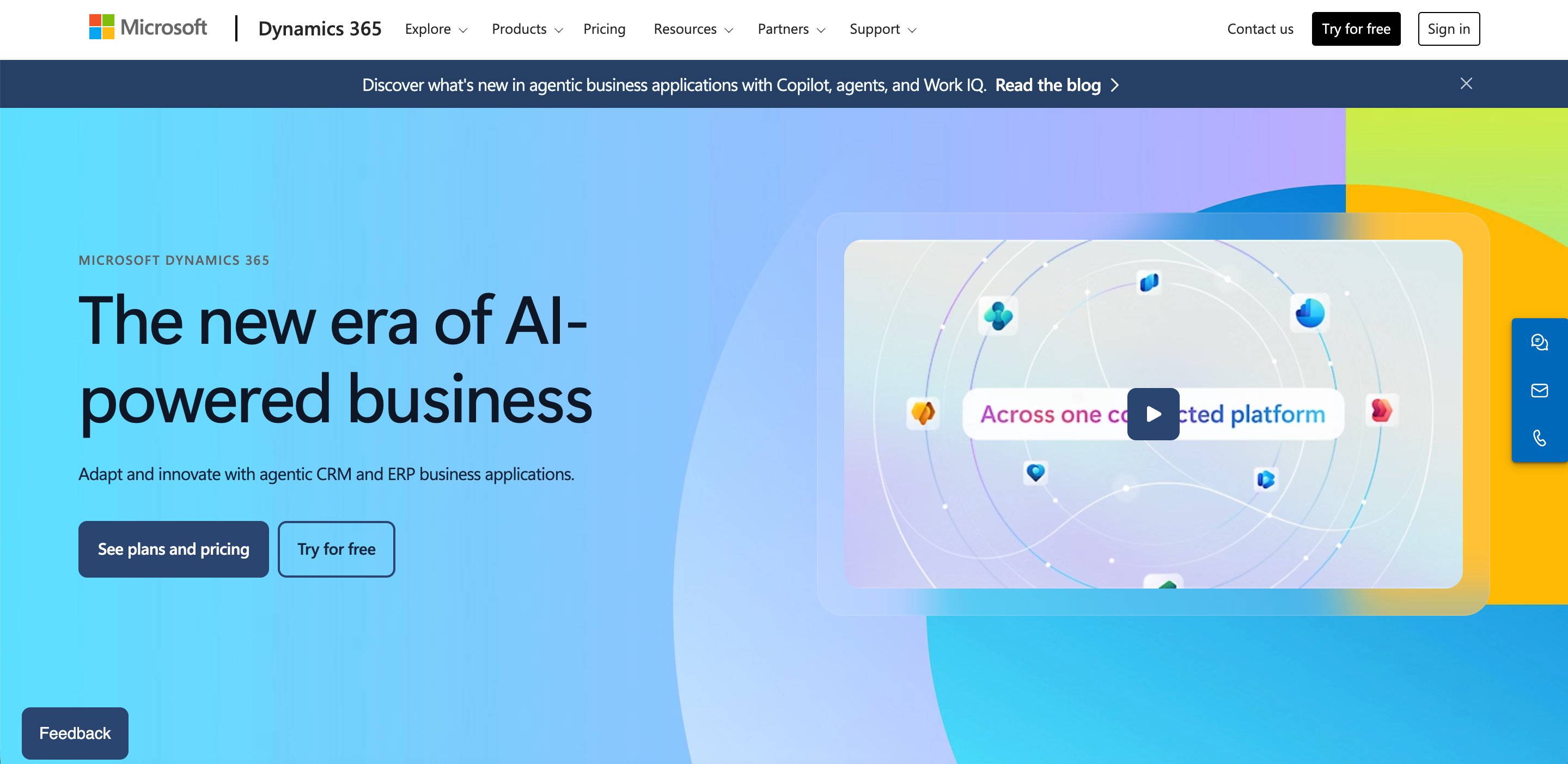
Microsoft Dynamics 365 provides a comprehensive CRM solution for financial institutions through its Banking Accelerator. It helps banks manage customer relationships, automate workflows, and connect retail and commercial banking teams using a unified data model.
Key features
- Banking Accelerator with industry templates
- Relationship management
- Workflow automation
- Mobile referral management
- Microsoft ecosystem integration
Pricing
Plans start at $65 per user/month, with additional costs depending on modules and licensing.
8. Zoho CRM
Source: zoho.com
Overview
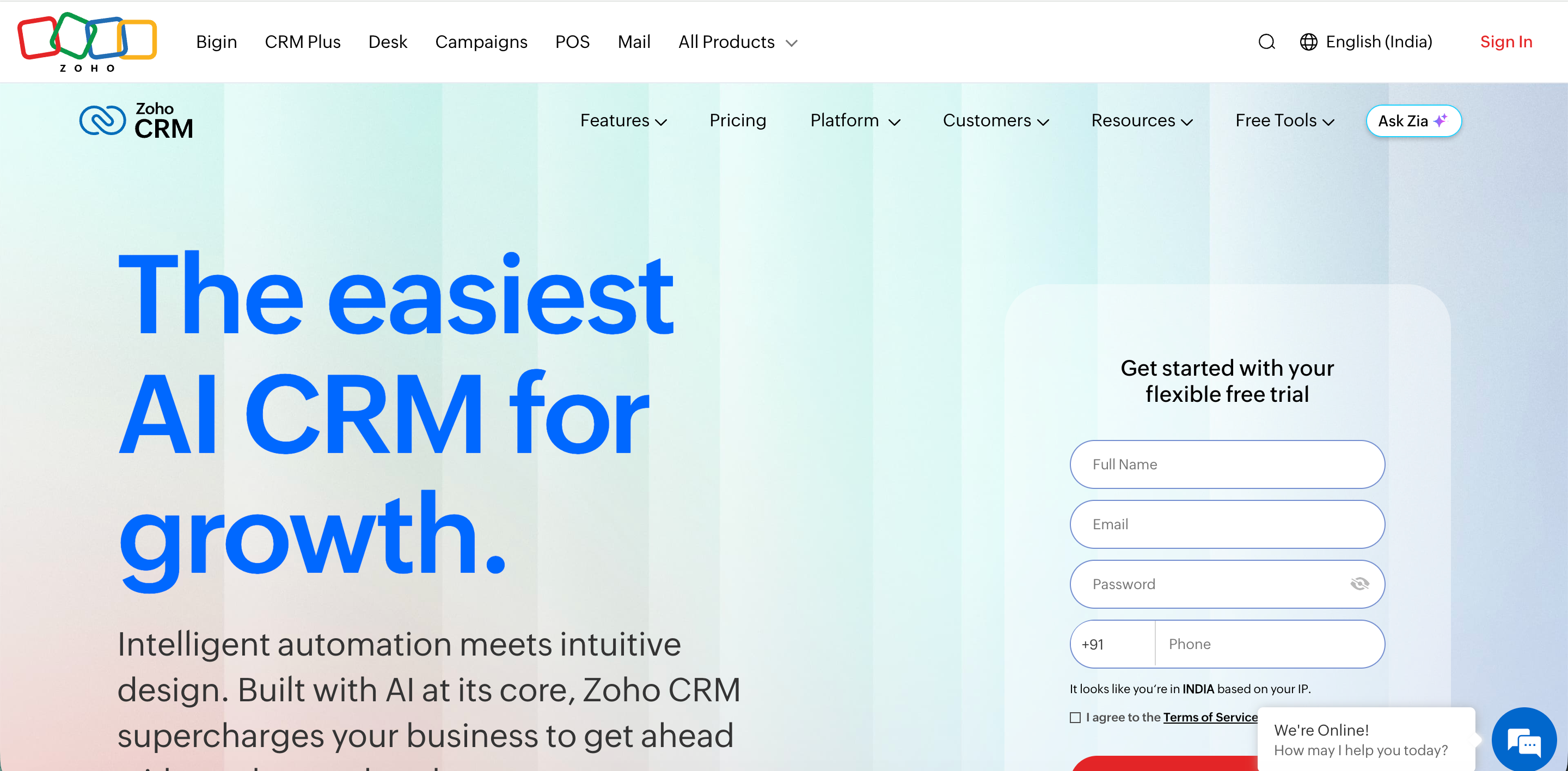
Zoho CRM helps banks and financial institutions manage customer relationships, automate sales processes, and deliver personalized experiences across multiple channels. Its AI assistant, workflow automation, and extensive integration ecosystem make it a good fit for banks looking for an affordable yet scalable CRM.
Key features
- AI-powered sales assistant (Zia)
- Customer 360° profiles
- Workflow automation and approval processes
- Omnichannel communication (email, phone, chat, and social)
- Analytics, forecasting, and custom dashboards
Pricing
- Standard: Starts at $14/user/month
- Professional: Starts at $23/user/month
- Enterprise: Starts at $40/user/month
- Ultimate: Starts at $52/user/month
9. Pega Customer Decision Hub
Source: pega.com
Overview
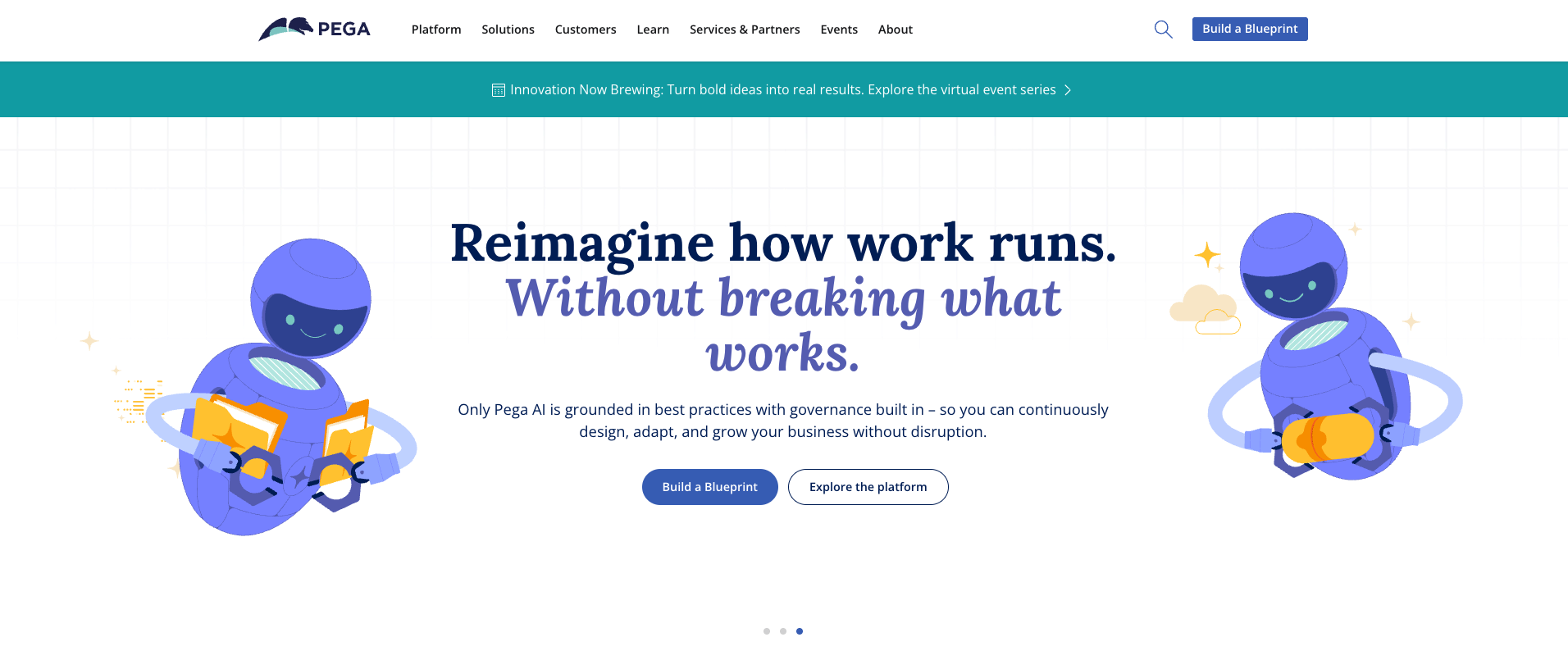
Pega Customer Decision Hub is an AI-powered customer engagement platform designed for large financial institutions. It helps banks deliver real-time personalized recommendations across digital and branch channels while improving customer retention and cross-selling opportunities.
Key features
- Next-best-action recommendations
- Real-time customer decisioning
- AI-driven customer engagement
- Customer journey orchestration
- Enterprise-grade compliance and governance
Pricing
Custom pricing available through Pega.
10. SugarCRM
Source: sugarai.com
Overview
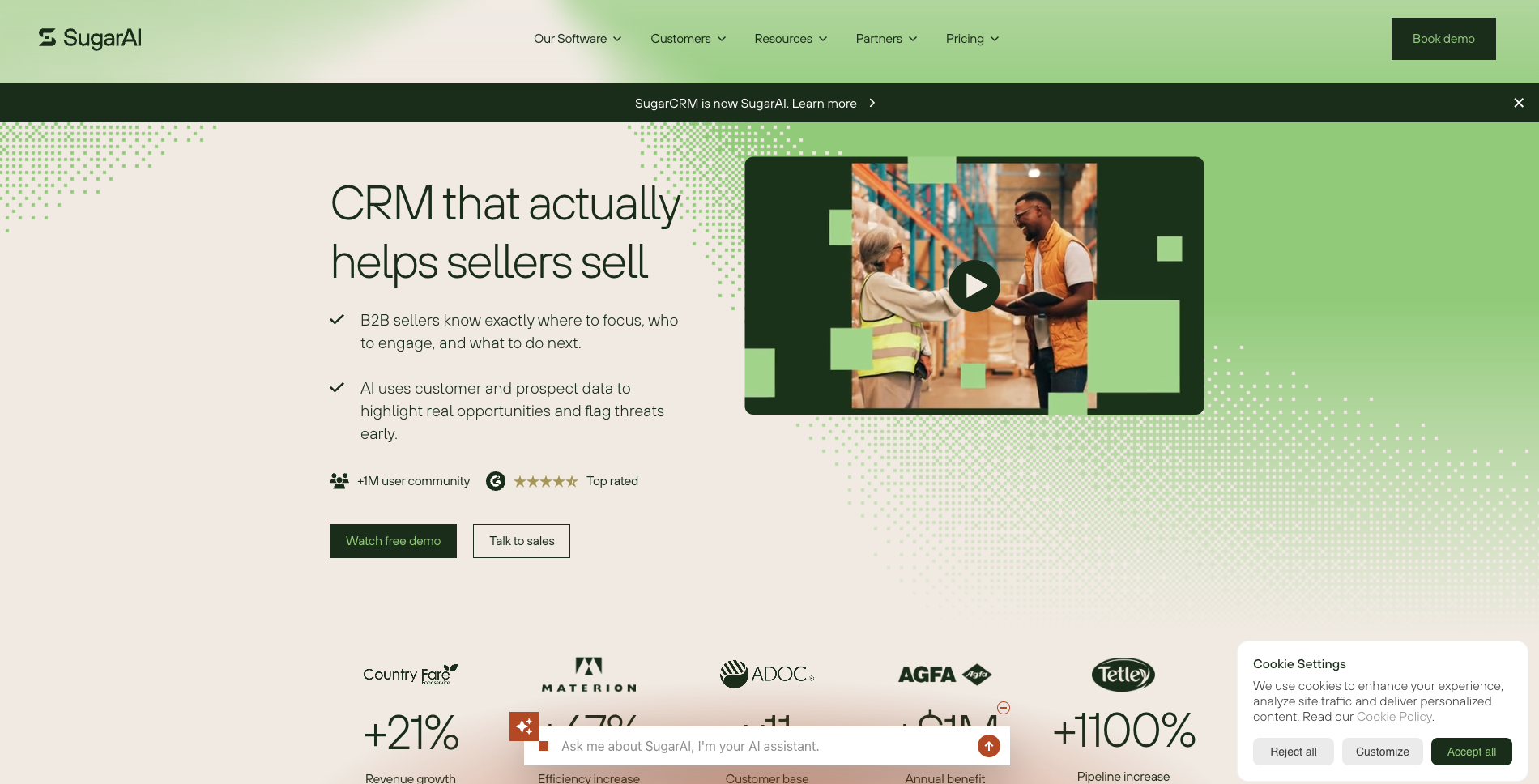
SugarCRM enables banks to unify customer data, automate relationship management, and improve customer service. Its AI-powered insights and configurable workflows help financial institutions strengthen customer engagement while reducing manual work.
Key features
- Customer 360° view
- Sales automation and pipeline management
- AI-powered forecasting and analytics
- Workflow automation
- Customer service and case management
Pricing
- Essentials: Starts at $19/user/month
- Standard: Starts at $59/user/month
- Advanced: Starts at $85/user/month
- Premier: Custom pricing
📖 Mini Case Study: How DBS Bank Uses AI and Automation to Improve Customer Experience
Challenge
As DBS expanded its digital banking services, it needed to reduce manual processes, improve operational resilience, and deliver faster, more personalized customer experiences across millions of customer interactions.
Solution
DBS invested heavily in AI, workflow automation, and digital process transformation. The bank automated a significant portion of its operational workflows, introduced AI-powered assistants for customer service, and embedded AI into technology, operations, and customer engagement.
Results
- Over 80% of addressable operational processes are now automated through workflows.
- The bank has eliminated more than 1.3 million employee hours of manual work.
- AI-powered customer service assistants are expected to reduce call handling time by 20%.
- Automation has improved operational efficiency while enabling employees to focus on higher-value customer interactions.
Banking CRM workflows
Workflows revolutionize how banks execute repeatable processes across departments. CRM systems automate multi-step functions from application intake through fulfillment and create standardized paths that reduce errors and accelerate service delivery.
1. Customer onboarding workflow
When a customer applies to open a new account, the CRM automates the onboarding journey from identity verification to account activation. This reduces manual work, speeds up approvals, and ensures regulatory compliance.
Workflow
- The CRM captures the customer's application from online or branch channels.
- Identity verification, KYC, and AML checks run automatically.
- Customers receive secure requests to upload the required documents.
- OCR extracts data from submitted documents and populates customer records.
- Applications that meet all compliance requirements move to approval, while exceptions are routed to compliance officers.
- Once approved, the CRM creates the customer profile, activates the account, and sends welcome communications.
Result: Faster onboarding, fewer manual errors, and a better customer experience.
2. Loan application workflow
A banking CRM streamlines the entire lending process by automating task assignments, customer communication, and approval tracking.
Workflow
- A loan application automatically creates a new opportunity in the CRM.
- The application is assigned to the appropriate loan officer.
- Customers receive confirmation emails and document upload requests.
- Automated reminders follow up on missing documents.
- Credit review, underwriting, and appraisal tasks are assigned to the relevant teams.
- Stakeholders receive notifications as each approval stage is completed.
- After loan disbursement, the CRM schedules follow-ups, customer check-ins, and cross-sell campaigns.
Result: Better pipeline visibility, faster approvals, and improved borrower communication.
3. Mortgage management workflow
Mortgage applications involve multiple teams and approval stages. A banking CRM keeps every stakeholder aligned while tracking documents and approvals in one place.
Workflow
- Mortgage applications are routed to credit analysts for initial review.
- Underwriters evaluate borrower eligibility and supporting documents.
- Document teams verify required paperwork and request missing information.
- Approval requests move through predefined authorization levels.
- The CRM tracks pre-closing and post-closing conditions until completion.
- Every activity is logged automatically to maintain a complete audit trail.
Result: Standardized mortgage processing, improved compliance, and reduced approval delays.
4. Relationship manager workflow
Relationship managers rely on CRM to maintain a complete view of every customer while automating routine administrative tasks.
Workflow
- The CRM displays a unified customer profile with products, interactions, and opportunities.
- Meeting briefs and customer insights are generated before appointments.
- Call notes and meeting summaries sync automatically to customer records.
- Follow-up tasks and reminders are created after every interaction.
- KYC refreshes and document requests are triggered when compliance updates are required.
- Approval workflows route requests to the appropriate managers and departments.
Result: Relationship managers spend more time building customer relationships and less time on manual administration.
How to choose the right banking CRM?
1. Assess your bank's specific needs
Identify your bank's size, customer base, and key challenges first. Define clear goals: are you improving retention, speeding onboarding, or boosting cross-sell rates? Banks must tailor CRM systems to unique requirements, whether enhancing customer engagement, streamlining internal processes, or gaining complete customer interaction views.
Answer one question before shortlisting: where do your relationship-owning bankers already work? Review extending that system before buying a separate solution if they use platforms like nCino or Baker Hill.
2. Review integration capabilities
Bi-directional, immediate integration with your specific core banking system predicts frontline adoption better than any other factor. Confirm your core, digital banking platform, and loan origination system by name during vendor diligence.
The CRM must connect with core banking and payment platforms to deliver value. Teams manually resolve data across systems without proper integration. This creates incomplete customer pictures that drive poor decisions.
3. Think about budget and pricing models
Model total cost of ownership at your actual seat count and integration scope. Per-seat enterprise licensing and platform subscriptions carry different cost structures. Include implementation partner costs that enterprise platforms typically require.
4. Check vendor experience with banks
Choose CRM designed for financial institutions. Demand role-based demos for teller lines, contact centers, lending, and executive dashboards. A CRM that only sales management uses becomes shelfware with per-seat licenses.
Final thoughts
Banking CRM transforms how you manage customer relationships, simplify operations, and boost revenue growth. The right platform centralizes customer data and automates workflows while delivering AI-powered insights that improve retention and cross-selling results.
Choose a CRM that integrates naturally with your core banking systems and addresses your specific challenges. Prioritize vendor experience with financial institutions and verify integration capabilities before committing.
Proper implementation determines success. Set clear goals and migrate data with care. Invest in staff training to drive adoption. The platforms and workflows covered in this piece give you everything needed to modernize your customer relationship strategy and stay competitive in today's digital banking world.



.png?2026-06-23T07:37:24.214Z)