SALES STRATEGY
What is sales enablement? The complete guide for sales teams in 2026

By Geethapriya
Last updated on Jul 10, 2026
Explore this blog to understand what sales enablement really means, how it differs from sales training, what your sales team actually needs from it, and how to build a program that drives measurable revenue results.

Geethapriya
Updated on Jul 10, 2026
Most sales teams have a content folder. Some have a training calendar. A few have a sales playbook sitting somewhere on a shared drive that nobody reads after onboarding week.
None of that is sales enablement.
Sales enablement is the systematic effort to ensure that every rep, at every stage of the sales cycle, has the right message, content, tools, and coaching to close deals. It is not a one-time event. It is not a marketing deliverable. And it is not something you implement once and move on from.
In 2026, when buyers conduct most of their research independently before speaking to a sales rep, where B2B deals involve six or more decision-makers, and where economic scrutiny has extended sales cycles, the quality and consistency of your enablement function is often what separates a team hitting quota from one that is not.
This guide covers the full picture: what sales enablement actually means, what it is not, how it differs from sales training, what salespeople actually need from it, and how to build a program that works. We also break down B2B versus B2C approaches and include real community insights from sales practitioners who have lived this firsthand. For teams already thinking about inbound vs. outbound strategy and how enablement fits into that split, this guide connects the two.
Key takeaways
- Sales enablement is an ongoing strategic process, not one-time training, that provides tools, content, and technology to optimize selling effectiveness
- Companies with formal enablement programs achieve 49% win rates versus 42.5% without, and see 84% quota attainment compared to 60%
- Successful enablement requires cross-functional alignment between sales, marketing, and operations, with shared definitions and clear ownership
- Modern buyers spend only 20% of their buying cycle with sellers, making every interaction critical for demonstrating value
- AI-powered tools and conversation intelligence are transforming enablement from reactive support into proactive, data-driven guidance
- The investment pays off significantly: organizations with structured enablement reduce onboarding time by 40–50% and are 10x more likely to consistently hit revenue goals
What is sales enablement?
Sales enablement is the process of giving your sales team what they need to sell effectively, at the right moment, in the right format, for the right stage of the buyer's journey.
That includes content, coaching, tools, training, and technology. But the keyword is systematic. Enablement is not a one-off task assigned to marketing. It is a function with ownership, measurement, and continuous iteration.
The core components are:
- Content and collateral: playbooks, battlecards, case studies, and product guides aligned to each buyer stage
- Technology CRM platforms, sales engagement tools, and conversation intelligence software are embedded into daily workflows
- Process: analysis of where deals stall, what objections surface, and which behaviors correlate with wins
- Coaching, structured, ongoing skill development tied to live deal activity, not generic quarterly training
About 90% of sales organizations now have a dedicated enablement program, person, or function. And 92% of executives report that their enablement efforts have directly helped boost sales.
What sales enablement is not
Several common misconceptions limit the effectiveness of enablement programs:
- It is not a content library. Centralizing documents matters, but enablement goes well beyond organizing a folder of pitch decks.
- It is not a marketing function. Marketing provides assets, but enablement requires sales-side context, the daily friction reps face, where conversations break down, and which objections reappear.
- It is not immeasurable. Content usage rates, win rates tied to training completion, and time-to-productivity for new hires are all trackable KPIs.
- It is not a one-time implementation. Markets shift, products evolve, and buyer expectations change. Enablement must adapt continuously.
Sales enablement vs. sales training
The most persistent source of confusion is treating enablement and training as interchangeable. They serve different purposes, operate on different timelines, and require different ownership.
Dimension | Sales Enablement | Sales Training |
|---|---|---|
Definition | An ongoing strategic function that equips the entire sales organization with tools, content, technology, and support | A specific skill-development activity delivered at defined points in time |
Scope | Covers the whole organization, individual gaps, team gaps, process, content, and tooling | Focused on specific skills: objection handling, product knowledge, sales methodology |
Timing | Continuous, runs in the background, responds to market changes in real time | Episodic, delivered during onboarding, annual kickoffs, or when new products launch |
Question it asks | What systemic resources, tools, or process changes will help our whole team sell better? | What specific skills do our reps need to improve right now? |
Retention challenge | Addresses the 70% forgetting problem by embedding support into the daily workflow | Vulnerable to rapid decay, reps forget 70% of training content within one week |
Ownership | Sales enablement function, with coordination across sales, marketing, and operations | Sales managers, L&D teams, or external trainers |
Output | A better-equipped organization, higher win rates, shorter ramp times, and better content usage | Better-skilled individuals, stronger objection handling, improved product knowledge |
Training develops the sellers. Enablement creates the environment in which those sellers can thrive. Both matter, but treating training as your entire enablement strategy is one of the most common reasons programs underperform.
What do salespeople actually need from sales enablement?
There is a real gap between what companies think they are providing and what reps actually find useful. Understanding that gap is where a good enablement strategy starts.
Only 29% of sales reps say their enablement materials are satisfactory. Reps spend less than 30% of their time actually selling; the rest goes to searching for content, updating CRM records, and internal meetings. That is the problem that enablement is supposed to solve.
When you ask salespeople directly, not in a survey crafted by leadership, but in real conversations, the picture becomes specific:
- Clarity on what makes this product genuinely better for this specific customer, not a feature list, but a story that lands in a real conversation
- Battlecards that tell them what to say when a competitor comes up, not product specs, but actual talk tracks
- Case studies and proof points from customers who look like the prospect they are talking to right now
- Coaching that is tied to actual deals in flight, not generic role-play exercises with a fictional scenario from six months ago
- A CRM and tool stack that works with them, not against them, that surfaces the right information at the right moment without requiring manual input
What the sales community says
"Good sales enablement gives sellers three things: clarity, confidence, and content that actually works in the real world."
"The best programs I've seen focus less on fancy decks and more on helping reps win conversations. That means:
- Clear messaging on how your product solves real customer pain
- Battlecards that don't just list features but show what to say when the competition comes up
- Real-world examples and talk tracks that sound human, not scripted
- Coaching that ties back to deals in-flight, not generic roleplays."
— Sales practitioner, r/sales community
This captures what separates average enablement from effective enablement. Clarity means reps know exactly what to say and why. Confidence means they have practised it in contexts close enough to real selling that it sticks. Content that works means assets built for the moment of use, not for the marketing slide deck.
Why sales enablement matters in 2026
Buyer behavior has shifted in ways that make enablement more critical than ever, not less.
Modern B2B buyers conduct extensive independent research before speaking to a rep. They spend just 20% of their buying cycle with sales, which means every conversation needs to deliver real value, not a pitch they could have read on your website.
Economic pressures have intensified buyer scrutiny. Budget cycles are tighter. Purchasing committees are larger. The average B2B deal now involves six or more decision-makers. Every stakeholder has a different concern, and without content, talk tracks, and coaching tailored to that complexity, deals stall.
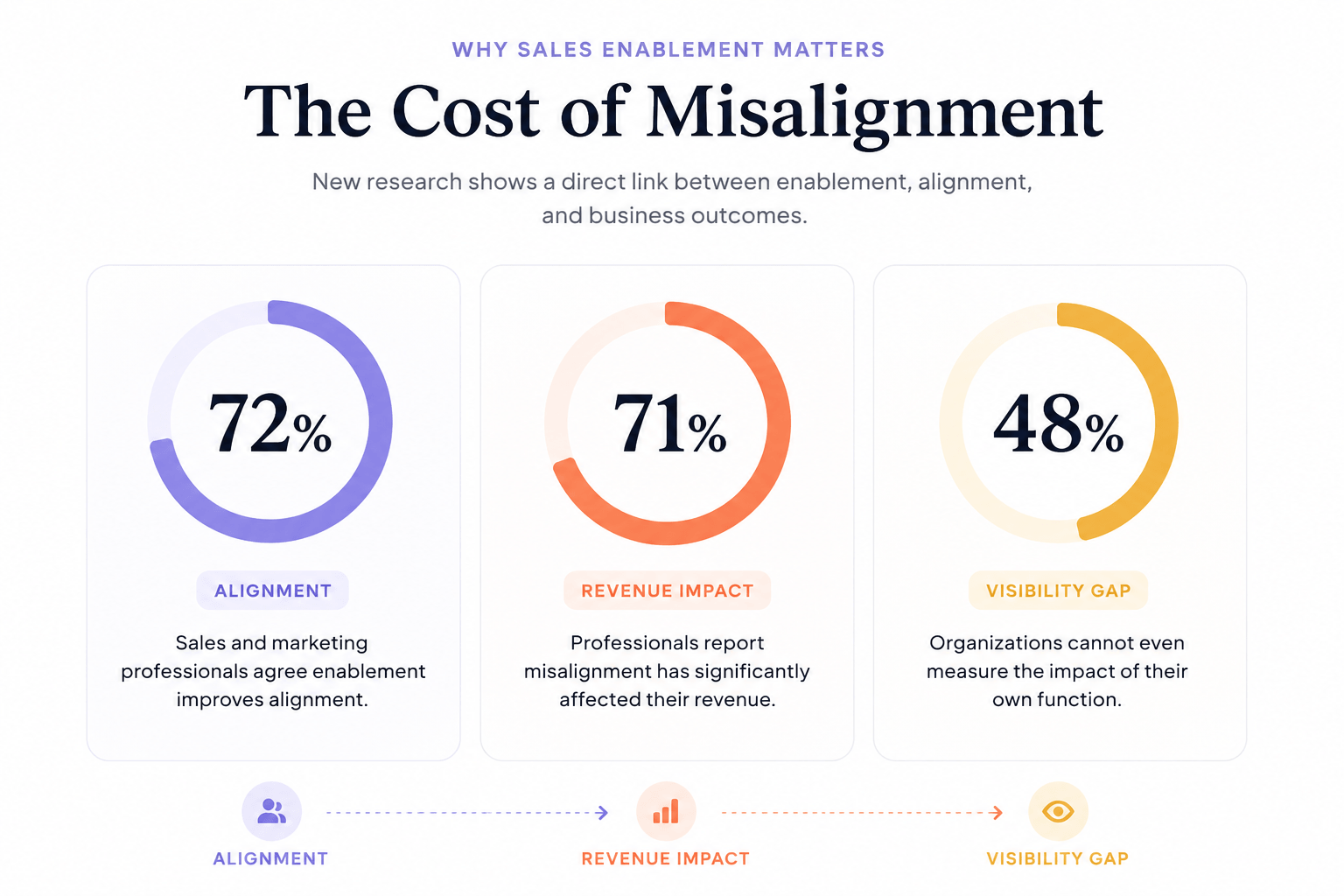
Research shows that 72% of sales and marketing professionals agree their companies should implement enablement to support alignment between the two functions. Without that alignment, 71% of professionals say misalignment has significantly affected their company's revenue. And nearly half (48%) report they cannot even measure the impact of their own function, a visibility problem that sales automation and proper CRM tooling can directly address.
Effect on revenue and win rates
- Organizations with formal enablement strategies achieve a 49% win rate on forecasted deals, vs. 42.5% without structured programs
- Companies with mature enablement functions see 84% quota achievement rates, vs. 60% for organizations without
- Structured enablement reduces new hire onboarding time by 40–50%
- 84% of B2B revenue organizations now invest in dedicated sales enablement departments
- Companies with structured enablement are 10x more likely to consistently hit revenue goals
Key benefits of sales enablement
- Faster ramp time for new hires: Structured onboarding with clear 30/60/90-day milestones gets new reps to first deal faster, reducing the productivity gap that costs most growing teams significant revenue.
- Better content utilization: Reps stop spending 440 hours annually hunting for the right asset; the right content is surfaced at the right deal stage through a managed, searchable system.
- Higher quota attainment: 76% of reps who have proper enablement support report feeling prepared to hit quota; without it, fewer than half of sellers achieve their targets.
- Shorter sales cycles: When reps have the right messaging for each stage, they move buyers through the funnel with fewer stalls.
- Stronger sales-marketing alignment: Shared definitions of the ICP, buyer personas, and value propositions eliminate the friction that causes 71% of companies to lose revenue from misalignment.
- Consistent buyer experience: Enablement ensures every rep delivers the same quality of conversation regardless of experience level, protecting brand and deal quality.
- Data-driven coaching: Managers stop relying on gut feeling and start coaching to specific behaviors identified through conversation intelligence and deal data.
Sales Enablement That Actually Shows Up in Every Deal
B2B vs. B2C sales enablement: how they differ
Sales enablement is not a single universal model. The strategy, tools, content types, and measurement approaches look very different depending on whether your team sells to businesses or directly to consumers.
Both environments benefit from enablement, but the pain points, buying dynamics, and program design diverge significantly. Here is how:
Dimension | B2B Sales Enablement | B2C Sales Enablement |
|---|---|---|
Buying process | Multi-stakeholder, 6+ decision-makers, months-long evaluation cycles | Single buyer or household, often a same-day or same-week decision |
Content needs | ROI calculators, technical documentation, case studies by industry, competitive battlecards, legal/compliance materials | Product demos, FAQ sheets, lifestyle content, comparison charts, customer testimonials |
Rep's role | Consultative advisor: educates, builds consensus, maps stakeholder concerns across the buying committee | Product guide and closer: answers objections quickly, creates urgency, handles emotional buying signals |
Coaching focus | Discovery, multi-threading, executive conversations, navigating procurement and legal | Speed, objection handling at the point of sale, empathy, and product knowledge |
CRM depth | Deep pipeline tracking, opportunity scoring, account history, and buying committee mapping | Lead management, fast follow-up sequences, volume handling |
Measurement | Win rate, deal velocity, quota attainment, time to productivity, forecast accuracy | Conversion rate, average transaction value, repeat purchase rate, CSAT |
Biggest enablement gap | Lack of persona-specific messaging and content for each buying committee member | Inconsistent in-store or call handling; rep-to-rep experience varies widely at volume |
For B2B teams in particular, especially those selling to multiple stakeholders across longer sales cycles enablement is what makes the difference between a rep who can handle a discovery call and one who can navigate an entire committee through a 90-day evaluation. That is a fundamentally different skill set, and it requires fundamentally different support.
This is especially true for B2B sales teams at SaaS and technology companies, where the product evolves quickly, competitive differentiation shifts frequently, and the people buying are sophisticated, they have read your competitors' websites, they know the talking points, and they are evaluating you on the quality of the conversation, not just the product spec.
How to build a sales enablement strategy that works
A sales enablement strategy is only as strong as the execution behind it. The following five steps provide a practical framework, not a theoretical one.
Step 1: Align with business goals and stakeholders
Before you build anything, establish alignment across your revenue organization. Sales, marketing, and operations need shared definitions: who the ideal customer is, how big that addressable market actually is, what the value proposition is, and what the sales process actually looks like.
Assign clear ownership with a RACI model. Sales enablement orchestrates the program and owns training. Sales operations handles CRM configuration and workflow. Revenue leadership sets strategic priorities and allocates resources. Without this clarity, enablement work gets duplicated, undermined, or ignored.
Step 2: Identify gaps through listening
Diagnose where your team actually struggles before you build anything. There are two distinct types of gaps:
- Cohort gaps, problems affecting the whole team, such as low CRM adoption, poor discovery call structure, or weak objection handling across the board
- Individual gaps, personal blind spots, like a rep who discounts too early or struggles to navigate procurement conversations
Run manager surveys, listen to call recordings, and track where deals consistently stall. 69% of reps identify prospecting as their biggest challenge. But 52% of leaders say their managers need to coach more often. That disconnect between where reps hurt and where managers spend time is exactly where enablement should focus first.
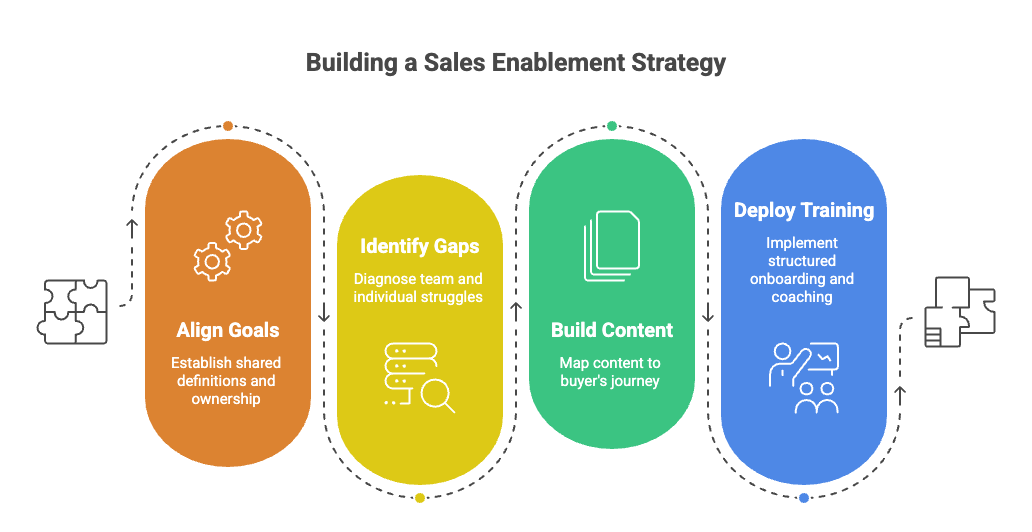
Step 3: Build content mapped to the buyer's journey
Develop content tied to specific buyer stages and personas. Top-of-funnel content should help reps open conversations. Mid-funnel content builds the business case. Late-stage content handles procurement objections and accelerates sign-off.
Involve sales in content creation from the start. When marketing builds assets in isolation, reps ignore them. Pilot content with a small group before rolling it out. Assign owners to update assets when products change, and retire unused content so the library stays lean.
Step 4: Deploy training and coaching programs
Structured onboarding should have clear milestones: foundational fluency in the first 30 days, certification on core skills by day 60, and first deal closed by day 90. But onboarding is only the beginning.
Because reps forget 70% of training within a week, ongoing reinforcement matters more than the initial session. Build coaching frameworks that target specific behaviors, call structure, talk-to-listen ratio, and objection handling at specific stages rather than vague performance assessments.
Step 5: Measure results and iterate
Track leading indicators (content usage rates, training completion, coaching session frequency) alongside lagging indicators (win rates, quota attainment, deal velocity). The connection between the two tells the real story.
When reps who completed a specific training module show a 15% higher win rate in competitive deals, that is the kind of evidence that builds executive buy-in and drives continuous investment in the program.
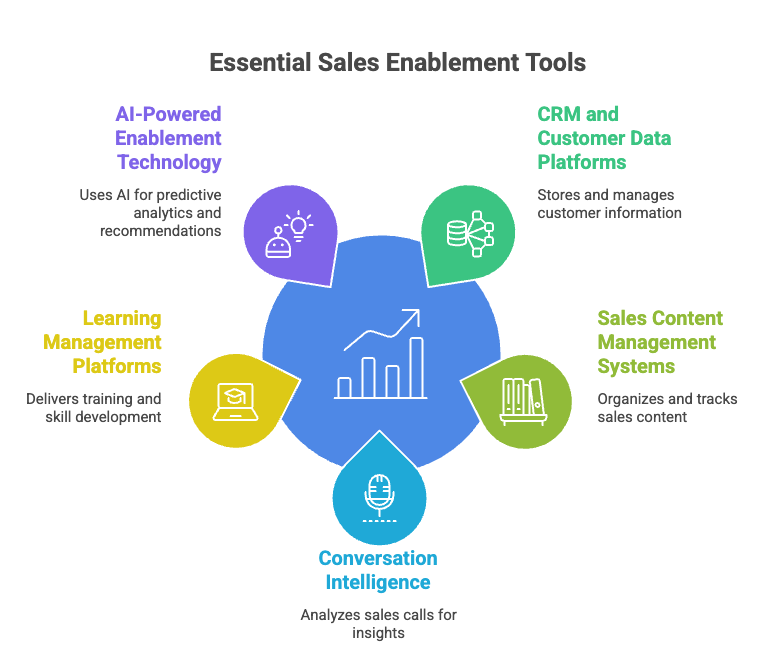
Essential sales enablement tools for modern teams
CRM and customer data platforms
Your CRM stores contact details, tracks conversations, and manages your sales pipeline. Customer data platforms (CDPs) unify behavioral data from websites, apps, emails, and offline sources, tracking anonymous visitors before they become known contacts and merging that activity history when prospects convert. AI-native CRMs like SparrowCRM go further, surfacing buying intent signals, lead fit scores, engagement data, and next recommended actions directly inside the rep's workflow, without requiring manual interpretation.
Sales content management systems
Reps waste 440 hours annually searching for the right content. Content management systems centralize pitch decks, case studies, battlecards, and product sheets in searchable, version-controlled libraries. The best platforms track which assets drive engagement and which correlate with closed deals, so content decisions are driven by outcome data, not gut feel.
Conversation intelligence and call coaching
Conversation intelligence software records calls, generates transcripts, and surfaces patterns that separate wins from losses, competitor mentions, talk-to-listen ratios, objection frequency, and deal risk signals. Managers get coaching insight without listening to every call. Reps review their own recordings between sessions. 81% of sales teams now use AI in their workflows, and conversation intelligence is where most of that adoption is happening.
Learning management platforms
Sales-focused LMS platforms deliver onboarding programs, certification paths, and skill development courses, ideally integrated with your CRM so training can be assigned based on actual performance gaps rather than arbitrary schedules. Gamification elements maintain engagement over time.
AI-powered enablement technology
AI transforms enablement from reactive support into proactive guidance. Predictive analytics score leads based on conversion likelihood. Recommendation engines surface relevant content during live calls. Generative AI drafts tailored outreach and creates battlecards on demand. The most advanced platforms use outbound sales CRM intelligence to trigger follow-up sequences based on conversation signals, reducing the manual work that keeps reps away from actual selling.
Measuring sales enablement success
Only 68% of organizations feel confident in the data they use to track enablement effectiveness. The solution is measuring both leading and lagging indicators, and connecting them to tell the story of what is actually driving results.
Metric | What It Measures | Benchmark |
|---|---|---|
Content adoption rate | How often do reps access and share assets in active deals | Teams using content scorecards see 18% increase in internal views |
Win rate on forecasted deals | Direct measure of enablement impact on closing | 49% with enablement vs 42.5% without |
Quota attainment | Percentage of reps hitting or exceeding the target | 84% with mature enablement vs 60% without |
Ramp time to first deal | How fast new hires close their first deal post-onboarding | Enablement should reduce ramp time by 25–40% |
Sales cycle length | Time from first touch to closed-won | Shorter cycles indicate reps are guiding buyers with confidence |
Training completion + win rate correlation | Whether completing specific training correlates with improved outcomes | Reps completing competitive training showing 15%+ higher win rates = program working |
Final thoughts
Sales enablement is not a nice-to-have. It is the difference between a sales organization that hits quota consistently and one that keeps investing in training events that do not move the needle.
The companies achieving 84% quota attainment are not doing it through better hiring alone. They have built systems, content that works in real conversations, coaching tied to real deals, tools that surface the right information at the right moment, and measurement frameworks that continuously improve all of the above.
If you are building or rebuilding your enablement program, start with one initiative, measure its impact carefully, and build from there. For teams thinking through how enablement connects to broader sales techniques and sales skills development, the silo of resources at SparrowCRM covers each layer of that stack in detail.
Your enablement program should evolve as your buyers and markets change. Start somewhere. Measure everything. Iterate continuously.

Geethapriya
Geethapriya is a Growth Marketer and Business Researcher who researches and writes about CRM, sales, marketing, and customer engagement. Her work focuses on understanding industry trends, customer and sales challenges, and how businesses can use technology to build more effective growth processes.