SALES STRATEGY
20 Upselling techniques that work in B2B sales

By Geethapriya
Last updated on May 26, 2026
Explore this blog to discover 20 upselling techniques designed for B2B sales teams, each with a real CRM sales example so you can apply them immediately.

Acquiring a new customer costs five to seven times more than retaining and growing an existing one. Yet most B2B sales teams spend the majority of their time and budget chasing new logos while leaving significant revenue sitting on the table inside their current accounts.
Upselling, done well, is not a pressure tactic. It is a trust signal. It says: I know your business well enough to know you need more than what you are currently paying for, and here is exactly why.
This guide walks through 20 proven upselling techniques tailored for B2B sales, each backed by a real-world conversation example. It also covers the best timing for upselling, common mistakes sales teams should avoid, and how a CRM can help make the entire process more consistent and scalable.
What is upselling?
Upselling is the practice of encouraging an existing customer or active prospect to purchase a higher-value version of what they are already considering. In B2B, this typically means moving a customer from a starter or basic plan to a higher tier, unlocking additional seats, adding premium features, or extending a contract to a longer term at a better rate.
The goal is not to push someone into spending more. The goal is to match them with the solution that actually fits where their business is going, not just where it is today.
Upselling vs. cross-selling: the quick distinction
These two terms are often used interchangeably, but they mean different things in practice.
Dimension | Upselling | Cross-selling |
What it is | Upgrade to a higher tier or plan | Add a complementary product or feature |
Goal | Increase deal value through the premium tier | Increase deal value by adding to the cart |
B2B CRM example | Moving a prospect from Starter to Growth plan for AI features | Adding a sequences module to an existing CRM subscription |
Best timing | After the initial value has been demonstrated | During or just after the original sale |
Both have their place in B2B account expansion. This blog focuses on upselling, upgrading what someone already has or is about to buy.
20 upselling techniques for B2B sales teams
Each technique below includes a real-world B2B conversation example. The scenario is consistent throughout: a sales rep at SparrowCRM is selling or expanding a CRM subscription to a VP of Sales, Founder, or RevOps lead at a 10–50 person SaaS company.
1. Understand the customer's real problem before pitching the upgrade
Surface-level discovery produces surface-level upsells. Before you recommend anything, make sure you understand not just the stated problem but the underlying one. What process is breaking? What is the cost of that break? What is the outcome the customer actually needs?
The technique is simple: ask one more layer of questions than feels comfortable. The deeper the insight, the more natural the upgrade pitch becomes.
CRM example: "You mentioned the team is losing track of follow-ups when deals go quiet. That is actually one of the core things our Growth plan is built for, it gives you AI-generated next actions on every deal, so reps never have to decide what to do next. Can I show you how that works for a team your size?"
2. Lead with the business outcome, not the feature
Features are forgettable. Outcomes are what close deals. Every upgrade pitch should be anchored in a business result the customer has already told you they care about: revenue, time saved, churn reduced, pipeline visibility improved.
Before you mention what the higher tier includes, state what the customer gets as a result of being on it.
Example: "Moving your team to the Enterprise plan would give your RevOps lead a single dashboard view of every rep's pipeline, broken down by stage and deal health. Right now, you mentioned she is pulling that together manually every Friday. That is probably three to four hours a week you get back immediately."
3. Use usage data to trigger the upsell conversation
One of the most effective upsell triggers is a customer who is bumping up against their current plan limits. If someone is using 90% of their contact limit, sending the maximum sequences per month, or has every team member seat filled, that is not a sales opportunity; that is a customer who needs more, and they probably already know it.
A CRM that surfaces this data proactively allows you to start the upsell conversation before the customer hits a wall rather than after they get frustrated.
Example: "I noticed your team enrolled over 240 contacts into sequences last month, which puts you right at the edge of your current plan limit. Before you hit a cutoff mid-campaign, I wanted to walk you through what the next tier unlocks: unlimited sequence enrollment and A/B testing on email variants."
4. Time the upsell to a value milestone
The worst time to upsell is before the customer has experienced value from what they already have. The best time is immediately after a win: a deal closed, a workflow automated, a report that finally made sense of messy pipeline data.
Value milestones are natural opening moments for upsell conversations because the customer is in a positive emotional state about the product and can see the return on investment with their own eyes.
Example: "Congrats on the quarter, I saw your team closed 14 deals through the pipeline, which is a significant jump from last quarter. That kind of volume is exactly when teams start to hit the ceiling on single-pipeline setups. Our Growth plan lets you run multiple pipelines simultaneously, which is useful if your AEs are splitting enterprise and SMB motions."
5. Let the customer upsell themselves with a comparison
Sometimes the most persuasive sales technique is to show the options and say nothing. When customers can see a clear, structured comparison between their current plan and the upgrade features, limits, and use cases side by side, many will draw their own conclusions.
This works especially well in B2B because buyers want to feel in control of the decision. Give them the information architecture that makes the upgrade obvious without the feeling of being pushed.
Example: "Let me pull up a quick comparison so you can see exactly what each plan covers for a team your size. I will keep quiet while you look at it, just flag any row where you are not sure what the feature actually does in practice."
6. Use social proof from a similar account
In B2B sales, buyers trust the experience of businesses that look like theirs more than any pitch you can deliver. Before introducing an upgrade, name a specific customer in the same industry, at a similar company size, who made a comparable move and can articulate the result.
Keep the social proof precise. Vague references to "many customers" carry no weight. A specific company type, a specific challenge, and a specific outcome land.
Example: "We have a fintech team in Austin, 18 reps, similar setup to yours, who moved to the Growth plan specifically for the AI deal scoring. Their manager told me it cut their pipeline review meetings from 90 minutes to 30 because the AI pre-ranks deals by risk before the call. Happy to share that case study if it would help your internal conversation."
7. Offer a trial of the premium tier first
Reducing the perceived risk of an upgrade is one of the most reliable ways to accelerate the decision. Offering a two-week or 30-day trial of the higher tier gives the customer the experience of the upgrade before they commit to the cost.
In SaaS and CRM sales specifically, this works well because teams often have workflows that they need to see running before they can justify the spend to a finance team or founder. Let the product do the selling.
Example: "What I would suggest is this: we flip your account to the Enterprise plan for the next 30 days at no additional charge. Your RevOps lead gets access to the full reporting suite, including the custom dashboard builder. If at the end of 30 days the reporting alone has not saved her meaningful time, we go back to your current plan. No obligation. Would that work?"
8. Frame the price as a cost per outcome, not a cost per seat
When a customer hears "the next plan is $200 more per month," the instinct is to weigh $200 against the features list. When they hear "the upgrade costs $200 a month and will recover 10 hours of manual reporting work per week at your team's salary rate," the math looks completely different.
Translate the price delta into the language of the outcome it produces. B2B buyers are trained to evaluate ROI, so give them the ROI framing directly.
Example: "The difference between your current plan and Growth is $180 per month. Your ops lead currently spends about 4 hours a week building pipeline reports manually. At a conservative $40/hour cost, that is $640 of internal time per month. The AI reporting upgrade on Growth runs those reports automatically. The math is fairly clear."
9. Tie the upgrade to a pain point they have already named
Never introduce a pain point to justify an upsell. If the customer has not named the problem, it feels manufactured. But if they told you about a specific frustration three calls ago and you remember it and connect it to the upgrade, that is the opposite of a sales tactic; it is listening.
Build a habit of logging pain points from every call inside your CRM so you can retrieve them when the upsell moment arrives. The callback to something they said weeks ago demonstrates genuine attention.
Example: "You mentioned in our first call that your biggest frustration was not knowing which deals were actually at risk until it was too late. I kept that in mind. The deal health scoring on our Growth plan is exactly built for that; it flags at-risk deals 7 to 10 days before they go cold, based on engagement signals. I thought this was the right time to bring it back up."
10. Use AI-generated buying signals to identify readiness
In modern CRM platforms, you do not have to guess when a customer is ready for an upsell conversation. Buying intent scores, engagement rate changes, and feature usage spikes are all signals that a customer is experiencing either growing appetite or growing friction, both of which are upsell opportunities.
SparrowCRM's AI scoring widget surfaces ICP fit, engagement rate, buying intent, and response rate at the contact and company level. When a customer's buying intent score spikes, that is a data-backed prompt to initiate the conversation.
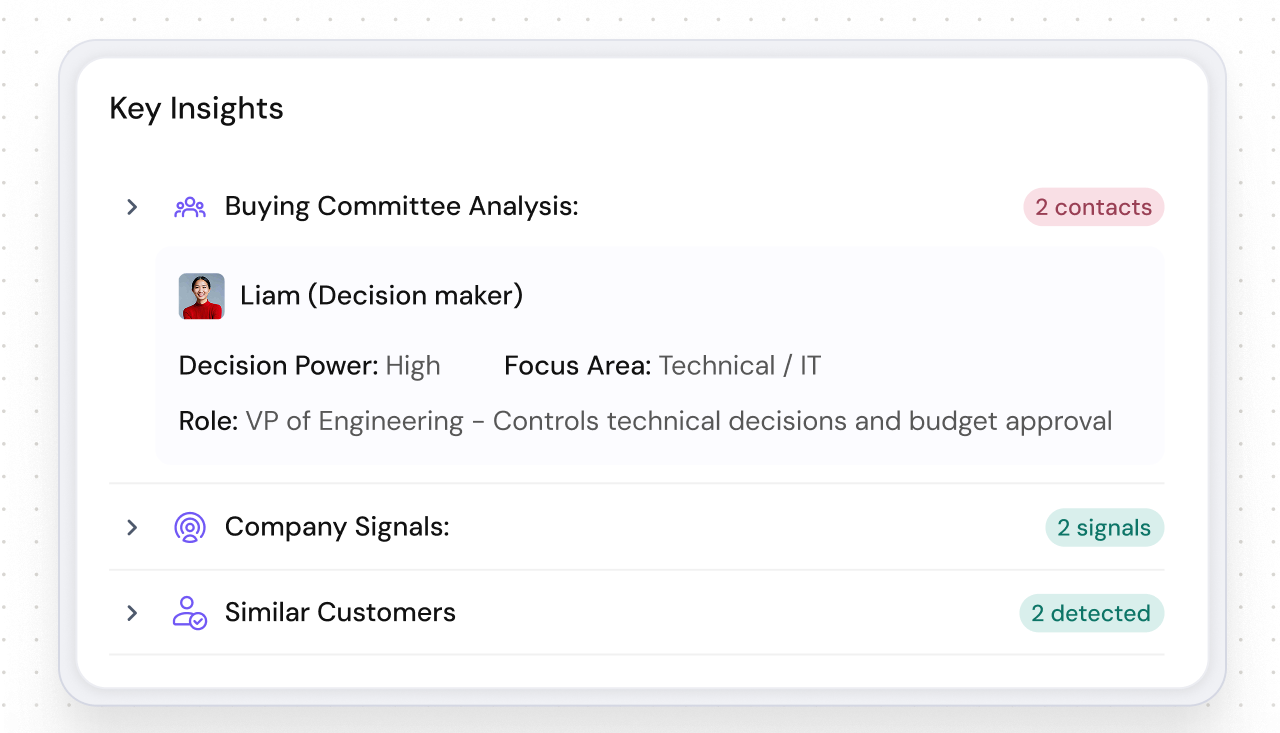
Example: "I was reviewing your account in the CRM and noticed your engagement score has jumped significantly over the last three weeks. Your team has been logging meetings, replies, and activity at a much higher rate than when you first started. That usually signals a team that has found its groove and is ready to push the ceiling. That is a good time to talk about what the next tier unlocks."
Help Reps to Identify the Right Upgrade Moment
11. Involve the economic buyer before the formal pitch
In B2B sales, the person you speak with day-to-day is rarely the person who approves additional spend. If you build an upsell case with a champion but never bring the economic buyer into the conversation, you are setting yourself up for a stall.
Before making a formal upgrade proposal, find a natural way to involve the decision-maker. A brief executive summary, a short ROI call, or even a forwarded email with a clear business case can change the dynamic significantly.
Example: "I want to make sure the proposal is useful for your conversation with your CEO. Would it help if I put together a one-page summary that frames the upgrade in terms of pipeline visibility and revenue impact, the things she tends to care most about? That way, you have something to put in front of her rather than trying to reconstruct the whole conversation."
12. Anchor the upgrade against the cost of inaction
Loss aversion is one of the most consistent findings in behavioural economics. People are more motivated to avoid a loss than to acquire an equivalent gain. In B2B upselling, this means framing the upgrade not as something gained but as something lost if they stay on the current plan.
What is the cost of staying where they are? Missed deals, manual work, poor pipeline visibility, slower ramp for new hires? Name it specifically.
Example: "The way I see it, your team is going into next quarter without a reliable way to know which deals are worth doubling down on and which ones are stalling. That means your reps are distributing effort evenly across a pipeline where maybe 30% of deals will actually close. Staying on the current plan means that the pattern continues. The upgrade gives you the deal scoring to fix that."
13. Use a renewal or QBR as the natural upsell trigger
Quarterly business reviews and renewal conversations are the most natural contexts for upsell discussions because both parties expect a forward-looking commercial conversation. The customer is already reviewing the value delivered and thinking about what comes next. You are not interrupting anything; you are participating in it.
Prepare for every QBR with a specific upgrade recommendation tied to something that came up during the review.
Example: "Looking at what your team has accomplished in the last two quarters and where your growth targets are heading, I think we should spend the last ten minutes of this call talking about what the Enterprise plan enables for a team scaling past 20 reps. The reporting and pipeline configuration flexibility alone would be relevant given what you just shared."
14. Build urgency without false pressure
Urgency is a legitimate upsell lever when it is genuine. A real pricing change, a true capacity limit, an upcoming feature deprecation, these create real reasons to act. What destroys trust is manufactured urgency that the customer can see through.
If there is a genuine constraint, pricing holds until the end of the quarter, a promotional onboarding package expires, or a cohort for implementation support is limited, say so plainly and once. Do not repeat it as a pressure tactic.
Example: "I want to be straightforward with you: our pricing is being revised at the end of the month, and the Growth plan will increase by approximately 15%. If you have been considering the upgrade, locking in now makes sense from a budget perspective. But I am not going to push you on it if the timing is not right, it is not right."
15. Use a sales sequence to warm up the upsell
Not every upsell can be closed in one call. For customers who have heard the upgrade pitch but have not committed, a structured follow-up sequence keeps the conversation alive without requiring a rep to manually remember to re-engage.
A well-designed upsell sequence sends value before it asks for anything, a case study, a feature highlight, or a product update that is directly relevant to something the customer mentioned. By the time the direct ask arrives, the customer has been warmed up.
You can read more about building effective follow-up sequences in our guide to sales sequences and how to build them in your CRM.
Example: "After our last call, I set up a short three-email sequence for you, not sales emails, more like a product briefing. The first one goes out tomorrow and covers how teams your size typically use the AI deal scoring in their weekly pipeline review. I just want to make sure you have the full picture before we circle back."
16. Incentivise the upgrade with implementation support
In B2B, one of the biggest objections to upgrading is not price; it is change management. Teams worry about reconfiguring their setup, retraining users, and the disruption of switching to a more advanced plan. Offering to remove that friction as part of the upgrade package directly addresses the real hesitation.
Incentives that reduce friction-free onboarding support, a dedicated CSM for 90 days, and migration assistance are more compelling in B2B than discounts because they solve the actual problem the buyer is afraid of.
Example: "I know switching pipeline configurations mid-quarter is not something your team wants to deal with on their own. If we move forward with the Enterprise upgrade before the end of the month, I will have our onboarding team handle the full migration and reconfiguration; your reps will not have to touch a setting. It typically takes two sessions, and they are done."
17. Upsell through customer success, not just sales
Sales reps are expected to push upgrades. Customer success managers who recommend an upgrade are perceived as advisors. The same upsell pitch, delivered by a CSM in the context of a check-in call, carries a different and often more credible weight than the same words from a sales rep.
Build a system where CSMs are equipped with upsell triggers and recommended language so the expansion conversation can happen naturally as part of ongoing account management rather than only when a sales rep schedules a dedicated call.
Example: "I was reviewing your account before this check-in, and I noticed your team has been manually logging most of their call notes. On the Growth plan, you would get automatic call transcription and AI summaries, which would feed directly into the deal record without anyone touching it. Given how often you have mentioned wanting better call data, I thought it was worth raising."
18. Cross-sell as a bridge to the upsell
Sometimes the most effective path to an upsell is a cross-sell first. Adding a complementary module or feature builds the customer's relationship with the product, increases stickiness, and often surfaces the natural next-level need that justifies the upgrade.
Think of the cross-sell as creating the conditions for the upsell. A customer who has now integrated the CRM with their email, calendar, and Slack is a customer who is about to feel the limits of their current plan.
Example: "Since you connected your Gmail to the CRM last month, your team has been logging email activity automatically, which is great. The thing I would flag is that on your current plan, you are limited to manual follow-up tasks. If you add the sequences module, those follow-ups become automated, and your reps stop dropping the ball after three touches. That is the natural next step from where you are."
19. Personalize the upsell pitch using CRM engagement data
Generic upsell pitches fail because they feel generic. A pitch that references what the customer has actually been doing inside the product which features they use most, where they spend time, which deals they have active, feels like a recommendation from someone paying attention.
This is where CRM data becomes a sales advantage. Instead of pitching the upgrade based on what the plan includes, pitch it based on the customer's own usage patterns and what the upgrade would change specifically for their workflow.
Example: "Looking at your account, your team has created 47 manual tasks in the last 30 days, all follow-up reminders. That is a lot of manual overhead. On the Growth plan, those would be generated automatically by AI based on deal stage and engagement signals. Your reps would get a prioritized task list every morning without building it themselves. That is probably the single thing that would change most for your team day-to-day."
20. Follow up with a specific upgrade path email after a no
A no to an upsell is seldom a permanent no. It is usually a timing issue, a budget cycle constraint, or a stakeholder who was not yet in the room. The teams that capture the most expansion revenue are the ones that have a systematic plan for what happens after a no.
Send a specific, non-generic email 30 to 60 days after the no. Reference the original conversation, acknowledge the timing, and provide one new piece of information, a customer story, a new feature, or a calculation they had not seen before, that makes re-opening the conversation feel natural.
Example:"Hi [Name], I know the timing was not right when we talked about the Growth plan upgrade in March. I wanted to share something that came up since then: we released a new forecasting module that lets you generate a quarterly revenue projection directly from your active pipeline, including confidence scores by deal. Given what you mentioned about needing better forecast visibility before your board meeting, I thought it was worth a second look."
When to upsell: Timing by deal stage
Timing is everything in upselling. The same pitch, delivered at the wrong moment, will land as a pressure tactic. Here are the three moments in a B2B customer relationship where upsell conversations have the highest success rate:
- Before the sale closes: When a prospect is evaluating your product, lay out the full plan spectrum clearly and let them choose. Prospects often self-select a middle or higher tier when the comparison is well-structured. This is not upselling aggressively; it is informed buying.
- After the first value milestone: The 30-day or 90-day mark, after a team has gotten a win from the product, is the highest-conversion moment for an upsell conversation. The customer can see the ROI and is ready to discuss investing more in it.
- At renewal: Renewal conversations are the most commercially open moments in a B2B relationship. The customer expects to discuss what comes next. An upsell framed as a natural evolution of what is already working is rarely seen as a sales tactic.
How a CRM helps you execute upselling at scale
Most upselling fails not because the pitch is wrong but because the timing is inconsistent. Reps forget to follow up. Signals that indicate readiness go unnoticed. The upsell conversation happens reactively, when a customer asks, rather than proactively, when a customer is ready.
SparrowCRM is an AI-native CRM built for B2B sales teams that turns upselling from a rep-dependent skill into a systematic process. Here is how it works in practice:
- Buying intent scores: SparrowCRM's AI scores every contact and company on buying intent, based on email replies, meeting attendance, deal movement, and website activity. When intent spikes, reps get a clear signal that the account is in an expansion-ready state.
- AI-generated next actions: Every deal record surfaces a prioritized list of recommended next steps. If the AI detects an upsell-ready account, the recommended action will reflect that, prompting the rep at exactly the right moment.

- Engagement rate tracking: The engagement score across contacts within an account makes it easy to see which accounts are highly active and which are going cold. High engagement is a green light for an upgrade conversation. Cold engagement is a signal to re-qualify before pitching.
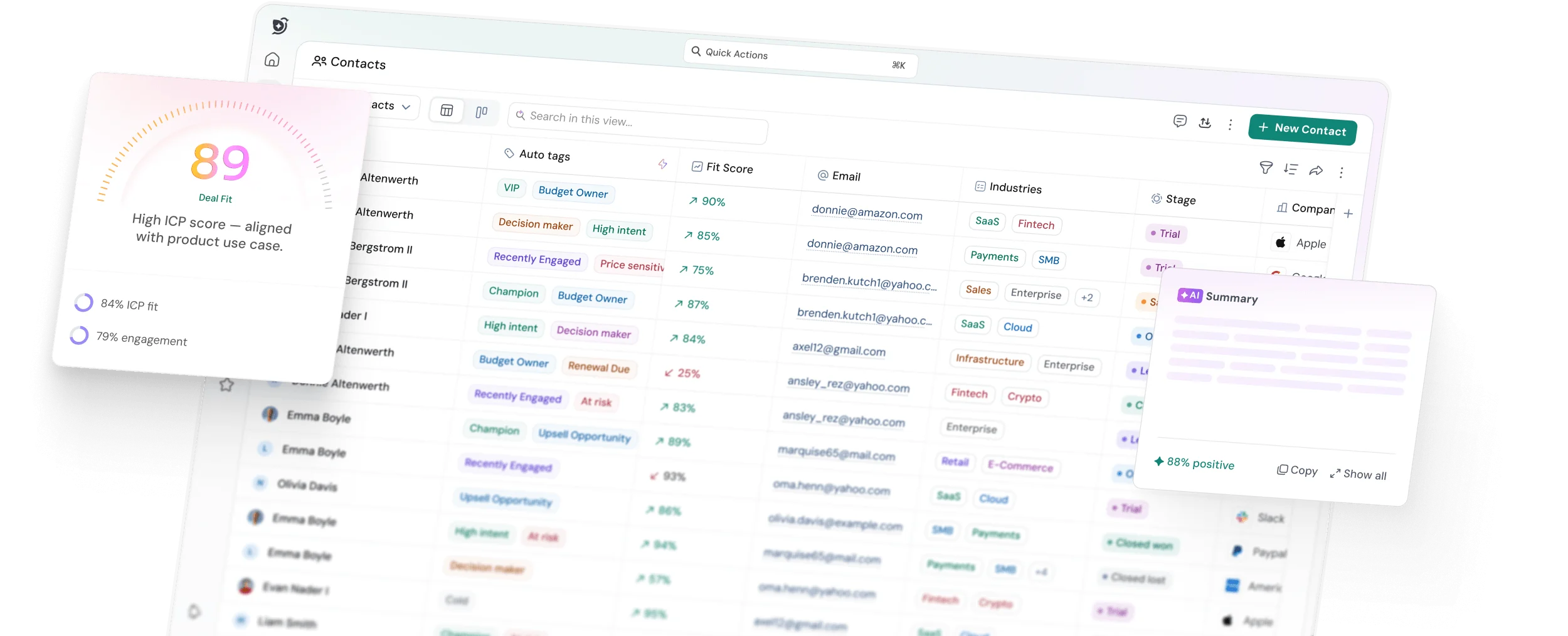
- Deal and company health scores: For existing customers, the company fit score and health indicators in SparrowCRM tell the success team which accounts have the highest potential for expansion and which ones need to stabilize first.
For teams serious about improving their sales closing techniques, upselling, having this infrastructure in place is the difference between a strategy and a system.
From first touch to close, automate your entire sales pipeline with AI
Upselling mistakes to avoid
Even the right technique will fail if paired with the wrong behaviour. These are the five most common upselling mistakes in B2B sales and how to correct them.
Mistake | Why it hurts | What to do instead |
Pitching too early | Prospect hasn't seen value yet; feels like a money grab | Wait for a value milestone, a win, a renewal, or a usage spike |
Upselling the wrong tier | Prospect feels misunderstood; trust erodes | Map the upgrade to a pain point they've named explicitly |
Ignoring the economic buyer | Champion loves it, but the budget holder never hears the ROI case | Involve the decision-maker before the formal upsell pitch |
Pitching features, not outcomes | Feature lists don't justify spending; outcomes do | Frame every upgrade as a business result, not a capability |
No follow-up after a no | A no today is not a no forever; silence loses the future deal | Send a specific upgrade path email 30–60 days later |