CRM SOFTWARE
CRM integrations: what they are, types, tools, and how to set them up

By Geethapriya
Last updated on May 26, 2026
Explore this blog to understand what CRM integrations are, why they matter, which types work best for your team, and how to set them up without wasting time or budget.

- What is CRM integration? (meaning and definition)
- Why CRM integration matters for sales teams
- Key benefits of CRM integration
- Types of CRM integrations
- Native integration vs. third-party add-on: which should you choose?
- The most valuable CRM integrations for B2B sales teams
- How to set up a CRM integration (step-by-step)
- Free vs. paid CRM integrations: what you actually get
- Common CRM integration challenges (and how to handle them)
- When should you integrate your CRM?
Your CRM holds your most valuable business asset, customer data. But a CRM that sits alone, disconnected from the tools your team uses every day, is just an expensive contact list.
CRM integrations change that. They connect your CRM to the rest of your business email, Slack, LinkedIn, marketing tools, billing systems, support platforms, so data flows where it needs to go, automatically, without anyone copying and pasting between tabs.
This guide covers everything you need to know: what CRM integration means, why it matters, which types exist, how to choose between native and third-party options, and how actually to set one up.
What is CRM integration? (meaning and definition)
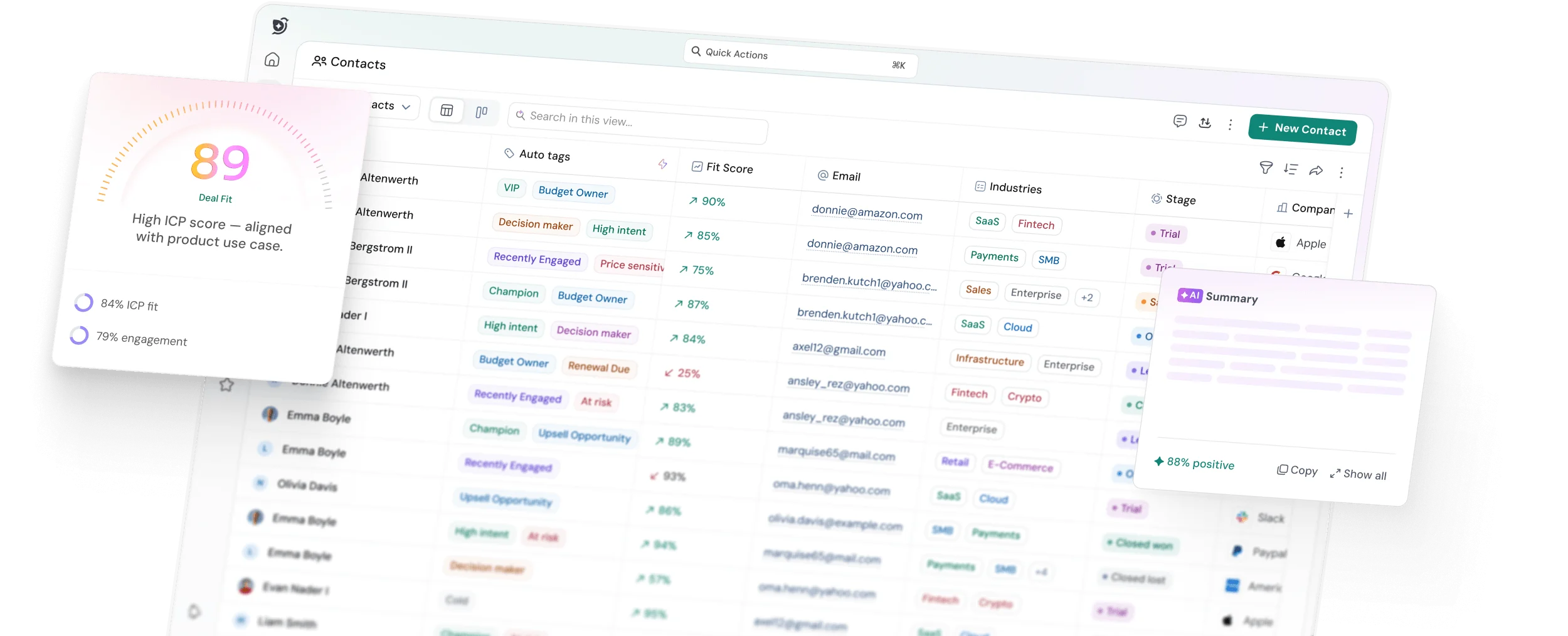
CRM integration is the process of connecting your CRM system with other business applications so they can share data automatically. Instead of logging into five different tools to get a complete picture of a customer, your team sees everything in one place.
The term "CRM software integration" covers a broad range of connections, from syncing your inbox to linking your CRM with your ERP, support desk, or marketing automation platform. At its core, it removes the manual handoffs between tools that slow sales teams down. According to IBM research, 82% of companies face workflow disruptions due to poorly integrated CRM systems.
CRM software integration vs. CRM API integration: what is the difference?
CRM software integration is the broad category of any method of connecting your CRM to another tool.
CRM API integration is one specific method within that category. An API (Application Programming Interface) is a set of rules that lets two software systems communicate directly. When your CRM connects to Slack or LinkedIn via their APIs, that is an API integration.
Other integration methods exist, such as native connectors, third-party middleware, and file transfers, and are covered in the Types section below.
Why CRM integration matters for sales teams
The cost of disconnected systems
The average sales organization uses more than 10 different tools to move a deal from prospect to close. Without integration, data sits in silos. Reps copy customer details between platforms. Updates get missed. Forecasts become guesswork.
- Sales reps spend 79% of their time on tasks that could be automated, such as logging emails, updating deal stages, and copying contact details across tools.
- That translates to roughly four full working days a week spent on admin instead of selling.
- 57% of sales teams attribute lost productivity directly to poor integrations.
Poor data quality amplifies the problem further. Without connected systems, your CRM fills with duplicate records, outdated contacts, and incomplete fields. These are not just data hygiene issues; they cost companies millions in missed opportunities and bad decisions.
What changes when your CRM is connected
When your CRM integrates with the tools your team already uses, the impact is immediate and measurable:
- Sales cycles shorten by 15–20% on average when CRM is connected to communication tools.
- Customer retention rates increase by up to 27% with properly integrated CRM systems.
- Teams using integrated CRM report 27% higher win rates and 26% better productivity.
Connected systems also create better forecasting. When your CRM, marketing automation, and billing tools share data, pipeline visibility sharpens. AI-driven insights can surface patterns that manual reporting consistently misses.
Key benefits of CRM integration
Benefits for sales teams
- Faster lead routing: Marketing automation platforms can push qualified leads directly into your CRM the moment they hit a score threshold, no manual handoff.
- Deal visibility in real time: Slack channels tied to specific deals give sales reps instant updates on deal progress without opening the CRM.
- Reduced data entry: LinkedIn CRM integration alone saves sales reps an average of 5.5 hours per week on manual data entry.
- Higher close rates: Businesses that integrate CRM with their full tech stack consistently see more proposals sent, shorter cycles, and better quota attainment.
Benefits for support and marketing
- Support teams resolve issues 26% faster through integrated CRM and ticketing systems, agents see the full customer history before the first message.
- Marketing teams gain instant access to lead quality data from sales, tightening feedback loops between campaigns and conversions.
- Companies with aligned sales and marketing, enabled by shared CRM data, generate 208% more revenue from their marketing efforts.
Types of CRM integrations
Not all CRM integrations work the same way. The method you choose affects speed, cost, security, and how much your team has to maintain over time.
API-based integrations
The most common and flexible method. APIs create a direct communication channel between your CRM and another application. They enable real-time data sync and customer profile updates within seconds of an action. Most modern CRMs and business tools are built API-first. Learn more about how CRM features are structured to support API connectivity.
API architecture has three layers that work together:
- System APIs: Connect directly to core data sources, ERPs, customer databases, and billing systems. They handle simple retrieval and storage operations.
- Process APIs: Orchestrate data from multiple System APIs and execute business logic. A Process API calculates a lead score based on website visits, email engagement, and download history, then updates all connected platforms automatically.
- Experience APIs: Deliver tailored interfaces for specific users. The executive dashboard, the mobile app for reps, and the customer self-service portal all powered by Experience APIs.
Native integrations
Built directly into the CRM by the vendor. No third-party tool required. The connection comes pre-configured, works within the parent platform, and is maintained as part of your CRM subscription.
Native integrations are faster to set up, more stable, and typically lower cost. Their limitation is that a CRM vendor can only build so many native connections.
Third-party and middleware integrations
Tools like Zapier, Workato, and Boomi sit between your CRM and other applications, translating data formats and routing it between systems. They offer broader coverage than native integrations and work with thousands of apps. The trade-off is added complexity, vendor dependency, and ongoing maintenance costs.
File transfer and manual integrations
The simplest approach: export data from one system as a CSV file, then import it into another. Works well for legacy systems without modern APIs. It is not real-time and requires regular manual effort, but for smaller operations or infrequent data syncs, it is a practical starting point.
Native integration vs. third-party add-on: which should you choose?
This is one of the most consequential decisions in your CRM setup. The wrong choice costs money, time, and sales performance.
Factor | Native Integration | Third-Party Add-On |
Setup cost | Included in CRM subscription | $6,000–$24,000 per integration |
Ongoing maintenance | Handled by CRM vendor | Separate contracts, 20–25% added to license fees |
Hidden costs | Minimal | API overage fees, custom fields ($60/field), tool stacking (~$50/user/month) |
Data security | Fewer touchpoints, on-platform | More attack surface, external vendor risk |
Customization | Limited to the vendor roadmap | Highly flexible for unique workflows |
Scalability | Stable pricing as team grows | Tiered pricing, costs rise with usage |
Best for | Core revenue workflows (CRM + email, billing, forecasting) | Niche tools, edge cases, non-standard workflows |
For most teams at the 2–50 person stage, the right approach is a hybrid: use native integrations for your most critical workflows, email, calendar, and billing and limit third-party add-ons to tools that genuinely cannot be replaced by native options.
One important note: custom integration development can reach $50,000–$150,000 annually once you factor in engineering, testing, and deployment. That figure alone is reason to exhaust native options first.
For a deeper look at how the CRM foundation shapes integration decisions, see the CRM software guide.
Discover how integrated CRM systems simplify sales, marketing, and support.
The most valuable CRM integrations for B2B sales teams
Not all integrations deliver equal return. For B2B sales teams at growing companies, these are the integrations that have the most direct impact on pipeline and revenue.
Slack CRM integration
Slack has over 38 million active users and more than 2,600 app integrations. When you connect it to your CRM, your team stops switching between messaging and customer data, it all comes to them. Learn more about the specific Slack CRM integration setup and use cases in detail.
The business case is concrete: teams using Slack + CRM integration close $2.6 million more in revenue annually, see 36% better team engagement, and cut customer response times by 30%.
Practical applications by team:
- Sales: Dedicated Slack channels per deal, with CRM updates pushed automatically, win rates jump 27%.
- Support: Case swarming via Slack channels reduces resolution time by 28% and cuts ticket costs by 15%.
- Marketing: Instant lead handoffs from marketing to sales through shared Slack channels.
- Customer success: Automated churn risk alerts trigger direct Slack messages to account managers.
LinkedIn CRM integration
For B2B sales, LinkedIn is where prospects live. Integrating it with your CRM means contact records stay current, outreach is personalised, and lead data flows in automatically. The full breakdown of LinkedIn CRM integration tools and methods covers seven tools in detail.
The numbers make the case: LinkedIn CRM integration improves lead conversion rates by up to 30%, saves reps 5.5 hours per week on manual data entry, and delivers $2.4 million in productivity savings over three years for organisations using Sales Navigator.
Top tools for LinkedIn CRM integration:
- LinkedIn Sales Navigator: Native sync with Salesforce, HubSpot, Microsoft Dynamics, and Zoho. Embedded profiles appear directly in CRM records.
- Surfe (ex-Leadjet): Places your CRM inside LinkedIn, adds contacts with one click, sync conversations automatically. Saves ~60 minutes per day.
- Zapier: Builds automated workflows between LinkedIn Lead Gen Forms and your CRM without any code.
Email and calendar integration
Every email your rep sends and every meeting they book contains valuable context. Email and calendar integration captures that context automatically, with no manual logging. Look for two-way sync so that updates in your calendar reflect in the CRM and vice versa.
This integration sits in the high-priority native category. For most CRMs, a native email connector is included in the subscription and is the first integration any team should activate.
Marketing automation integration
Connecting your CRM to marketing automation tools like HubSpot, Mailchimp, or ActiveCampaign closes the loop between marketing spend and sales results. Warm leads route to the CRM automatically when engagement scores cross qualification thresholds. Sales gets alerted immediately, no lead sits waiting.
This integration is also critical for accurate attribution. When your CRM and marketing platform share data, you can finally answer: which campaigns produced the deals that closed?
ERP and support tool integration
For finance and operations: connect your CRM to your ERP system so that when a deal closes, a client record is created in your financial platform automatically, no manual data transfer, no billing delays.
For support: connect your CRM to a ticketing system like Zendesk or Sparrowdesk. New cases in either system appear in both places. Account managers and support specialists see the same information simultaneously.
How to set up a CRM integration (step-by-step)
Step 1: Map your systems and data flow first
Before touching any tool, document which systems need to connect and what data should move between them. Be specific: which fields map to which, in which direction, and how often.
A basic data mapping table looks like this:
Field in CRM | Field in Connected Application | Sync Direction | Frequency |
Customer Name | Name | Bidirectional | Real-time |
Email Address | Contact Email | CRM → App | Real-time |
Deal Stage | Opportunity Status | Bidirectional | Real-time |
Support Ticket ID | Case Number | App → CRM | Every 5 min |
This documentation is not just a setup step; it becomes your maintenance reference when something breaks.
Step 2: Choose your integration method
Based on the systems involved, select the right method: native connector (preferred for stability), API-based via middleware, or third-party tool. Evaluate each against reliability, maintenance burden, and cost, not just feature coverage. Refer to the native vs. third-party comparison above.
Step 3: Secure your connection
Use OAuth tokens or API keys for authentication; never hardcode credentials. Confirm that data in transit is encrypted. For any integration touching customer PII, verify GDPR, CCPA, or relevant compliance requirements with the vendor before going live.
.png?2026-04-25T14:04:29.402Z)
Step 4: Test in the sandbox before going live
Run every integration scenario in a test environment first. Test edge cases: what happens when a field is blank? When a duplicate record is created? When the API call fails? Issues discovered in the sandbox cost hours to fix. Issues discovered in production cost customers.
Step 5: Monitor and maintain post-launch
Integration health does not manage itself. Set up health checks every 5 minutes for critical connections. Track:
- API response times (target: under 500ms)
- Success rates per integration endpoint
- Data sync duration and frequency
- Error logs and failure alerts
Review integration performance monthly. APIs change. Vendors update their schemas. What worked at launch will need adjustment as your stack evolves.
Free vs. paid CRM integrations: what you actually get
Not every integration requires a budget line. Understanding what free options cover and where they fall short saves you from over-investing early and under-delivering later.
Integration Type | Free Options | What You Lose Without Paid |
Email & Calendar | Most CRMs include basic Gmail/Outlook sync | Advanced logging, template tracking, sequence automation |
CSV export, browser extensions (LinkMatch, Dux-Soup free tier) | Real-time sync, bulk enrichment, Sales Navigator automation | |
Slack | Basic Slack app from CRM marketplace | Automated deal alerts, workflow triggers, custom bots |
Marketing Automation | Zapier free tier (100 tasks/month) | Multi-step Zaps, higher volume, advanced filters |
Support Ticketing | Limited native connectors | Two-way sync, SLA tracking, case escalation rules |
ERP | Rarely available for free | Full field mapping, real-time sync, error handling |
The practical rule: start with free or native integrations for your highest-volume workflows, and invest in paid tools only when you hit a specific limitation that is costing you time or revenue. Many 2–50 person teams run effectively on native + one or two paid middleware tools.
Watch for hidden costs in paid third-party tools: storage overages ($125/month after 500MB), API call limits with overage charges, and platform training time that rarely appears in the vendor's quote.
SparrowCRM — the AI-native CRM built around connected workflows
Most CRMs treat integrations as an afterthought, a marketplace of add-ons you bolt on after buying. SparrowCRM is built differently. As an AI-native CRM, it comes with smart field mapping, automated integration suggestions, and built-in connectors for the tools B2B sales teams use most. No middleware required. No $24,000 integration projects. Just connected data from day one.
Common CRM integration challenges (and how to handle them)
Knowing the challenges before you start is the difference between a smooth rollout and a six-month engineering detour.
- Engineering resource drain: A typical API integration takes 1–3 months of engineering time. That conflicts with every other priority on the roadmap. Solution: exhaust native and iPaaS options before building custom. Integration platforms like Workato reduce build time significantly.
- Scaling to multiple CRM platforms: Salesforce, HubSpot, and Microsoft Dynamics all have different field names, authentication methods, and data models. Custom mapping multiplies with every new platform. Unified API platforms like Merge solve this by acting as a single integration point.
- API rate limits: CRM platforms cap how many API calls you can make per day. Poorly built integrations hit these limits and disrupt your business processes. Build in rate limit handling and exponential backoff from the start.
- Uptime expectations: Your clients rely on steady data flow. 99.9% uptime means no more than 43 minutes of downtime per month. Meeting this requires error handling, retry logic, and redundancy, not just a working connection.
- Data quality degradation: Integrations create more touchpoints for data to go wrong. Duplicate records, mismatched fields, and outdated contacts multiply when multiple systems write to each other. Build validation rules into every sync.
- Security and compliance: Every additional integration adds to your attack surface. IBM data shows the average cost of a data breach reached $4.45 million in 2023. Limit data exposure, enforce multi-factor authentication on all integration credentials, and audit access quarterly.
For a broader look at what can go wrong during CRM adoption, the CRM reporting and analytics guide covers how to detect data integrity issues before they become pipeline problems.
When should you integrate your CRM?
The honest answer: earlier than most teams do it, and with more intention than most teams bring to it.
Here are the operational triggers that signal it is time:
- Reps are logging the same data in more than one system. If your team updates the CRM and then updates Slack and then updates a spreadsheet, that is three times the work and three opportunities for inconsistency.
- Your pipeline visibility is unreliable. If leadership cannot get a confident forecast because data lives in too many places, integration is the fix, not a better dashboard.
- Marketing and sales are working from different data. When marketing passes leads that sales considers unqualified, or when sales cannot see what campaigns generated a prospect, the disconnect is a data plumbing problem.
- Your team is growing, and onboarding new reps takes too long. A connected CRM dramatically reduces onboarding time because new reps have full context on every account from day one.
- Customer support cannot see sales history, and sales cannot see support tickets. If your customer-facing teams operate in silos, the customer feels it and eventually leaves.
Start with one integration that solves your most painful daily problem. Prove value there, then expand. The teams that get the most from CRM integration build incrementally, not with a 12-integration big-bang launch that collapses under its own complexity.

Frequently Asked Questions (FAQs)
Related Articles

02 Apr, 2026
What Is CRM Software? The Complete Guide for Sales Teams in 2026
19 Apr, 2025
CRM vs ERP: Key Differences Explained for Businesses

16 Sep, 2025