CRM SOFTWARE
CRM vs ERP: Key Differences Explained for Businesses

By Geethapriya
Last updated on May 26, 2026
Explore this blog to understand the core difference between CRM and ERP, how each system works, when to implement one before the other, and how integrating both creates a measurable business advantage backed by a real-world SAP-Salesforce case study.

CRM and ERP are two of the most commonly confused enterprise software categories, and for good reason. Both centralize data, both automate workflows, and both claim to improve business performance. But they solve fundamentally different problems.
CRM manages the revenue side: how you attract, convert, and retain customers. ERP manages the operational side: how you procure, produce, account, and staff. When businesses integrate the two, Nucleus Research found teams experience 20 to 30 percent growth in productivity across sales, service, and operations. Blue Shield of California illustrates the ERP impact directly; they saved $500,000 after implementing a cloud ERP system.
This piece explains the fundamental differences between CRM and ERP systems and helps you choose the right solution for your business needs. You'll discover how these platforms operate independently and together to boost your company's success and development.
What is CRM?
CRM (Customer Relationship Management) systems work as a central hub that manages all customer interactions and data. The platform organizes and analyzes how customers interact with your business.
A CRM stores detailed customer information such as:
- Contact details and demographics
- Purchase history and priorities
- Support requests and communication records
- Marketing campaign responses
Sales, marketing, and customer service teams rely on CRM software. Sales teams track leads and opportunities to close deals faster. Marketing teams make use of information to create targeted campaigns. Customer service representatives can see past interactions to offer customized support.
Companies that use CRM see better customer service, improved productivity, and higher customer retention rates. On top of that, CRM systems handle routine tasks like data entry and email marketing automatically. This gives teams more time to build strong customer relationships.For a deeper look at how CRM systems are categorized, see our guide to types of CRM.
What is ERP?
ERP (Enterprise Resource Planning) systems connect your back-office operations. These systems act as detailed hubs that bring together departments and functions within your company.
Your ERP system creates one shared database for all financial and operational data. It handles essential business processes like accounting, procurement, and inventory management. The financial parts; general ledger, accounts payable, accounts receivable, and payroll are the foundations of every ERP system.
ERP manages more than just finances. It handles supply chain operations, manufacturing processes, and human resources. The system removes data silos and ensures information flows smoothly across your organization. Teams can see operational insights instantly and make better decisions.
ERP systems automate repetitive tasks, which reduces manual work by a lot and streamlines processes. Companies with ERP systems report faster financial closes, better financial controls, and clearer data visibility across departments.
CRM vs ERP: Head-to-Head Comparison
Here is how the two systems differ across the dimensions that matter most for a purchasing or implementation decision:
Dimension | CRM | ERP |
Primary focus | Customer-facing operations: sales, marketing, support | Back-office operations: finance, supply chain, HR, production |
Who uses it | Sales reps, marketing teams, customer service agents | Finance, accounting, operations managers, executives |
Core data | Contacts, leads, deals, campaigns, support tickets | Financial records, inventory levels, purchase orders, payroll |
Goal | Generate and retain revenue by improving customer relationships | Reduce operational costs and improve resource efficiency |
Automation examples | Lead scoring, email sequences, pipeline alerts, follow-up tasks | Invoicing, inventory reorders, payroll processing, and financial reporting |
Implementation time | 2–8 weeks for most SMBs | 3–9 months, depending on company size and complexity |
Typical cost | $12–$80 per user/month for most SMB plans | $150–$300 per user/month for core ERP modules |
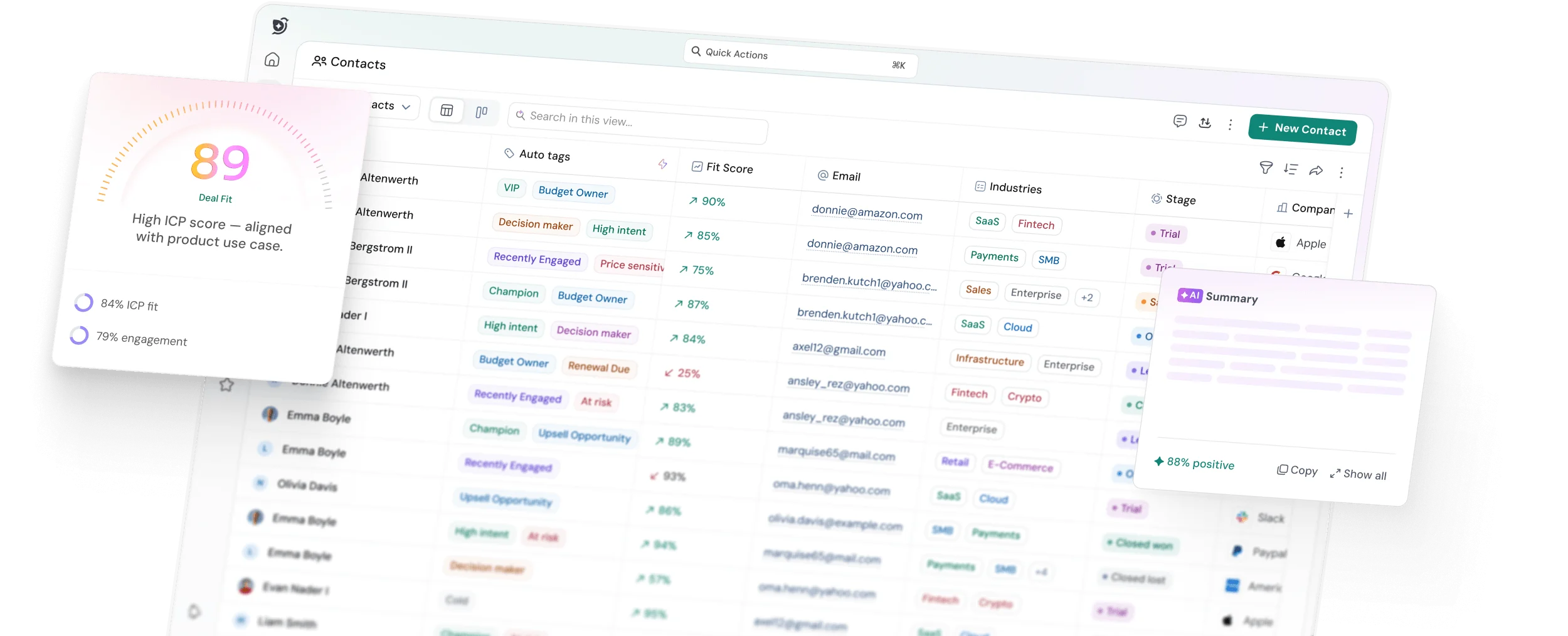
AI-native capabilities | Buying intent, ICP fit scoring, engagement scoring, competitor mentions, next actions | Demand forecasting, anomaly detection in financials, and automated reconciliation |
Overlap area | Order history, basic invoicing in some CRM platforms | Basic contact and account management in some ERP systems |
Key Features of ERP vs CRM
CRM and ERP systems both come with powerful features that serve different business needs. Let's get into what each system offers to help you decide which matches your requirements.
CRM systems excel at managing customer relationships through these core features:
1. Contact management: Creates a central hub for all customer information and interaction history
2. Sales tracking: Monitors leads, opportunities, and deals through your sales pipeline
3. Marketing automation: Handles campaigns, email outreach, and individual-specific communications
4. Customer service tools: Manages support tickets and complaints
5. Analytics: Gives an explanation about customer behavior and sales performance
ERP systems focus on streamlining internal operations with these key capabilities:
1. Financial management: Handles accounts payable/receivable, general ledger, and forecasting
2. Supply chain management: Optimizes the flow of goods from procurement to delivery
3. Inventory control: Tracks stock levels and warehouse locations
4. Production management: Plans and monitors manufacturing processes
5. Business intelligence: Offers advanced reporting across all business operations
These systems differ primarily in their focus. CRM handles front-office functions like sales and marketing. ERP manages back-office operations like finance and supply chain.
From first touch to close, automate your entire sales pipeline with AI
Benefits of CRM and ERP Systems
Business software investments pay off substantially when you pick the right tools. Let's look at how CRM and ERP systems benefit your organization.
How CRM helps sales and marketing teams
CRM systems revolutionize your teams' customer interactions. Sales teams get instant access to detailed customer histories that help create customized communications to boost satisfaction and loyalty. Your team responds faster to questions about orders or billing with data in one place.
CRM's customer segmentation by demographics and behaviors makes marketing more precise. This targeted approach creates better campaigns with higher conversion rates. Research shows 65% of sales reps who used mobile CRM achieved their sales quotas.
The software also automates follow-ups, puts lead data in one place, and shows your sales team their next steps. Your team can focus on valuable tasks instead of manual work.
How ERP improves finance and operations
ERP systems make financial management smooth by creating one source of truth for all transactions. Your finance teams close books faster, create accurate reports, and stay compliant. CFOs spend less time gathering quarterly data and more time planning ahead.
Operations teams get up-to-the-minute data about inventory, production schedules, and supply chain performance. This clear view prevents rush orders and excess production, which cuts operational costs substantially.
About 90% of organizations using ERP reported full benefits in supplier interactions. ERP systems also boost security with stricter access controls to protect sensitive information.
Shared benefits: automation, insights, and growth
Both systems cut down repetitive tasks through automation. Your staff accomplishes more with fewer resources. Companies that combine CRM with ERP see even better efficiency gains as information moves naturally between departments.
Combined analytics from both systems offer deeper understanding. Sales patterns from CRM plus inventory data from ERP help make better customer-focused decisions. This detailed view helps spot upsell opportunities and predict customer needs accurately.
Cloud-based CRM and ERP solutions grow with your business. You can adapt to new needs without big hardware investments. This scalability helps your organization handle complex operations while keeping customer relationships strong.
How to Decide: Do You Need CRM or ERP?
Growing companies need both CRM and ERP systems, or a single platform that combines them. The real question isn't about necessity but rather which system you should implement and when.
Questions to ask before choosing
Your core business model should guide your decision. A CRM provides immediate benefits if your success depends on customer retention. An ERP might serve you better if resource or asset management takes priority.
These questions will help guide your decision:
- Do you struggle more with customer management or internal operations?
- How complex are your finances and customer base?
- Do multiple disconnected tools create confusion in your workflow?
- What budget and timeline constraints do you have?
Your responses will indicate whether you should begin with CRM, ERP, or implement both at once.
When to start with CRM
Complex customer relationships signal the need to start with CRM. While ERP software includes simple customer management features, CRM software excels at handling extensive customer bases across multiple channels.
CRM proves ideal for businesses that need better organization but aren't prepared for full ERP implementation. The system costs less and requires less setup time than ERP options. Companies often choose CRM first when they manage straightforward finances but need to maintain frequent contact with numerous customers.
CRM systems excel at marketing tasks and improving customer experiences with existing products rather than new product development.
When ERP should come
Businesses needing streamlined back-office processes should prioritize ERP. The system helps with hiring, accounting, and supply chain management, crucial elements for operational efficiency.
Companies experiencing quick growth benefit from ERP's ability to centralize important data. Many businesses switch to ERP when entry-level tools like QuickBooks start limiting their expansion.
Organizations with few high-value customers and complex financial needs often benefit from ERP implementation first. Small businesses usually need 3-4 months for ERP setup, while medium-sized companies require 6-9 months. This timeline demands careful planning.
What Happens When You Combine CRM and ERP?
A business ecosystem becomes more powerful than its individual parts when CRM and ERP systems work together. These systems create unified workflows and eliminate information gaps throughout your company if they connect properly.
Why integration matters?
CRM and ERP system integration directly affects your bottom line. Research firm Nucleus Research found that integrating CRM with other internal applications guides teams to "productivity increases across sales, service, and operations and a 20 to 30 percent growth in business". Several key advantages drive this growth:
Your teams get a single source of truth for customer data. Teams waste time with outdated or conflicting information without this integration. Sales reps can track new opportunities, create quote requests, and merge quotes with existing accounts as they happen.
Customer service quality rises significantly. Support teams see complete order history, inventory levels, and account status when front-office CRM data connects with back-office ERP systems.
Real-World Example: SAP and Salesforce Integration
Case Study: enosix + Smart Data
Industry: Enterprise Software
Challenge: Sales reps in Salesforce had no access to live SAP pricing or inventory data. Quoting required manual steps across disconnected systems, causing errors and delays.
What changed after integration:
- Sales reps accessed live SAP pricing, inventory, and customer data directly inside Salesforce
- Quoting speed and accuracy increased significantly SAP transactions, including quotes, orders, and contracts, which were created from Salesforce
- Manual correction steps were eliminated across the sales process
- CRM and ERP data stayed consistent. Salesforce became the single system of record for all sales activity
Final Thoughts
Making a choice between CRM and ERP systems is straightforward. Your business requirements should point you in the right direction. Customer relationships that stimulate your growth call for CRM, while operational needs demand ERP solutions. Many thriving businesses tap into the full potential of both systems.
Statistics paint a compelling picture. Companies integrating their CRM and ERP systems experience 20-30% growth. Enhanced customer service, efficient operations, and analytical insights create this impressive boost. The implementation process requires patience and strategy, but the rewards justify the effort.
These systems evolve alongside your business. Starting with one system today leaves room to add another as your needs expand. Success lies in selecting a solution that addresses your immediate challenges while anticipating future expansion.
A thorough assessment of your options pays off. Your budget, timeline, and available resources deserve careful attention. The systems you pick must resonate with your team. Even the most sophisticated software delivers results only when it becomes an integral part of your daily workflow.

Frequently Asked Questions (FAQs)
Related Articles

12 Apr, 2025
Sales CRM: Comparison on Features, Pricing, and Suitability
21 Apr, 2026
CRM integrations: what they are, types, tools, and how to set them up

05 May, 2025