LEAD MANAGEMENT
Lead nurture: how to build a process that turns cold leads into pipeline

By Ganesh Ravi Shankar
Last updated on Jul 24, 2026
Explore this blog to learn what lead nurture means, why it matters, and how to build a process with real sequences, tools, and AI features.

- What is lead nurturing?
- Why lead nurturing matters in B2B sales?
- How to build a lead nurture process?
- How to nurture a lead: example sequences by funnel stage
- AI features that actually improve lead nurturing
- Lead nurturing software: how SparrowCRM supports it
- Common lead nurture mistakes to avoid
- Final thoughts
Most B2B leads are not ready to buy the day they show up in your funnel. They need time, context, and a reason to trust you before a sales conversation makes sense. Lead nurture is how you use that time productively instead of losing the lead to silence. This blog breaks down the definition, the process, real sequences, and the tools that make it work.
What is lead nurturing?
Lead nurturing is the ongoing process of building trust with a prospect. You do this with relevant, well-timed touches until they are ready to buy. Not one aggressive phone call to follow up. It’s not just one discount email either. Instead, it’s a series of helpful content over weeks or months, aligned with where the prospect is at.
A solid lead capture strategy brings the contact into your system. Lead nurture is what keeps that contact warm. It keeps them warm until they are ready to talk to sales.
Why lead nurturing matters in B2B sales?
A disciplined b2b lead nurture program is what separates teams that hit pipeline targets from teams that don't. The three reasons below show up in the data, not just in theory.
The real cost of skipping lead nurture
Skip nurturing, and most leads simply go quiet. Roughly 80 percent of new leads never turn into paying customers without ongoing follow-up, according to Invesp research. That is not a small leak in your funnel. It is most of your pipeline disappearing from simple inattention.
Why do B2B buyers need more nurturing than B2C?
B2B deals involve more people, bigger budgets, and longer timelines than a typical consumer purchase. A single email rarely closes anything here. Gartner research shows buyers spend only about 17 percent of their buying journey meeting with suppliers. They spend as little as 5 percent of that time with any single sales rep. Nurture fills the rest of that timeline.
The revenue case for a value-based nurture process
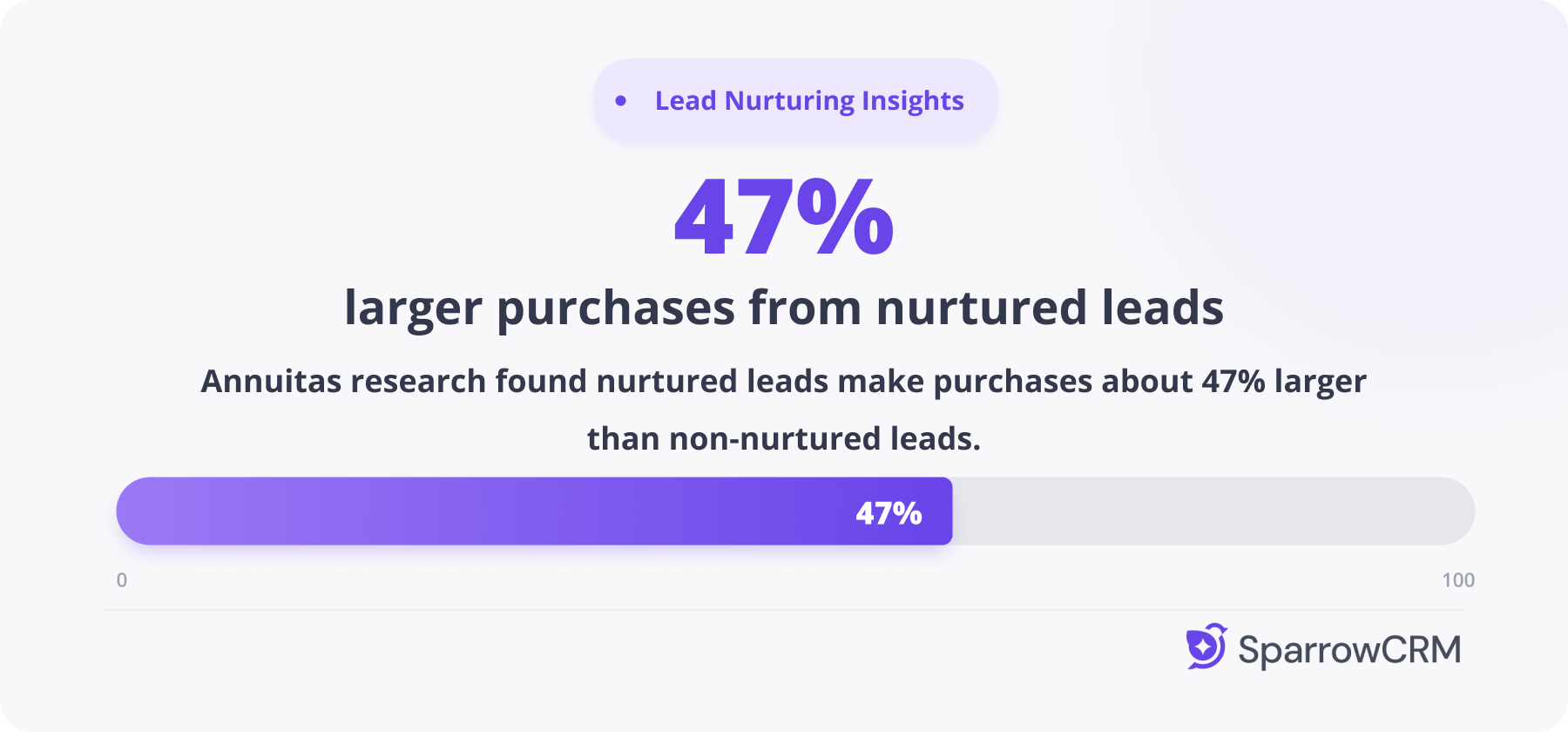
A value-based nurture process solves a prospect's problem instead of pushing a pitch. This approach pays off in deal size. Annuitas research found nurtured leads make purchases about 47% larger than leads that were never nurtured. Skipping this step costs you revenue per deal, not just leads.
How to build a lead nurture process?
The process of building a lead nurture system starts with segmentation, not content. Write the best email in the world, and it still fails if it lands with the wrong person at the wrong stage. Get segmentation right first, and everything downstream gets easier.
1. Segment before you send anything
Group leads by role, company size, and the specific problem they showed interest in. Do not group them only by which form they filled out. A VP of Sales at a 40-person SaaS company needs different content than a founder at a 10-person retail shop. This is true even if both downloaded the same guide.
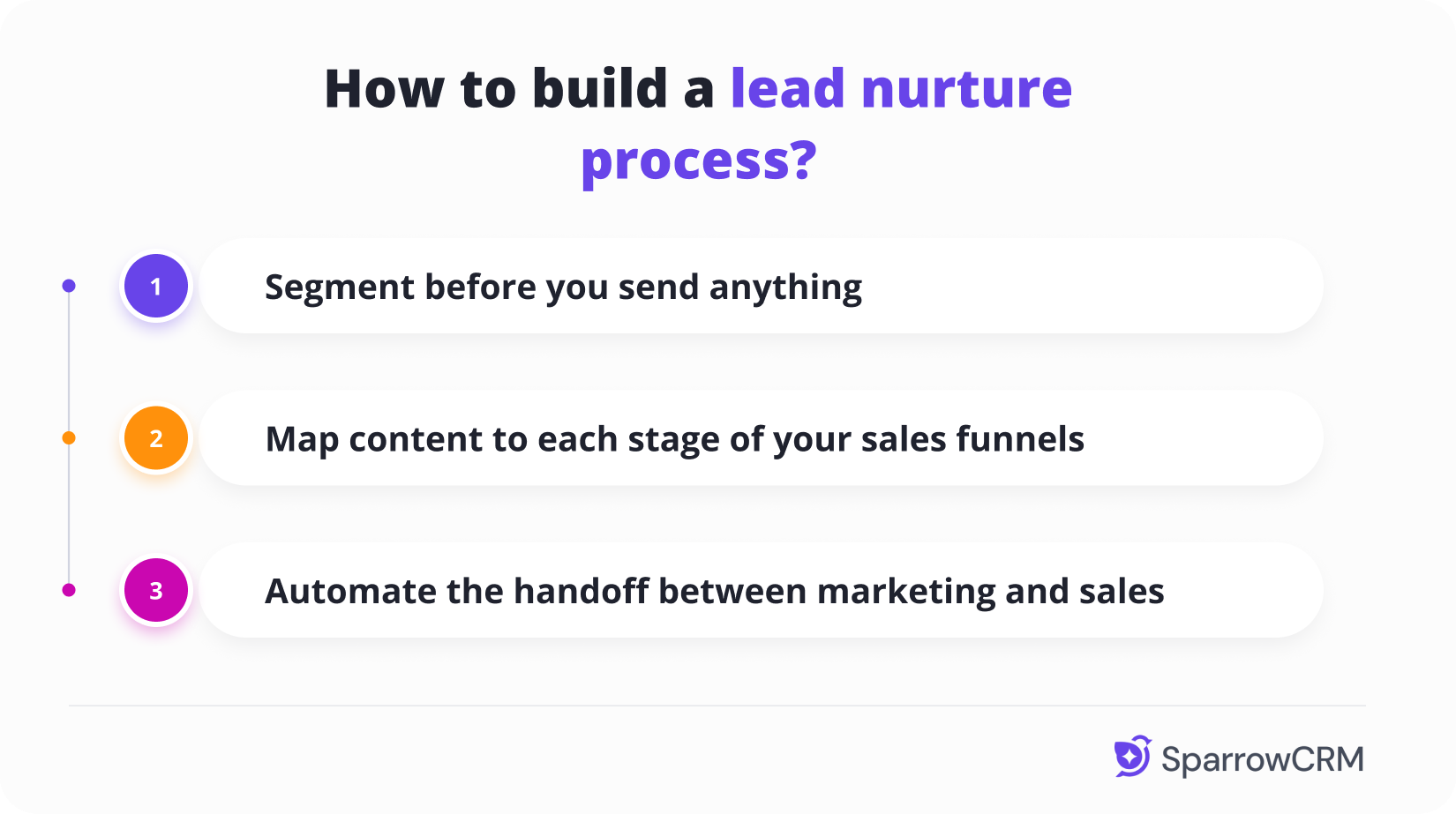
2. Map content to each stage of your sales funnels
Different content earns trust at different points in your sales funnels. Early-stage leads want education, not a demo. Mid-stage leads want proof, like case studies or comparisons. Late-stage leads want a reason to choose you specifically, over the other vendors they are also evaluating.
3. Automate the handoff between marketing and sales
Manual handoffs are where nurture programs quietly die. A lead engages, nobody notices, and the moment passes. SparrowCRM's buying intent signals flag the exact moment a nurtured lead starts showing real purchase intent. A rep gets pulled in at the right time, instead of days late.
How to nurture a lead: example sequences by funnel stage
Most of this runs through email marketing. A strong sequence often adds LinkedIn touches or a short call, too. Below are three full example sequences, one for each major funnel stage, written out email by email so you can adapt them directly to your own product and audience.
Top-of-funnel sequence (awareness)
This sequence starts the moment a lead downloads a resource, like a checklist or a guide. The goal here is trust, not a pitch. Nothing in this sequence should mention pricing or ask for a demo.
Email 1 · Day 1
Subject: Here's your [resource name]
Hi [First Name], thanks for downloading [resource name]. Inside, you'll find a practical breakdown of [core topic], including a few steps most teams skip. If anything in it raises a question, just hit reply. I read these myself.
Best,
[Sender Name]
Checkpoint before the next email: Check whether they opened Email 1 or clicked the resource link. Did they also visit your pricing page on their own? That is a stronger signal than a simple download. If so, move them into the middle-of-funnel sequence instead.
Email 2 · Day 4
Subject: The mistake we see most often
Hi [First Name], one pattern shows up in almost every team we talk to: [common mistake related to the topic]. It sounds small, but it's usually the reason for [specific consequence]. Here's a short breakdown of how to avoid it: [link to blog or resource]. No pitch here, just something worth knowing early.
Best,
[Sender Name]
Middle-of-funnel sequence (consideration)
This sequence targets leads who are actively comparing options. They already understand the problem. Now they need proof that your approach, and specifically your product, can solve it better than what they are currently doing.
Email 1 · Day 1
Subject: How teams like yours solve [problem]
Hi [First Name], teams your size usually solve [problem] one of two ways: [approach A] or [approach B]. Each has trade-offs. Here's a short comparison that breaks down which approach fits which situation: [link]. Let me know which sounds closer to where you are.
Best,
[Sender Name]
Checkpoint before the next email: Check whether they clicked into the comparison content, and how many times. Strong, repeat engagement is a signal. Move the demo invite earlier in the sequence
Email 2 · Day 5
Subject: A closer look at [feature]
Hi [First Name], following up on [problem] you mentioned earlier. Here is exactly how [feature] handles that specific case, with a short walkthrough: [link to demo video or page]. If it would help to see this applied to your own workflow, I'm happy to set that up.
Best,
[Sender Name]
Bottom-of-funnel sequence (decision)
This sequence goes to leads who are close to a decision, often comparing two or three vendors. The goal is to remove friction and answer the one objection standing between them and a yes.
Email 1 · Day 1
Subject: Recap: what we've covered so far
Hi [First Name], quick recap before you make a decision: you're solving [problem], you've seen [feature or proof point], and the main open question has been [likely objection]. Here is a summary doc you can share internally if that helps: [link].
Best,
[Sender Name]
Checkpoint before the next email: Check whether they replied with a question or forwarded the recap internally. Silence is normal at this stage. But a second visit to your pricing page is worth flagging to the rep before Email 2 goes out.
Email 2 · Day 3
Subject: On [common objection]
Hi [First Name], one thing that comes up a lot at this stage is [specific objection, for example implementation time or switching cost]. Here is exactly how that works in practice, and what teams like yours typically experience: [short, honest answer]. Happy to go deeper on a call if useful.
Best,
[Sender Name]
AI features that actually improve lead nurturing
Most “AI” in nurture tools amounts to a subject-line suggestion. The features that actually change outcomes tell you who to nurture harder, and when to stop nurturing and start selling. Four matter most.
1. ICP fit scoring
ICP fit scoring tells you which leads are worth a longer, more resourced sequence. It looks at firmographic signals like company size, industry, and role to compare a lead against your ideal customer profile. Leads with a strong fit get a fuller sequence; the rest get a lighter-touch track instead.
2. Buying intent signals
Buying intent signals catch the moment a quiet lead starts re-engaging: revisiting your pricing page, opening the same email twice, or searching for competitor comparisons. Your sequence can then shift from educational to sales-ready automatically, without a human watching every account by hand.
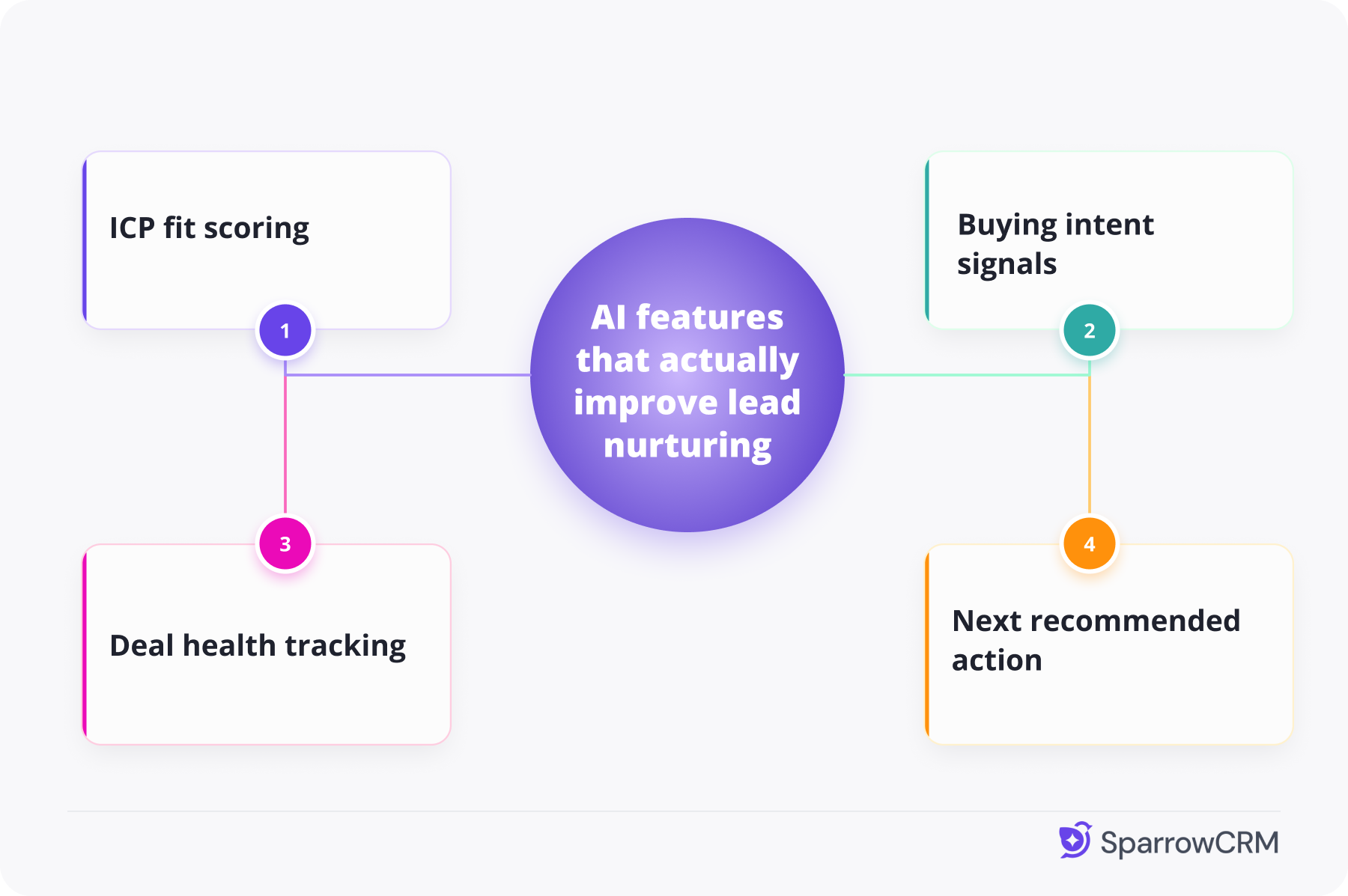
3. Deal health tracking
Once a nurtured lead becomes an active opportunity, deal health tracking keeps watching. It flags dropping engagement, missing stakeholders, or a stalled sequence, so a deal that is quietly going cold gets caught before it disappears from the pipeline entirely.
4. Next recommended action
This is the feature that turns signals into action. Instead of a rep guessing what to do with a re-engaged lead, next recommended action tells them exactly what step comes next, whether that is a specific email, a call, or simply more time in the nurture sequence.
Lead nurturing software: how SparrowCRM supports it
A nurture process is only as good as the system running it behind the scenes. Before picking a tool, look for four things: it should segment leads automatically, send sequences on a schedule, flag when a lead re-engages, and hand off to sales at the right moment, without a rep having to babysit a spreadsheet.
This is the layer SparrowCRM was built around. Instead of bolting nurture features onto a traditional CRM as an afterthought, SparrowCRM treats lead nurture as a core workflow, connected directly to scoring, pipeline, and rep activity in one place.
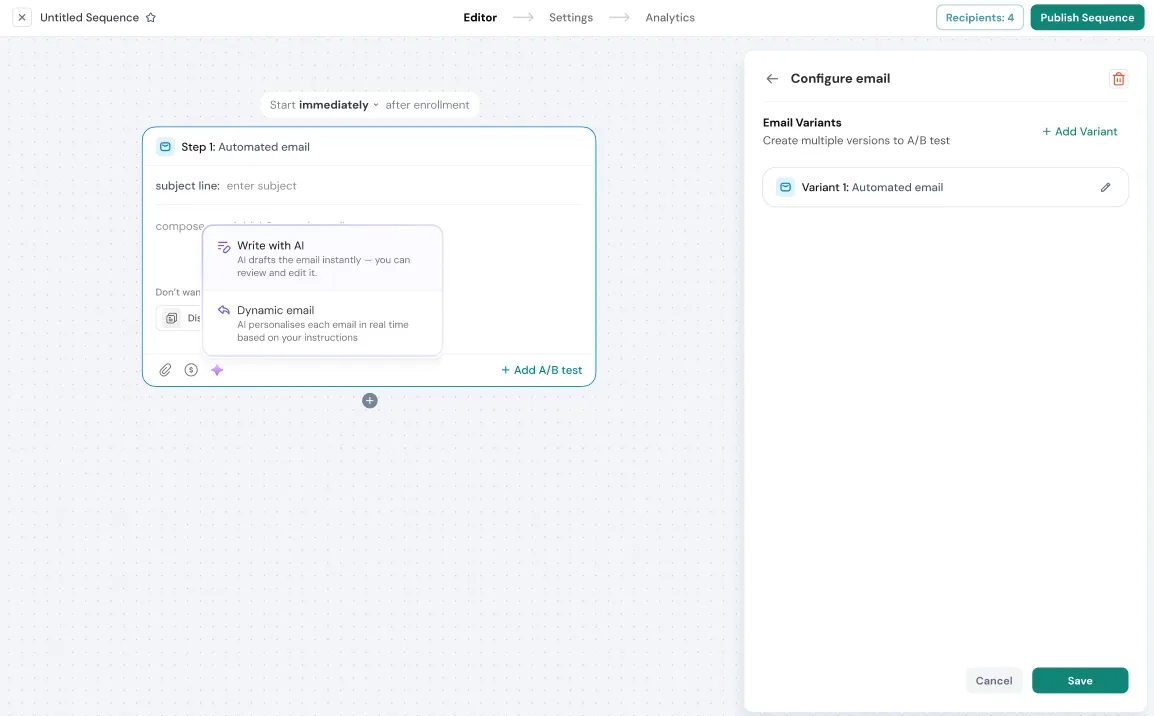
Segmentation happens automatically as leads come in, using firmographic data, role, and behavior, so your sequences start with the right audience instead of a flat list. Sequencing runs on autopilot once it is set up, sending the right email on the right day without a rep manually queuing anything.
Where it goes further is the handoff. SparrowCRM's buying intent signals watch engagement across every nurtured lead and flag the exact moment interest shifts from casual to serious. Instead of a lead sitting in a general list until someone happens to check it, a rep gets a clear signal and a suggested next step.
Turn More Leads Into Customers With SparrowCRM
Common lead nurture mistakes to avoid
Most nurture programs do not fail because the idea is wrong. They fail because of a handful of avoidable execution mistakes. Watch for these four.
1. Sending too many emails, too fast
A lead who just downloaded one guide is not ready for a five-email blitz in the first week. That reads as pressure, not value, and it is one of the fastest ways to earn an unsubscribe before you have earned any trust at all.
2. Ignoring behavior signals
Treating every lead in a segment as equally warm is a common mistake. A lead who opened every email and visited your pricing page twice is in a different place than one who has not opened anything in three weeks. Your sequence should branch based on that behavior, not ignore it.
3. Never handing off to sales
Some nurture programs run forever, quietly cycling a hot lead through more educational content long after they are ready for a real conversation. If a lead shows strong buying intent, the sequence should pause and route to a rep, not keep sending the next scheduled email.
4. Reusing the same email for every stage
A decision-stage lead does not need a definition of lead nurture, and an awareness-stage lead does not need a pricing comparison. Copy-pasting one generic sequence across every funnel stage is one of the most common reasons nurture programs underperform.
Final thoughts
Lead nurture is not a nice-to-have layer on top of your sales process. It is the difference between a funnel that leaks leads and one that turns them into a pipeline. Segment well. Match content to funnel stage. Use the sequences above as a starting point, and adapt them to your own audience.



.png?2026-07-01T11:07:52.418Z)