LEAD MANAGEMENT
What is lead qualification, and how does it work?

By Geethapriya
Last updated on Sep 11, 2026
Explore this blog to understand what lead qualification is, why it matters, which frameworks to use, and how to build a process that consistently surfaces your best-fit prospects.
.webp)
Geethapriya
Updated on Sep 11, 2026
Lead qualification is at the heart of the sales process. When done well, it helps sales teams build a stronger pipeline, focus on the right prospects, and improve their chances of closing deals. However, many sales teams still struggle to identify and prioritize the leads that are most likely to convert.
In this article, you’ll learn what lead qualification is, the different types of leads, popular qualification frameworks, and the step-by-step process for qualifying leads effectively.
TL;DR
Lead qualification helps you focus on the right prospects by looking at factors such as their needs, budget, and buying authority.
Not every lead is ready to buy. MQLs, SQLs, and PQLs show different levels of buying readiness, so each type needs a different approach.
BANT, CHAMP, and MEDDIC are popular frameworks that help sales teams decide whether a lead is worth pursuing.
A good qualification process keeps your pipeline healthy by helping reps spend less time on leads that are unlikely to convert.
CRM tools can automate parts of lead qualification, such as scoring and prioritizing leads, so reps can focus on the most promising opportunities.
What is lead qualification?
Lead qualification is the process of evaluating a prospect to determine whether they’re a good fit for your product or service and are worth pursuing as a potential customer. Sales teams typically look at factors such as industry, company size, job role, business needs, budget, and buying intent.
Let's understand a few important terms before diving deep into the concept
- Lead management: The process of capturing, organizing, tracking, and nurturing leads throughout the sales journey.
- Ideal Customer Profile (ICP): A description of the type of customer or company that is the best fit for your product or service.
- Qualified leads: Leads that match your ICP and show a genuine need or interest in your product or service.
- Unqualified leads: Leads that don't match your ICP or aren't currently ready or likely to buy your product or service.
Why does lead qualification matter?
Lead qualification matters for sales teams, and they need to qualify every lead that flows in; otherwise, it will cost the sales team effort. Below are the stats to have a look at.
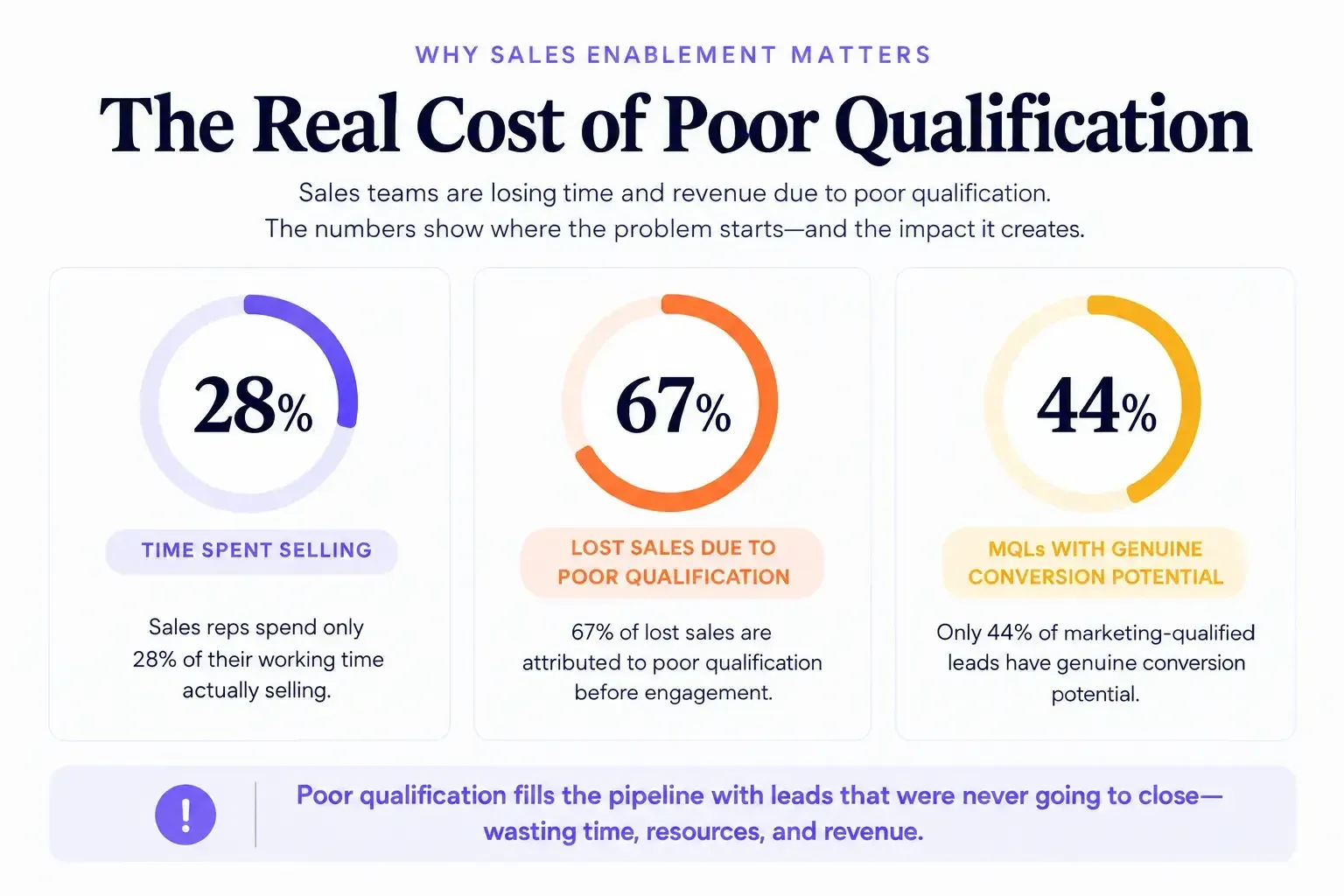
Sales reps spend only 28% of their working time actually selling. Poor qualification makes that worse by filling pipelines with leads that were never going to close.
The numbers are direct: 67% of lost sales are attributed to poor qualification before engagement, and only 44% of marketing-qualified leads have genuine conversion potential. Every unqualified lead that slips through consumes time that should go to a viable opportunity.
Let's understand how it improves the sales pipeline and sales cycle.
- Focuses on the right leads: When you qualify leads early, your sales team can focus on prospects who actually fit your ICP and have a genuine need for your product.
- Moves deals faster: Once you know a prospect is a good fit and ready to buy, your sales reps can spend more time having meaningful conversations instead of chasing leads that are unlikely to convert.
- Creates a healthier pipeline: A pipeline filled with qualified leads gives your team a clearer picture of which opportunities are worth pursuing and which deals are more likely to close.

How do you currently qualify leads?
What are the types of qualified leads?
Not all qualified leads are equally ready to buy. Sales organisations use four categories to track where a prospect stands.
Lead type | What it means | Typical conversion |
|---|---|---|
MQL (Marketing qualified) | Engaged with content, webinars, downloads, and email. Still in education mode, not ready for a sales call. | 10–20% |
SQL (Sales qualified) | Clear buying intent. Budget, authority, and need confirmed. Ready for a direct conversation. | Deal-stage dependent |
PQL (Product qualified) | Experienced value through a free trial or freemium. Qualification comes from behaviour, not just intent. | 15–30% |
SAL (Sales accepted) | An MQL that sales has formally reviewed and accepted. The bridge stage between MQL and SQL. | Depends on handoff quality |
PQLs consistently outperform MQLs in conversion because the prospect already knows the product works for their use case. If your product has a free trial or freemium tier, PQLs should get priority treatment in your qualification workflow.
Qualified vs unqualified leads: the difference that matters
An unqualified lead is not the same as a disqualified one. That distinction shapes how you respond.
Status | Definition |
|---|---|
Qualified | Meets need, budget, and authority criteria, ready for active sales engagement |
Unqualified | Fails one or more criteria right now, but may qualify later (budget freeze, junior contact, etc.) |
Disqualified | Fundamentally incompatible, wrong industry, no use case, impossible budget, regardless of timeline |
Research suggests up to 96% of leads entering the funnel are not immediately ready to buy. Treating all of them as disqualified is a significant pipeline mistake. Unqualified leads that match your ICP should enter a nurture track, not a rejection pile.
SparrowCRM automates lead scoring and qualification for you
Lead qualification frameworks: BANT, CHAMP, and MEDDIC
No single framework works for every sales environment. The right choice depends on deal complexity, cycle length, and how many stakeholders are involved.
Framework | Best for | Key trade-off |
|---|---|---|
BANT | Transactional deals, short cycles, single buyer | Too shallow for multi-stakeholder enterprise sales |
CHAMP | Consultative selling, relationship-led pipelines | Less structured on timeline; needs sales maturity |
MEDDIC | Enterprise sales, complex buying processes | High training overhead; requires disciplined CRM usage |
BANT
Developed by IBM, BANT evaluates Budget, Authority, Need, and Timeline. It is fast and effective for transactional sales with a single decision-maker and a short cycle. Where it falls short is in complex B2B deals: the budget is often undefined until a prospect recognises solution value, and authority is rarely held by one person.
CHAMP
CHAMP reorders the priorities: Challenges, Authority, Money, Prioritization. It puts pain discovery before budget, because organisations typically allocate funds after recognising a problem, not before. Prioritization replaces Timeline; instead of asking when someone plans to buy, CHAMP asks how this initiative ranks against competing priorities. It suits consultative selling where the relationship precedes pricing.
MEDDIC
MEDDIC covers Metrics, Economic Buyer, Decision Criteria, Decision Process, Identify Pain, and Champion. Created at PTC in 1996, it helped grow revenue from $300M to $1B. Built for enterprise complexity, multiple stakeholders, longer cycles, and formal procurement, the trade-off is higher training overhead and more rigorous CRM data management.
Watch these three practical lead qualification tips in action
Learn how to identify better opportunities and avoid wasting time on leads that won't convert.
The lead qualification process: step by step
Qualification is not a single conversation. It is a structured sequence that starts before the first call and continues until a prospect either advances or gets recycled into nurture.
1. Research before contact
Pull together company size, industry, revenue range, funding status, and tech stack before reaching out. This screens for ICP fit without using any selling time. A CRM centralises this research and tracks what has already been gathered per prospect.
2. Make contact and assess fit
First outreach is about establishing rapport and verifying your research. Use a qualification checklist during the call to work through ICP criteria. Prospects respond better when they sense you understand their business context before the questions start.
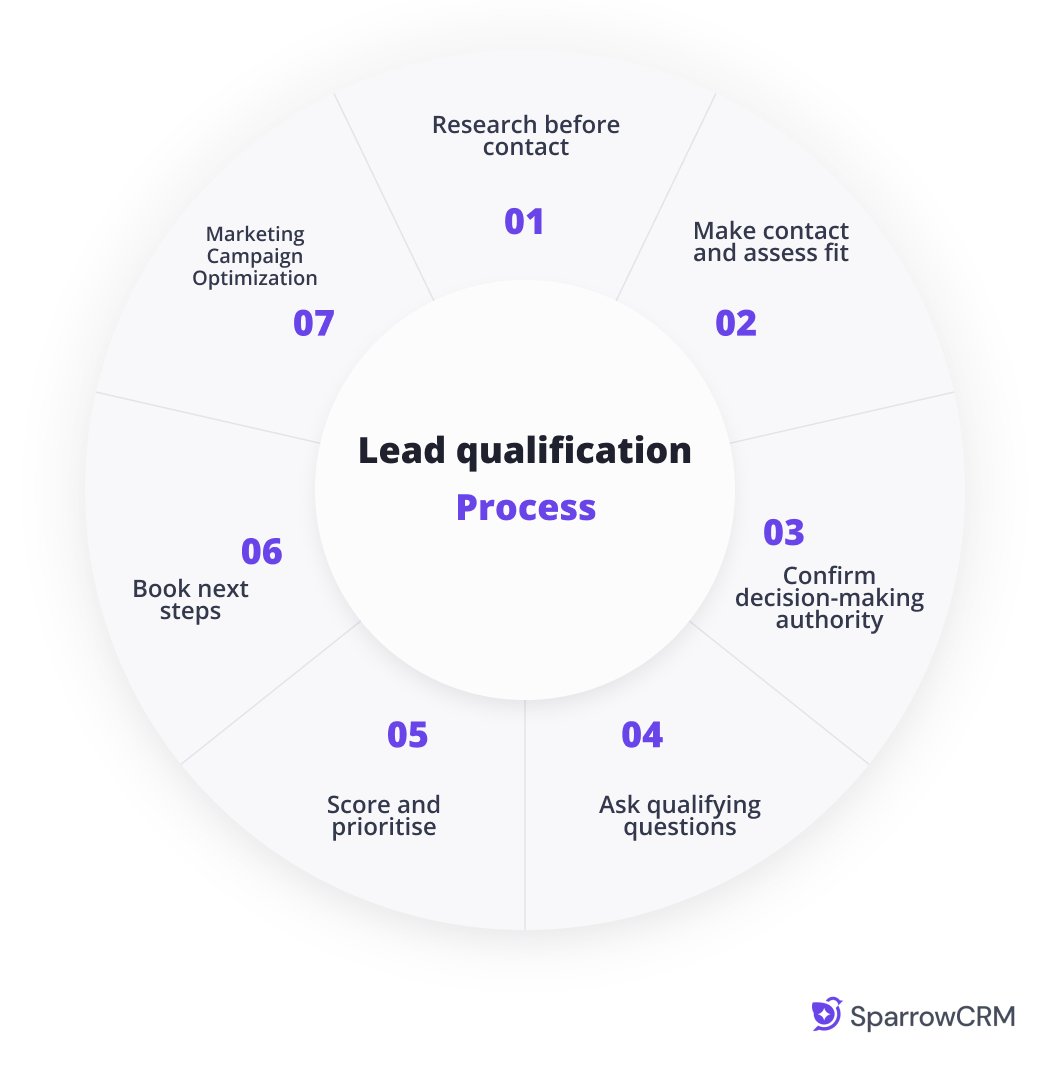
3. Confirm decision-making authority
In B2B companies with more than 100 employees, an average of seven people are involved in purchase decisions. Identify early whether your contact is the buyer, an influencer, or a gatekeeper, and map the buying committee accordingly.
4. Ask qualifying questions
Go beyond surface-level interest. Ask about current solutions, what is not working, the cost of inaction, and what success looks like. Open-ended questions reveal pain severity and urgency far better than yes/no prompts.
5. Score and prioritise
Assign scores based on demographic fit and engagement signals. Set thresholds that determine which leads are sales-ready and which need nurture. Manual scoring at volume is not sustainable; this is where CRM automation makes the most impact.
6. Book next steps
Leave every qualification conversation with a confirmed date and objective: a demo, a proposal review, or a stakeholder call. Vague follow-up commitments break momentum.
Lead qualification checklist
Every qualification interaction should cover these six criteria before a lead advances to SQL status.
Criterion | What to verify |
|---|---|
Genuine interest | Are they researching with intent, or just browsing? Look for specific, detailed questions. |
Real use case | Does their situation actually fit what your product does? Interest without application ends in churn. |
Budget capacity | Can they meet your pricing? Ask about the current solution spend and the ideal price range. |
Purchase timing | Is there an active buying process, or is this exploratory? Define the horizon. |
Decision authority | Is this person the buyer, or do you need to reach the economic buyer? |
Information access | Can your team get the data needed to support an informed decision for this prospect? |
How do CRM tools support lead qualification?
CRM tools can make lead qualification easier by helping teams score, organize, prioritize, and route leads based on predefined criteria. Here are a few examples of how popular CRM tools support the process:
- HubSpot: HubSpot is an all-in-one CRM for any business. HubSpot helps sales teams qualify and manage leads in a few specific ways:
- Contact health: Shows which contacts may need attention, helping reps decide who to follow up with first.
- Lead-source tracking: Shows where leads came from and tracks their activities, giving reps more context when evaluating a lead.
- Sales automation: Automates follow-ups so leads don't get missed while moving through the sales process.
- Salesforce: Salesforce supports lead qualification and management through features such as:
- Lead scoring: Helps sales teams identify and prioritize leads based on their likelihood of converting.
- Lead assignment: Automatically routes leads to the appropriate sales rep based on predefined rules, so new leads reach the right person faster.
- Lead tracking: Keeps information about lead activity and interactions in one place, giving reps the context they need to decide how to follow up.
Looking for tools to manage your leads? Check out our lead management software guide for a detailed look at the tools available.
- SparrowCRM: SparrowCRM supports lead qualification through features such as:
- AI lead scoring: Helps teams identify leads that are more likely to convert by evaluating relevant lead and engagement signals.
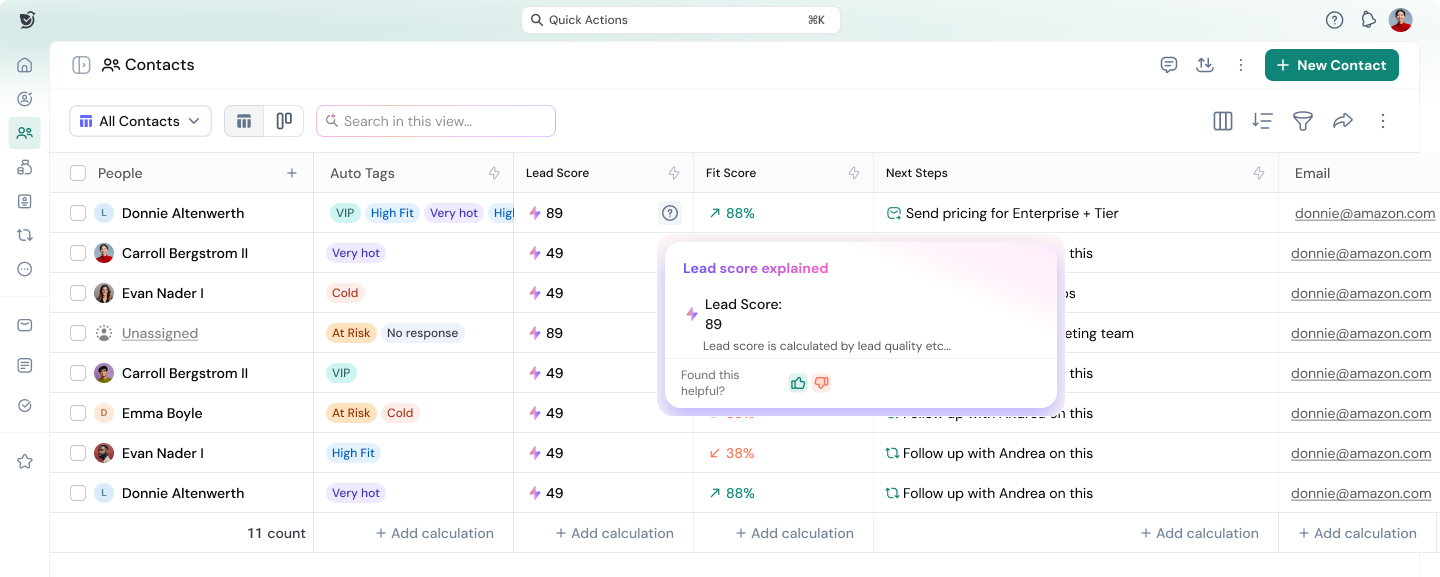
- ICP and buying intent: Helps reps understand whether a lead fits their ideal customer profile and shows signs of genuine buying interest.
- Lead routing: Automatically assigns qualified leads to the right rep based on predefined criteria, reducing the need for manual lead distribution.
Automate lead qualification with SparrowCRM.

Geethapriya
Geethapriya is a Growth Marketer and Business Researcher who researches and writes about CRM, sales, marketing, and customer engagement. Her work focuses on understanding industry trends, customer and sales challenges, and how businesses can use technology to build more effective growth processes.
.webp?2026-09-14T15:44:03.253Z)