CRM SOFTWARE
CRM experience: what it is, why it matters, and how to improve it

By Ganesh Ravi Shankar
Last updated on Jun 4, 2026
Explore this blog to understand what CRM experience really means, why it directly drives, and how to improve it across nine practical areas, with a dedicated section on how AI capabilities transform CRM from a data-entry tool into a proactive selling engine.

Most CRM problems are not software problems. They are experiencing problems. Reps avoid updating records because the system slows them down. Managers pull dashboards that don't reflect reality because the data going in is incomplete. Customers feel chased rather than understood because the outreach is disconnected from their actual behaviour.
The CRM experience, meaning how your team interacts with the system and how customers feel as a result, determines whether your CRM becomes your most valuable revenue asset or an expensive reporting burden.
This guide covers what CRM experience is, how it connects to revenue, the warning signs that yours needs attention, and nine practical ways to improve it, including how AI is reshaping what a great CRM experience looks like in 2026.
Key takeaways
- CRM experience is the way every customer-facing interaction, from first contact to renewal, is shaped by the data, automation, and intelligence within your CRM system.
- Poor CRM experience is directly linked to revenue loss: teams that don't trust their CRM enter inaccurate data, skip updates, and lose deals that better systems would have caught.
- AI transforms CRM experience from reactive record-keeping into proactive selling, surfacing intent signals, scoring leads, flagging risks, and recommending next actions in real time.
- Nine practical ways to improve the CRM experience include improving data quality, personalising touchpoints, automating follow-ups, enabling mobile access, and building feedback loops.
- Measuring CRM experience requires tracking adoption rate, data completeness, pipeline velocity, and customer satisfaction, not just login counts.
What is CRM experience?
CRM experience refers to the quality of every interaction a customer or prospect has with your business, shaped by how well your CRM captures, organises, and acts on their data. It also describes how effectively your sales team can use the CRM itself, because poor internal usability leads directly to poor external customer interactions.
Two dimensions of CRM experience are often confused:
- The internal experience of how reps, managers, and ops teams interact with the CRM day to day. If it is slow, cluttered, or requires too much manual input, adoption drops, and data quality deteriorates.
- The external experience is how customers feel when they interact with your business. When internal CRM usage is poor, customers experience the consequences: repetitive questions, irrelevant emails, delayed follow-ups, and missed commitments.
The two are directly connected. A sales rep who dreads logging into the CRM will not update contact records after calls. A manager who cannot trust the pipeline data will default to gut decisions over system data. And a customer who has to repeat their context on every call is experiencing the downstream effect of a CRM that nobody trusts.
A well-executed CRM experience closes that loop, making it easy for reps to do the right thing, so that customers consistently receive interactions that feel informed, timely, and relevant.
CRM experience is also distinct from CRM software. The software is the tool. The experience is what you build on top of it, the workflows, the data hygiene practices, the adoption culture, and increasingly, the AI layer that makes proactive action possible.
To understand the full range of CRM capabilities that contribute to this experience, see the types of CRM software and a breakdown of analytical, operational, and collaborative CRM systems.
How CRM experience is connected with your business revenue
CRM experience has a measurable revenue impact that most businesses underestimate because the losses are distributed and invisible. They show up as slower pipeline velocity, lower win rates, smaller average deal sizes, and higher churn, not as a single line item on a report.
Here is how the connection works across the revenue cycle:
Pipeline accuracy and forecast reliability
When reps do not trust the CRM, they stop updating deal stages accurately. Managers then make quota decisions based on data that is 30–60% unreliable. Missed forecasts lead to over-hiring, under-resourcing, and poor revenue planning. A poor CRM experience at the rep level becomes a financial planning problem at the leadership level.
Lead conversion rates
Speed and relevance determine lead conversion. Research consistently shows that responding to an inbound lead within the first five minutes increases conversion probability by up to seven times compared to a 30-minute delay. A CRM experience that surfaces new leads automatically, routes them to the right rep, and triggers a follow-up sequence immediately delivers that speed. A system that requires manual checking and manual entry does not.
Customer retention and expansion revenue
Retention is where CRM experience has its largest revenue impact. Customers who receive personalised, timely, and context-aware communication are less likely to churn and more likely to expand. A CRM that maintains a complete history of every interaction, call, email, meeting, and support ticket ensures that every renewal conversation starts from a position of knowledge rather than guesswork.
Acquiring a new customer costs five to seven times more than retaining an existing one. Every percentage point improvement in retention driven by better CRM experience has a compounding effect on annual recurring revenue.
Rep productivity and sales capacity
According to Salesforce's State of Sales research, sales professionals spend 60% of their time on non-selling tasks. The remainder goes to administrative tasks, data entry, and searching for information. A CRM experience that automates data capture, surfaces next actions, and eliminates redundant manual entry directly increases the percentage of time reps spend in revenue-generating activity. without adding headcount.
Signs your CRM experience needs improvement
Most teams do not recognise that their CRM experience has deteriorated until they are already losing deals to it. The following warning signs are the most reliable early indicators that your CRM experience needs attention.
Warning sign | What it signals | Business impact |
CRM data is incomplete or outdated | Reps are not entering information after interactions | Forecasts are unreliable; managers make decisions on stale data |
Low login frequency across the team | Reps find the system harder to use than their own spreadsheets or notes | No single source of truth; lost context across handoffs |
Sales reps duplicate effort manually | CRM is not automating the tasks it should handle | Wasted hours per rep per week; slower follow-up speeds |
Customer complaints about repetition | Reps lack context at touchpoints; no unified contact history | Customer churn, damaged trust, lost renewals |
Pipeline stages don't reflect reality | Reps are moving deals forward to satisfy management, not for accuracy | Inaccurate forecasting; missed revenue targets |
High CRM admin overhead | Too many manual fields, required updates, or complex workflows | Rep burnout; drop in adoption; CRM seen as a burden |
Deals lost to competitors mentioned in calls | CRM is not surfacing competitive intelligence from conversations | Missed opportunity to reposition; deals lost that could have been saved |
If three or more of these signs are present in your organisation, the problem is systemic, not a rep behaviour issue. Addressing it requires changes to the CRM experience itself, not more training or enforcement.
How AI improves CRM experience
Traditional CRM experience depends on human discipline, reps remembering to update records, managers reviewing pipelines manually, and teams manually coordinating follow-ups. AI changes this by making the CRM proactive rather than reactive. Instead of waiting for data to be entered, it surfaces signals. Instead of waiting for a manager to review, it flags risks. Instead of waiting for a rep to decide what to do next, it recommends the action.
The following capabilities illustrate how AI transforms each layer of the CRM experience.
ICP fit scoring and lead prioritisation
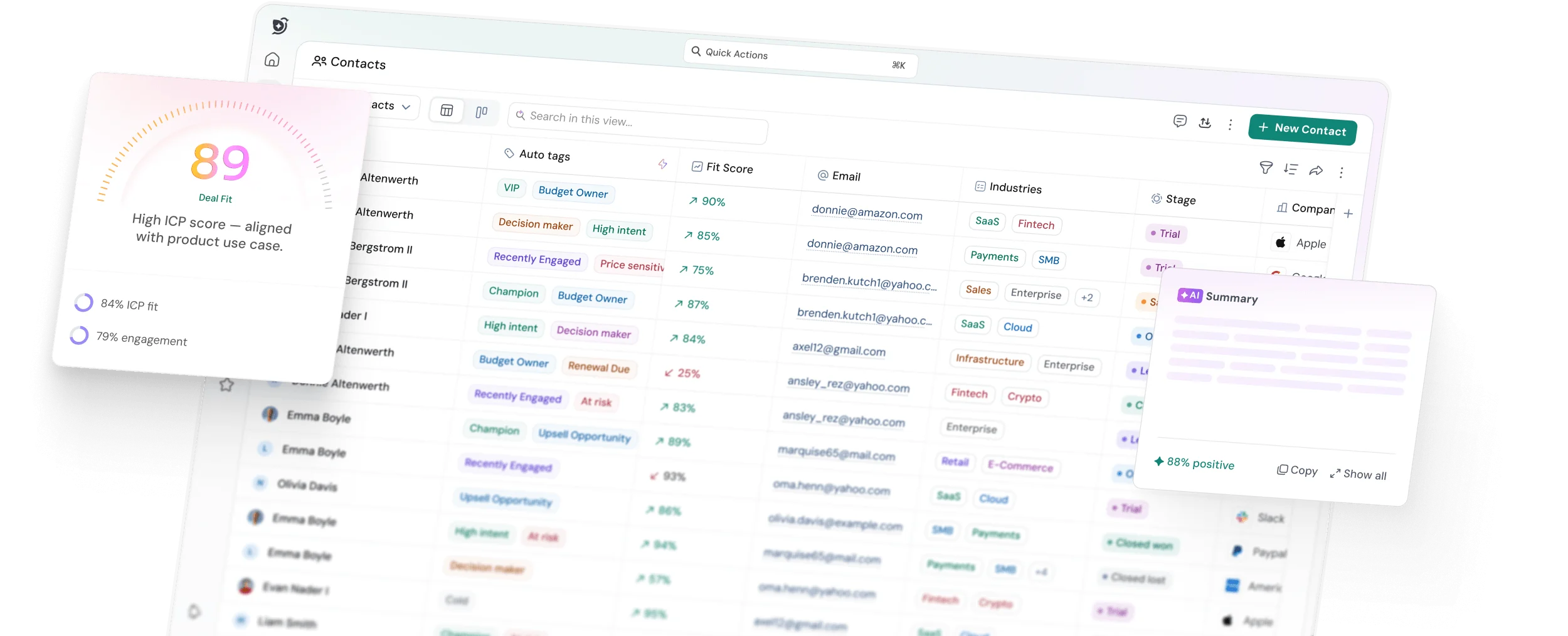
Not all leads deserve the same attention, but without a scoring system, reps default to working the most recent or the loudest. An ICP Fit Score evaluates each contact or account against your Ideal Customer Profile criteria, industry, company size, seniority, revenue range, and geography and surfaces a percentage score (High, Medium, or Low fit) directly on the contact record.
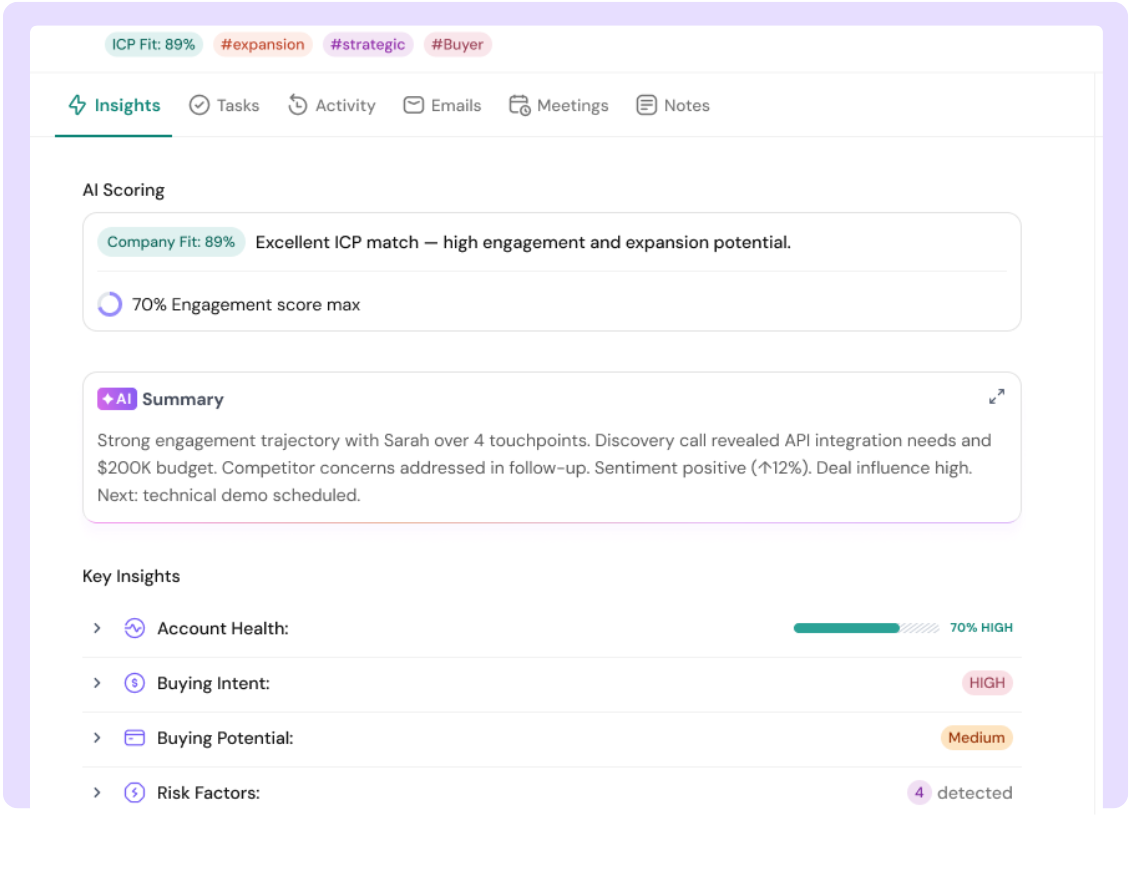
This removes the guesswork from prioritisation. Reps open the contact view and immediately know whether this is a high-fit account worth investing in or a low-fit contact that should receive a lighter-touch sequence.
Buying intent signals in real time
Buying intent is a real-time score that reflects how ready a contact is to move forward, based on signals aggregated from emails, call transcripts, meeting activity, deal movement, and website behaviour. Actions like pricing discussions, demo attendance, and positive replies all increase the intent score. Silence and stage stagnation reduce it.

The intent widget displays an overall score (0–100%) alongside the specific signals driving it, so reps understand not just that intent is high, but why, and can tailor their next conversation accordingly. It may also surface the top topics being discussed (Pricing, Integration, Security) to give reps a precise entry point for follow-up.
Engagement score and best contact time
The Engagement Score tracks how actively a contact is interacting with your outreach across emails, calls, meetings, and deal activity. It surfaces a 0–100 score, colour-coded to distinguish warm and active contacts from cold or at-risk ones.
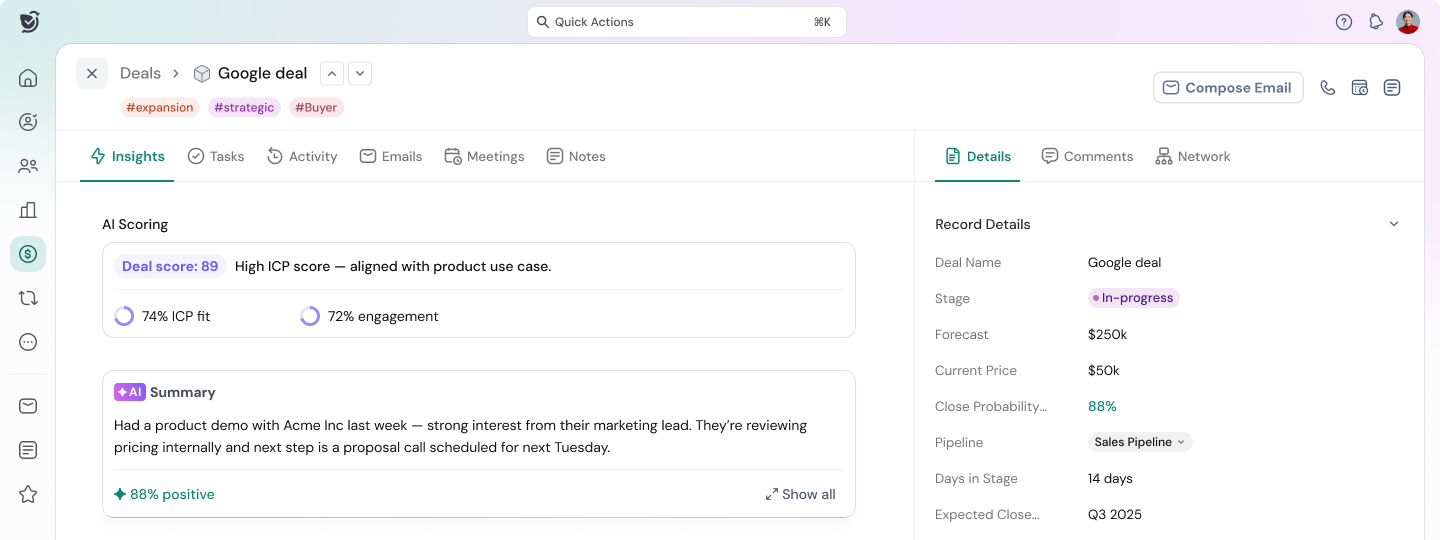
Paired with Best Contact Time, which uses past engagement patterns, response timing, channel preferences, and time zone data to recommend the ideal day, time, and channel for outreach, reps can reach the right contact at the right moment rather than guessing.
AI-recommended next actions
One of the most common causes of CRM experience failure is that reps do not know what to do next, so they do nothing. AI-recommended Next Actions resolve this by generating a focused to-do list for each contact and deal based on engagement signals, deal stage, and recent activity. Reps do not need to review an entire record history; the system tells them what to do, and they mark it done as they go.

Competitor mention detection
When a prospect mentions a competitor in an email, call, or meeting, that signal is easy to miss in the noise of a busy pipeline. The Competitor Mentions feature scans every communication automatically and surfaces the competitor name, where and when it was mentioned, and the exact quoted snippet. This gives reps the intelligence they need to reposition before competitive pressure shifts the deal.
Deal intelligence and loss analysis
The Deal Score tracks opportunity health based on activity patterns, engagement levels, deal movement, and risk signals, and shows not just the current score but the reasons behind any change.
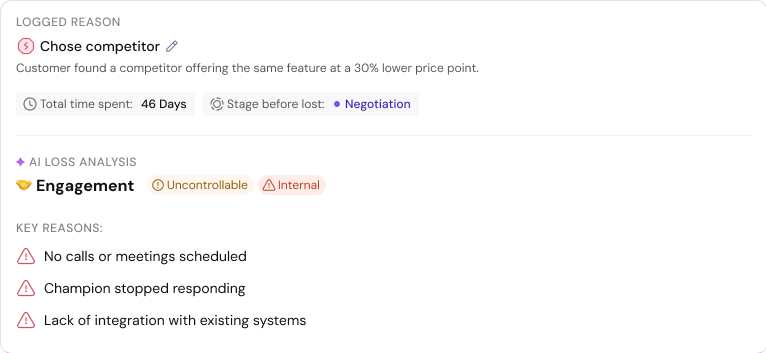
When a deal moves to lost, AI performs a structured analysis: it compares the rep's stated reason for the loss against the actual evidence from emails, meeting transcripts, and call recordings, identifies the real cause of friction, surfaces customer quotes that confirm the analysis, and provides takeaways that can prevent similar losses on future deals.
Buying committee mapping
Complex B2B deals involve multiple stakeholders, and single-threaded deals where only one contact is engaged are one of the most common reasons deals stall or are lost.
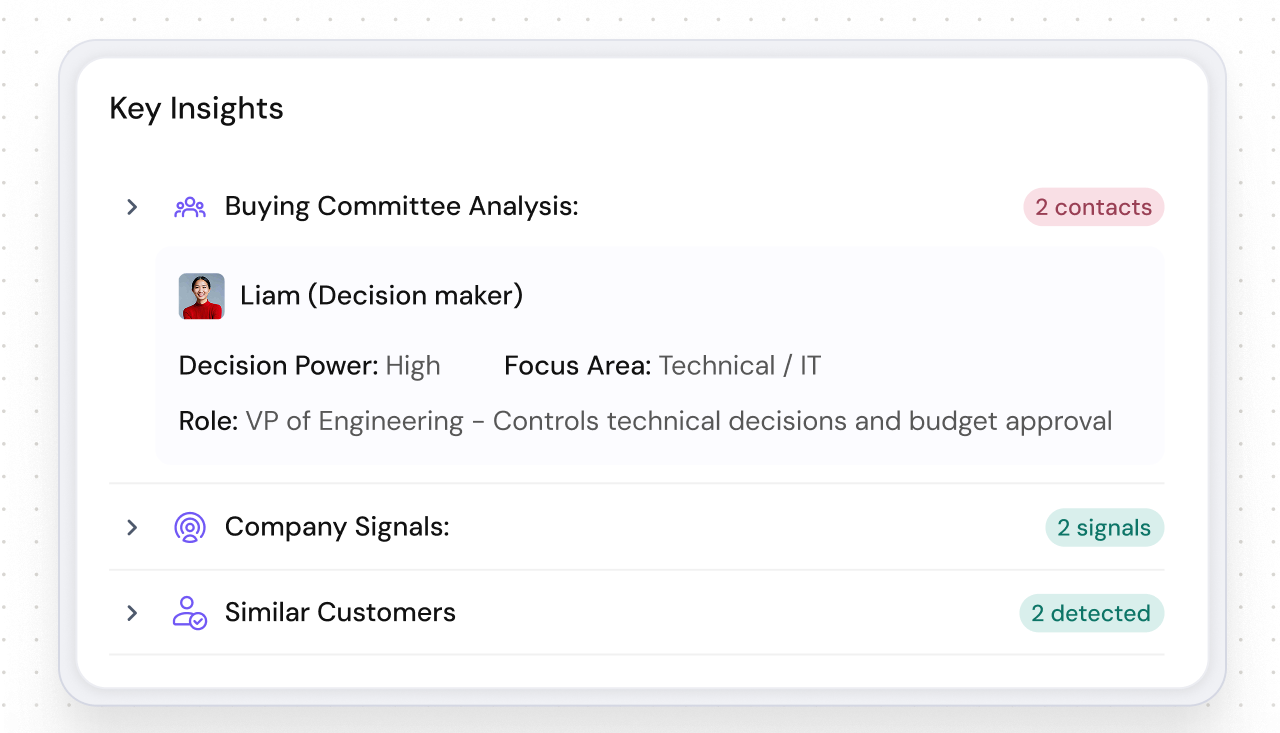
Buying Committee Analysis maps every contact associated with a company into clear decision roles: Decision Maker, Influencer, Champion, Economic Buyer, Technical Evaluator, Gatekeeper, and more. Each contact is assigned a decision-making power level (High, Mid, Low) and a primary focus area (Legal, Technical, Finance, Operations). This helps reps see immediately where gaps exist and who else should be engaged.
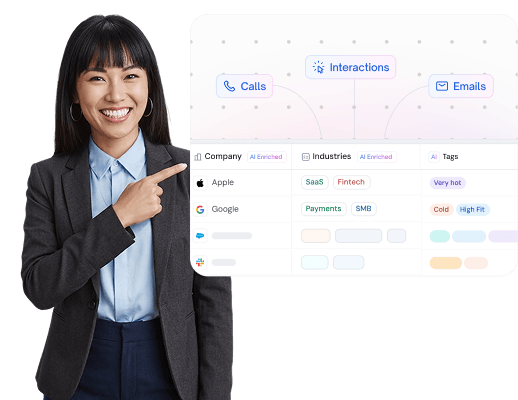
AI-nati CRM built for modern sales teams
9 ways to improve the customer experience with CRM
Improving CRM experience is not a single project; it is an ongoing practice across data quality, workflow design, team adoption, and technology. The nine approaches below address the most impactful levers, from immediate quick wins to structural improvements that compound over time.
1. Audit and fix your data quality first
No improvement to the CRM experience is sustainable if the underlying data is incomplete, duplicated, or stale. Start with a data quality audit: identify which fields are systematically empty, where duplicates exist, and which records have not been updated in more than 60 days. Set data completeness targets, above 90% for contact fields that drive segmentation and outreach, and use automation to flag records that fall below the threshold rather than relying on manual review.
Data quality is the foundation that makes every other CRM improvement reliable. Personalisation, AI scoring, and automated follow-ups all produce poor outputs when the input data is of low quality.
2. Redesign workflows around how reps actually sell
The most common reason reps work around the CRM rather than inside it is that the system was configured for how management wants to report, not for how reps actually move deals. Map your real sales process before configuring pipeline stages, required fields, and automation triggers. If a stage is required by the system but does not correspond to a genuine step in the buyer's journey, remove it.
Involve two to three high-performing reps in the workflow design process. Their adoption will pull the rest of the team along, and their input will surface the friction points that are invisible to managers and ops teams.
3. Automate follow-ups and task creation
Manual follow-up is the single largest source of wasted rep time and dropped deals. Set up automation to trigger follow-up emails when a prospect visits a pricing page or demo page, create a task when an email has gone unanswered for more than three days, enrol new leads in a nurture sequence within minutes of entering the CRM, and notify reps when a high-intent contact goes quiet after previously active engagement.
Automation does not replace the personal element of sales; it protects it. Reps who are not manually chasing tasks have more time for the conversations that actually require human judgment.
4. Personalise every customer touchpoint using CRM data
Personalisation is not about using someone's first name in an email subject line. It means using the full context the CRM holds, company size, industry, recent activity, buying signals, past interactions, and stated pain points, to make every communication relevant to where that specific buyer is in their journey.
This applies to outbound sequences, renewal conversations, upsell proposals, and support escalations equally. A customer who receives a renewal call that references specific milestones from their onboarding, addresses a concern they raised in month two, and proposes an expansion that maps to their stated goals is experiencing the result of excellent CRM data hygiene and intelligent use of that data.
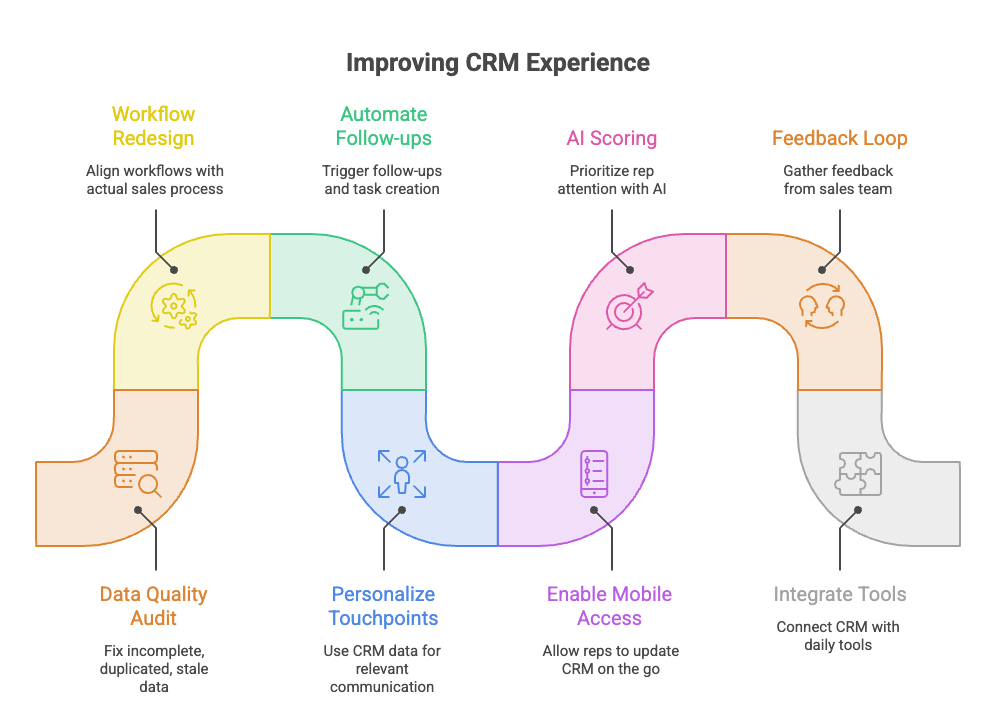
5. Enable mobile CRM access for field and remote teams
Data quality deteriorates when reps have to wait until they are back at their desks to log activity. A rep who takes a meeting note on a notepad and transcribes it later will produce less accurate, less detailed records than one who updates the CRM immediately after the conversation ends.
Mobile CRM access, with full pipeline visibility, contact history, note-taking, and task management, removes the gap between the field activity and the system of record. For teams where reps travel to client sites or attend conferences, mobile access is not a convenience feature. It is a data quality tool.
6. Use AI scoring to prioritise rep attention
A pipeline with 150 open deals does not mean a rep has 150 things to work on equally. AI scoring covering ICP fit, buying intent, engagement score, and deal health gives reps a clear prioritisation framework. High-fit, high-intent, actively engaged contacts should receive the most time, creative effort, and senior involvement. Low-fit, low-intent contacts should receive automated touchpoints until their score changes.
This improves CRM experience for both reps (less time deciding who to call next) and customers (higher-fit prospects receive more relevant, timely attention rather than generic mass sequences).
7. Build a CRM feedback loop with your sales team
The CRM experience will degrade over time without a structured feedback mechanism. Conduct brief quarterly reviews with reps, not to discuss pipeline performance, but to identify specific friction points in the CRM itself. What fields do they skip and why? What information do they wish the system surfaced? Which automations are helping and which are creating noise?
This feedback loop does two things: it surfaces actionable improvements that ops and admin teams can act on, and it reinforces with reps that the system is being built for them, not just for management reporting. Reps who feel their CRM feedback is heard are more likely to use the system consistently.
8. Integrate CRM with the tools reps use daily
CRM experience breaks down when reps have to context-switch between systems to complete a single task. If a rep needs to open Gmail to send an email, then open the CRM to log it, then open a calendar to schedule the follow-up, then open a spreadsheet to track the outcome, the system has failed the experience test.
Native integrations with email platforms, calendars, communication tools, and enrichment providers remove these context switches. Two-way email sync means every email sent and received is captured automatically. Calendar sync means every meeting is logged with the right contact and deal. This reduces the manual logging burden on reps and increases data completeness simultaneously.
9. Tie CRM adoption to visible revenue outcomes
The most durable improvement to CRM experience is cultural: making the connection between consistent CRM use and personal revenue performance visible and credible. Reps adopt tools that help them earn more money. When the data shows that reps who maintain complete pipeline records close at a higher rate, or that leads contacted within five minutes convert at a multiple of those contacted later, the CRM becomes a competitive advantage rather than a compliance requirement.
Share adoption data and outcome correlations in sales meetings without using it as a disciplinary measure. Recognise reps whose data quality drives accurate forecasting. Surface deal wins that were directly enabled by CRM intelligence, competitor signals caught in time, a renewal saved because a risk factor was flagged early, a deal unstuck because a buying committee gap was identified. These stories change the culture faster than mandates.
Measuring CRM experience
Improving CRM experience without measuring it is guesswork. The metrics below track the health of both the internal experience (how the team uses the system) and the external experience (how customers respond to CRM-driven interactions). Use them to set quarterly baselines, identify regression early, and validate that changes are producing the intended outcomes.
Metric | What to measure | Target benchmark |
CRM adoption rate | Percentage of reps logging activity inside the CRM weekly | Above 85% for healthy adoption |
Data completeness score | Percentage of contact and deal records with required fields filled | Above 90% for reliable forecasting |
Pipeline velocity | How fast do deals move from stage to stage on average | Consistent or improving month over month |
Lead response time | Time between a lead entering the CRM and the first outreach | Under 5 minutes for inbound leads |
Follow-up completion rate | Percentage of AI-recommended or scheduled tasks completed on time | Above 80% to protect deal momentum |
Customer satisfaction (CSAT) | Post-interaction survey scores tied to CRM-driven touchpoints | Above 80 CSAT for CRM-influenced journeys |
Deal loss rate by stage | Where deals are most commonly lost in the pipeline | Declining trend quarter over quarter |
Forecast accuracy | Predicted revenue vs. actual closed revenue per period | Within 10–15% variance |
Measure these metrics monthly, not just at quarterly reviews. Adoption rate and data completeness in particular can deteriorate quickly when a new rep joins, a workflow changes, or the team faces a high-pressure period. Early detection allows for targeted intervention rather than wholesale retraining.
Final thoughts
CRM experience is not a one-time implementation decision. It is the cumulative result of every workflow configuration, data quality practice, automation trigger, and adoption habit your team builds over time.
The businesses that get the most from their CRM are not the ones with the most features switched on. They are the ones who have aligned the system to how their team actually sells, maintained the data quality that makes AI and personalisation reliable, and built a culture where the CRM is seen as a selling tool rather than a tracking tool.
The shift from reactive record-keeping to proactive, AI-driven selling is already underway. The teams that invest in CRM experience now, not just CRM software, are the ones building a compound advantage in pipeline velocity, customer retention, and forecast accuracy that will be difficult for competitors to close.