AI & AUTOMATION
10 AI-powered CRM features your sales team actually needs (2026 guide)

By Ganesh Ravi Shankar
Last updated on Jun 3, 2026
Discover how AI-powered CRM features help your reps prioritize the right leads, spot deal risks early, and close more deals automatically.

Sales reps today spend less than 30% of their time actually selling. The rest is consumed by manual data entry, chasing status updates, and determining which lead to call next. That is the problem AI-powered CRM features were built to solve.
AI is no longer a premium add-on reserved for enterprise sales teams. Modern CRMs are embedding intelligence directly into the workflows where reps already work, in contact records, deal pipelines, and meeting summaries. The result is a system that does not just store information, but tells you what to do with it.
This guide breaks down the 10 most impactful AI-powered CRM features, explains how each one works, and shows what to look for when evaluating a platform. If you are new to CRM fundamentals, start with our CRM software guide before diving in.
What is an AI-powered CRM?
A traditional CRM is a database. It stores contact information, tracks deal stages, and logs activity, but it does not tell you what any of that data means. An AI-powered CRM goes further by analyzing the data it collects and turning it into decisions, predictions, and recommendations. For a full breakdown of how CRMs work, see what is CRM software.
Rather than asking a rep to review 200 contacts and decide who to prioritize, an agentic CRM scores each one based on engagement history, buying signals, and ICP match. Rather than waiting for a manager to spot a stalled deal, the system flags it proactively
According to Salesforce's State of Sales research, high-performing sales teams are 2.8x more likely to use AI in their CRM workflows than under performers. The technology has moved from experimental to essential — and understanding which features actually drive results is now a critical evaluation skill for any sales leader.
Difference between traditional CRM and AI-powered CRM
Capability | Traditional CRM | AI-Powered CRM |
Lead Prioritization | Manual sorting by rep | Automated scoring based on ICP fit, engagement, and buying intent |
Follow-Up Timing | Rep judgment or fixed schedule | AI recommends the best contact time per channel based on response history |
Deal Risk Detection | Manager review in pipeline meetings | Real-time risk flags: single-threaded, low engagement, competitor mentioned |
Meeting Follow-Up | Rep writes notes manually post-call | AI generates a summary, highlights pain points, and suggests next actions |
Competitive Intelligence | Rep recalls if mentioned in conversation | System auto-detects competitor mentions in emails, calls, and transcripts |
Win/Loss Analysis | Rep-reported reason at deal close | AI pinpoints the loss reason from transcript excerpts, email threads, and the deal timeline |
10 key AI-powered CRM features
Not all AI CRM features are created equal. Some are cosmetic — a generative AI button that drafts a templated email. Others are deeply operational and change how a rep manages their entire day. The features below are the ones that move the needle.
1. AI lead scoring (ICP fit score)
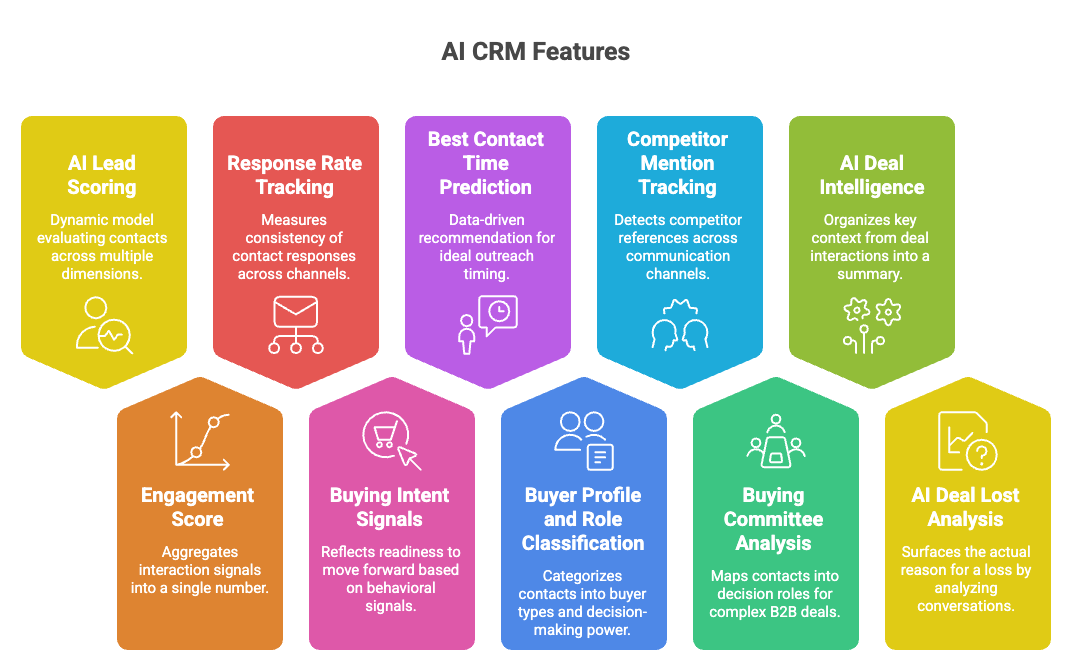
Lead scoring tells you how likely a contact is to convert, but traditional scoring models rely on manually defined rules that quickly become outdated. AI lead scoring replaces static rules with a dynamic model that evaluates each contact across multiple dimensions simultaneously.
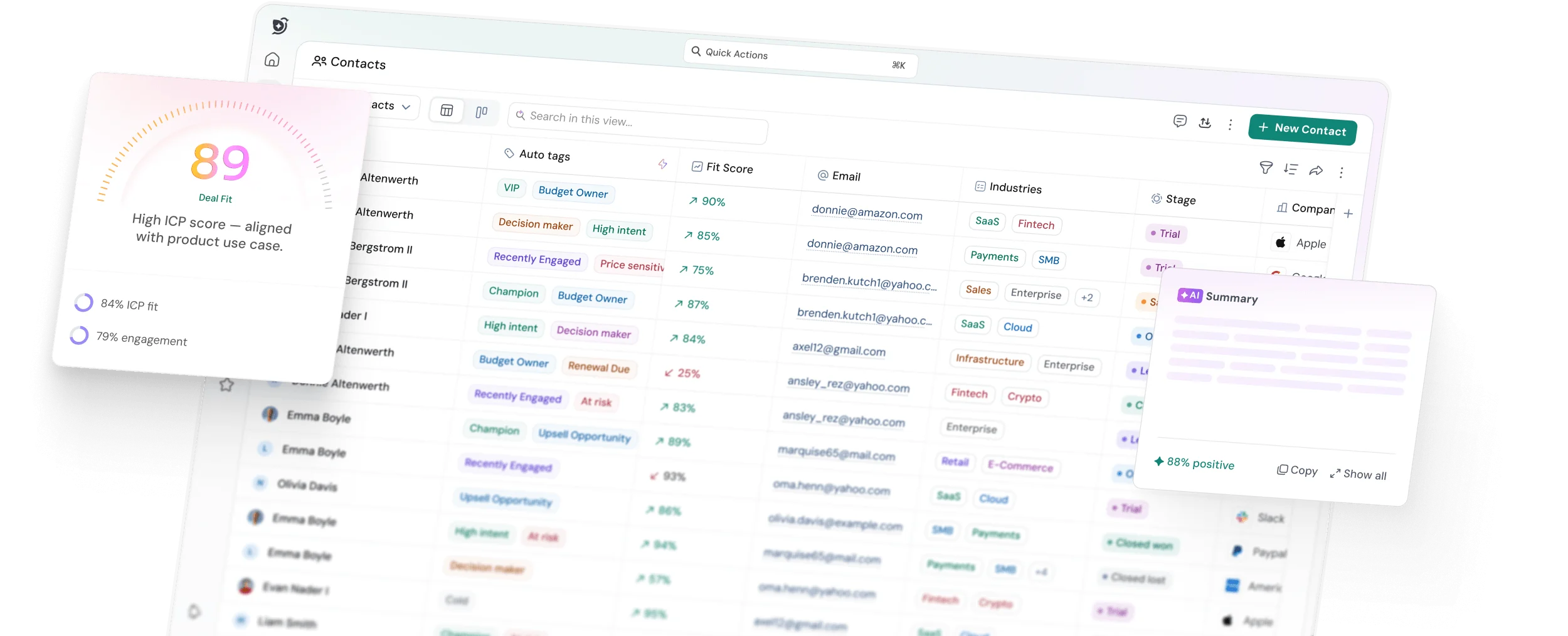
A well-built ICP Fit Score measures how closely a contact or company matches your Ideal Customer Profile. It evaluates factors like industry, company size, revenue, seniority level, and geography. The score is displayed as a percentage (0–100) with a label such as High, Medium, or Low fit, giving reps an instant read on whether a prospect is worth pursuing.
The key differentiator is adaptability. When your ICP criteria change, the scores update automatically across every contact record in your CRM without any manual re-scoring.
2. Engagement score
Knowing that a contact opened an email is useful. Knowing that they have attended three meetings, responded to 70% of your messages, and visited your pricing page twice this week is transformative. An engagement score aggregates these signals into a single number.
The score considers interactions across emails, calls, meetings, website activity, deal movement, and other touchpoints. It appears on a 0–100 scale with color coding so reps can instantly distinguish a warm, active account from a cold or at-risk one, without reviewing individual activity logs.
This feature is particularly valuable for sales managers reviewing pipeline health at scale. Instead of opening every deal record, they can scan engagement scores to identify which accounts need attention.
3. Response rate tracking
Response rate measures how consistently a contact responds to outreach across all channels, email reply rate, call answer rate, and meeting attendance rate. Each channel is normalized and equally weighted to produce a single percentage score.
On hover, reps can see the channel-wise breakdown, so they know whether a contact is strong on email but avoids calls, or attends meetings but never responds to written outreach. If a channel has no interaction data, the weight is redistributed automatically so the score remains accurate.
This helps reps stop wasting cycles on the wrong channel. If a decision-maker has a 10% email response rate but answers 80% of calls, the AI is telling you something important about how to reach them.
4. Buying intent signals
Buying intent is one of the most powerful and most underutilized signals in B2B sales. It reflects how ready a contact is to move forward, based on behavioral signals across the entire relationship.
A strong AI CRM captures intent signals from emails (pricing inquiries, product questions), calls, and meeting transcripts (demo requests, timeline discussions), deal movement (stage advancement, stakeholder involvement), and website activity (pricing page visits, feature page views). The system calculates an overall intent score from 0–100% with a label of High, Medium, or Low.
More importantly, reps can see the specific signals driving the score. If a contact asked about integrations twice in the past two weeks and forwarded a proposal to their CTO, those signals surface explicitly, so the rep understands why intent is high, not just that it is.
5. Best contact time prediction
Sales reps often reach out at the wrong time simply because they do not have visibility into when a contact is most likely to respond. Best Contact Time prediction solves this with a data-driven recommendation for the ideal day, time range, and channel for each contact.
The recommendation is built from past engagement patterns, response timing, meeting attendance history, channel preference, time zone, and recent activity. It also accounts for contextual factors like public holidays and typical working hours in the contact's region.
For sales teams working across multiple time zones, a common reality for US-based SaaS companies targeting enterprise accounts, this feature alone can meaningfully improve connection rates. IBM's research on AI in CRM highlights optimal outreach timing as one of the highest-ROI applications of AI in sales workflows.
6. Buyer profile and role classification
B2B deals rarely involve a single decision-maker. Understanding who holds budget authority, who influences the decision, and who can block a deal is a core skill in enterprise sales, but most CRMs offer no structured way to capture this.
A buyer profile feature categorizes each contact into a buyer type: Decision Maker, Influencer, Champion, Economic Buyer, Technical Evaluator, Blocker, End User, or Observer. Each contact is also assigned a decision-making power status and a primary focus area such as Legal, Finance, Technical, or Operations.
This gives reps a structured view of the buying committee before every sales conversation, so they know whether they are speaking to someone who can approve the purchase or someone who needs to be kept informed.
7. Competitor mention tracking
When a prospect mentions a competitor, that conversation is critical intelligence. But when it happens in an email thread or a call transcript that only the rep sees, it often never reaches the broader team.
Competitor mention tracking automatically detects when a contact references a competing product across emails, meeting conversations, and call transcripts. The system shows the competitor's name, the channel and date of the mention, and the exact quoted snippet for context.
This allows sales teams to understand competitive pressure early and adjust positioning before it influences the deal outcome. When combined with AI-generated recommendations for handling objections, it becomes a real-time competitive coaching tool embedded directly in the contact record.
8. Buying committee analysis
For complex B2B deals, knowing who is in the room is as important as knowing what the room wants. Buying committee analysis maps all contacts associated with a deal or company into clear decision roles, grouped by buyer type, decision-making power level, and focus area.
This feature helps reps identify gaps in stakeholder coverage, for example, if no contact with the budget authority has been engaged, or if the Legal team has not been looped in despite a compliance requirement surfacing in conversations. According to Gartner's CRM research, deals with three or more engaged stakeholders close at significantly higher rates than single-threaded opportunities.
The analysis surfaces automatically from meeting participation, job titles, and interaction patterns — so reps do not need to manually tag and classify every contact.
9. AI deal intelligence and deal score
Deal score reflects the current strength of an opportunity based on activity patterns, engagement levels, deal stage movement, and risk signals. When the score changes up or down, the system explains why: which signals contributed to the shift and what changed since the last update. For a deeper look at how pipeline management works, see our guide on AI pipeline management.
Beyond the score itself, AI deal intelligence organizes key context from all deal-related interactions into a structured summary: the prospect's stated pain points, their requirements, the solution they are currently using, and the blockers that could prevent the deal from closing. This gives reps and managers a coherent picture of deal health without reading through every email and call transcript individually.
For pipeline reviews, this means managers spend less time asking 'where does this deal stand?' and more time working on how to advance it.
10. AI deal lost analysis
Most CRM systems record why a deal was lost, but only what the rep chose to enter. That is rarely the full picture. AI deal lost analysis goes deeper, surfacing the actual reason for a loss by analyzing email threads, meeting transcripts, call recordings, and deal activity patterns.
When a deal moves to a lost stage, the AI generates a structured analysis covering: the rep-logged reason, the AI-identified actual reason (which may differ), takeaways for handling similar deals in the future, a deal health timeline showing how engagement and scores shifted week by week, and direct excerpts from customer conversations that illustrate where the deal broke down. CallMiner's research on AI-enhanced CRM found that teams using conversation intelligence for deal loss analysis reduced avoidable churn by identifying repeatable objection patterns across their pipeline.
This is the feature that separates learning organizations from those that repeat the same mistakes. When reps can read the actual customer quote that signaled the deal was at risk three weeks before it was lost, the lessons stick in a way that a loss code in a dropdown never could.
Every AI-powered CRM feature your team needs natively inside SparrowCRM.
Benefits of AI CRM for sales teams
The operational benefits of AI-powered CRM features compound over time. Individual features save hours per week. Together, they change how a sales team operates.
- Faster lead prioritization: AI scoring eliminates the time reps spend manually assessing which contacts to work. High-fit, high-intent accounts surface automatically.
- Higher contact rates: Best contact time predictions mean reps reach out when prospects are most likely to respond, not according to a fixed cadence.
- Earlier deal risk detection: Deal scores and risk factor alerts let managers intervene before a deal is lost, not after the rep has already moved on.
- Better competitive positioning: Real-time competitor mention tracking means the sales team never misses a competitive conversation, regardless of where it happened.
- Stronger pipeline reviews: Deal summaries and buying committee analysis give managers the full picture in seconds, not after 10 minutes of questions.
- Institutional learning from losses: Deal lost analysis converts every closed-lost opportunity into a structured coaching resource for the team.
According to McKinsey's research on AI in sales, organizations that embed AI into their commercial workflows see 10–15% improvements in sales productivity and 20% reductions in customer acquisition cost over time. The efficiency gains are real — but they require the right features, not just any AI label on a product page.
What to look for when evaluating an AI CRM
Not every CRM that uses the word 'AI' on its product page delivers meaningful intelligence. Here is a five-point framework for evaluating AI CRM features before committing to a platform.
- Native AI vs. bolt-on integrations: AI that is built into the CRM data model produces better results than a third-party integration layered on top. Native AI reads from all deal, contact, company, and activity data simultaneously; bolt-on tools only see what you export to them.
- ICP customization: A lead scoring model built on someone else's ICP definition is not your lead scoring model. Look for platforms that let you define and update ICP criteria using your own CRM fields.
- Signal transparency: Avoid black-box AI scores. The best systems show you the signals driving a score, so reps understand why a contact is rated High Intent, not just that it is.
- Deal-level intelligence depth: Surface-level automation (email templates, chatbots) is table stakes. Look for deal scoring, buying committee analysis, risk detection, and post-loss analysis to evaluate real AI depth.
- Ease of adoption for SMB teams: Enterprise AI tools often require dedicated admins and weeks of configuration. For SMB and midmarket sales teams, look for AI features that activate on existing data without setup overhead.
For a detailed breakdown of how to automate your sales process once a CRM is in place, see our guide on CRM sales automation. iTransition's analysis of AI use cases in CRM is also a useful reference for understanding how different industries are applying these features in practice.
Platforms like SparrowCRM are built specifically for SMB and midmarket sales teams that need enterprise-grade AI without the enterprise implementation burden. AI features activate on your existing contact, deal, and communication data no configuration required.
How SparrowCRM brings these AI features together
SparrowCRM is an AI-powered CRM built for modern sales teams at SMB and midmarket companies. Rather than adding AI as a layer on top of a legacy database, SparrowCRM embeds intelligence directly into every object in the system: contacts, companies, and deals.
Every contact record includes an AI scoring widget showing ICP fit percentage, engagement score, response rate, and buying intent signal with the specific drivers behind each score. Reps see not just a number but the exact signals of a pricing inquiry last week, three consecutive meeting attendances, and a competitor mentioned in a call transcript that explain the score.
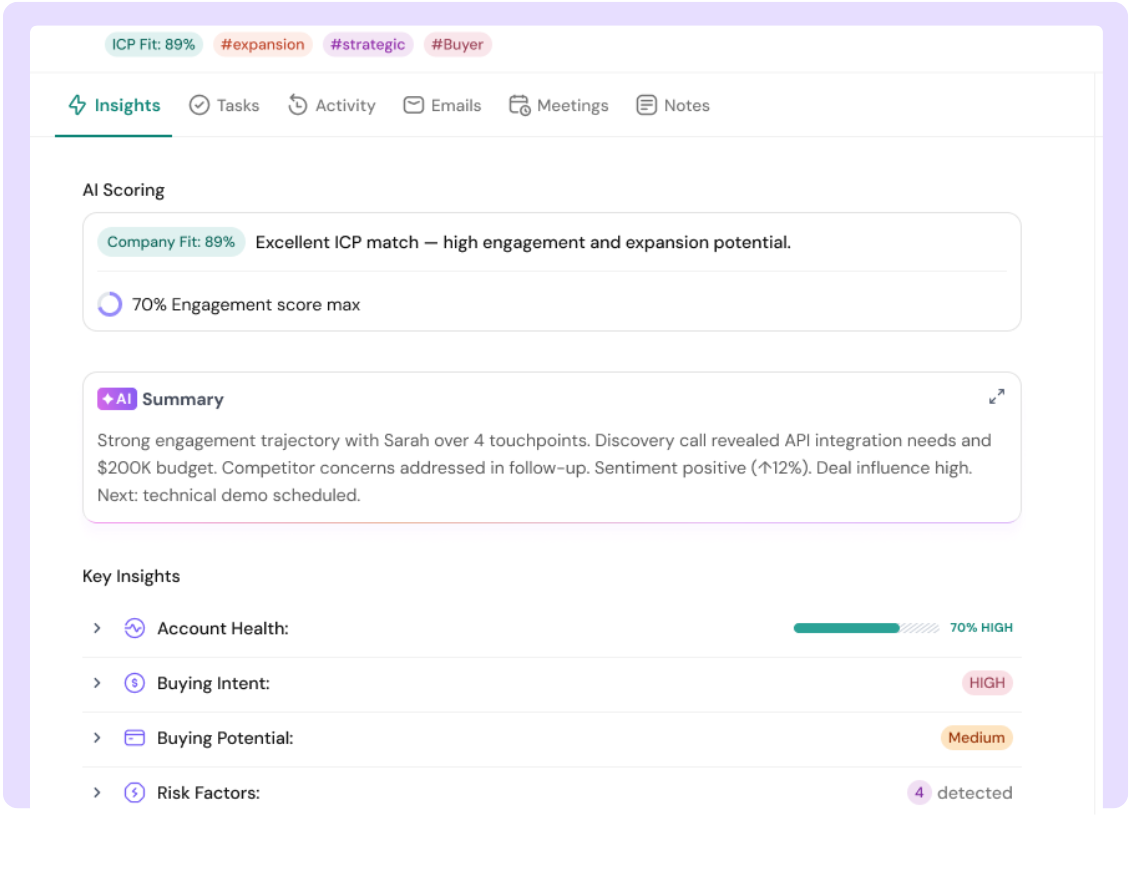
At the deal level, SparrowCRM's AI Scores widget combines deal health, company fit, and engagement data into a single view. The Deal Summary organizes context from all deal interactions into structured insights on pain points, requirements, blockers, and existing solutions. When a deal is lost, SparrowAI performs a full deal lost analysis: surfacing the real loss reason from transcripts, showing the week-by-week deal health timeline, and extracting the exact customer quotes that marked the inflection point.
For sales teams that need to manage complex multi-stakeholder deals, the Buying Committee Analysis maps every contact into buyer type, decision-making power level, and focus area, making it possible to identify coverage gaps before they become close risks. You can also explore how call intelligence feeds into these AI features by surfacing deal-critical signals directly from meeting and call transcripts.
Final thoughts
AI-powered CRM features are not a future capability, they are a present competitive advantage. Sales teams that use AI to prioritize leads, detect deal risk, and understand their buying committees are closing deals faster and losing fewer opportunities to inaction or poor timing.
The features that matter most are not the flashiest ones. AI lead scoring, buying intent signals, best contact time prediction, buying committee analysis, and deal lost analysis are the capabilities that change how a rep manages their day and how a manager runs their pipeline.
When evaluating platforms, go beyond the AI branding and ask whether the intelligence is native, transparent, and calibrated to your ICP. Those three questions will separate the tools that actually help from the ones that add complexity without output.