AI & AUTOMATION
AI sales agents: Types, how they work & best patforms (2026)

By Geethapriya
Last updated on Aug 3, 2026
Discover how AI sales agents handle prospecting, follow-up, and pipeline monitoring, so your reps can focus entirely on deal closing

- What is an AI sales agent?
- Types of AI sales agents
- Top AI sales agent platforms compared (2026)
- Best AI sales agent tools in 2026
- How do AI sales agents work?
- Key capabilities of AI sales agents
- Key benefits of AI sales agents for sales teams
- Real-world result: how EAB increased demo requests by 120% with a conversational AI agent
- How to choose the right AI sales agent for your team
- Challenges of implementing AI sales agents (and how to avoid them)
- Final thoughts
Sales reps spend a significant portion of their day on administrative tasks instead of selling. AI sales agents change that by understanding deal context, deciding the next best action, and automating routine work like follow-ups, record updates, and scheduling. In this guide, you'll learn what AI sales agents are, how they work, the different types available, and how to choose the right one for your sales team.
Key takeaways
- AI sales agents are autonomous systems that initiate action based on live deal context; they are not chatbots or rule-based automations.
- They run a four-step loop: data ingestion → NLP reasoning → autonomous action → continuous learning, across every connected data source.
- CRM-native agents (such as SparrowCRM's agentic layer) outperform API-connected tools in context depth, sync reliability, and adoption speed. Learn more in our agentic CRM guide.
- According to McKinsey, agentic AI delivers 3-15% productivity gains and 20-40% reductions in cost-to-serve for revenue teams.
- AI improves sales productivity by reducing repetitive work, accelerating follow-ups, and helping reps focus on high-value conversations.
What is an AI sales agent?
An AI sales agent is an autonomous agent inside your sales workflow. The defining characteristic is that it does not wait to be told what to do. It continuously monitors signals across your CRM, email, calendar, and call transcripts, identifies what action a deal requires at that moment, and executes it, without a rep initiating the step.
AI sales agent vs. chatbot: what is the difference?
Chatbot | AI Sales Agent | |
Mode | Reactive, responds when triggered | Proactive, initiates action independently |
Logic | Scripted decision trees | ML reasoning from live context |
Scope | Single-channel, single task | Multi-channel, multi-step workflows |
Learning | Static, requires manual updates | Self-optimizing from every interaction |
CRM connection | External or API-based | Can run natively inside the CRM |

Do you think AI agents will become a standard part of sales teams?
Types of AI sales agents
AI sales agents generally fall into two categories based on how much they can act without human involvement:
- Autonomous AI Agents: Work independently by analyzing data and taking actions such as responding to leads, answering questions, and booking meetings without requiring human input.
- Assistive AI Agents: Provide insights, recommendations, or draft actions, but leave the final decision and execution to a sales representative.
Many modern AI-powered CRMs combine both approaches, automating repetitive tasks while keeping strategic decisions in the hands of sales teams.
Top AI sales agent platforms compared (2026)
Platform | Best For | Key Agentic Feature | CRM Native | G2 Rating | Pricing |
SparrowCRM | SMB and midmarket sales teams | AI scoring, buying intent, deal intelligence, risk detection, all inside the CRM | Yes | Free plan available; paid from $14/user/month | |
Artisan (Ava) | High-volume autonomous outbound | Multi-step personalized outbound sequences with autonomous reply handling | No | 4.0/5 (26 reviews) | From $600/month self-serve |
Clay | Prospect enrichment and segmentation | AI-powered data enrichment and personalized message generation at scale | No | 4.7/5 (185 reviews) | From $134/month; Enterprise custom |
11x.ai | Full outbound automation at scale | Fully autonomous SDR with end-to-end campaign execution | No | 4.5/5 (30 reviews) | Custom |
Warmly | Intent-based warm outreach | De-anonymizes website visitors and auto-enrolls them into AI outreach | No | 4.6/5 (208 reviews) | AI Web-Deanonymization starts from $10000/year |
Creatio | No-code agent workflow builders | Build custom multi-step agentic workflows without developer dependency | No | 4.7/5 (348 reviews) | From $40/user/month |
Gong (AI Agents) | Revenue intelligence and coaching | Call analysis, deal inspection, CRM auto-fill from call data | Partial | 4.7/5 (6,500+ reviews) | Custom |
Best AI sales agent tools in 2026
We compared these platforms on CRM depth, pricing transparency, and autonomy level — the three factors that matter most when choosing an AI sales agent for an SMB or mid-market team.
1. SparrowCRM
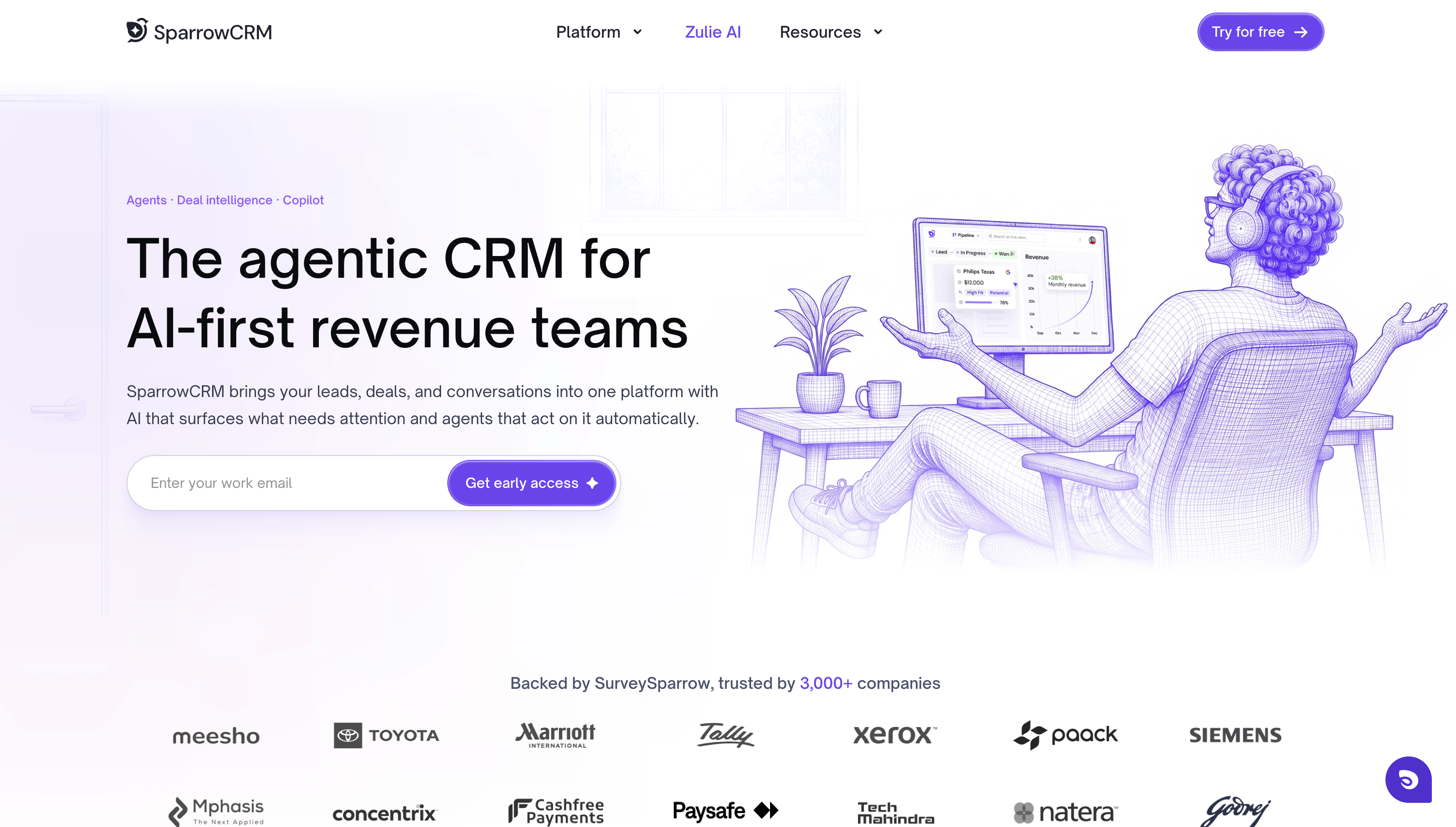
SparrowCRM embeds AI sales agents natively inside the CRM rather than connecting through a separate tool, built for SMB and mid-market teams. Every contact receives an ICP Fit Score and Buying Intent Score automatically, and deal records surface Risk Factors and a live Deal Score the moment a deal shows signs of stalling.
Meeting Intelligence generates AI Next Actions after every call without manual note-taking. Buying Committee Analysis tracks every stakeholder in a deal instead of a single contact.
Pros
- AI embedded natively in the CRM, no separate integration to maintain
- Scoring and risk detection run automatically across every contact and deal
- Buying Committee Analysis tracks multi-stakeholder deals, not just one contact
2. Artisan (Ava)
Source: artisan.co
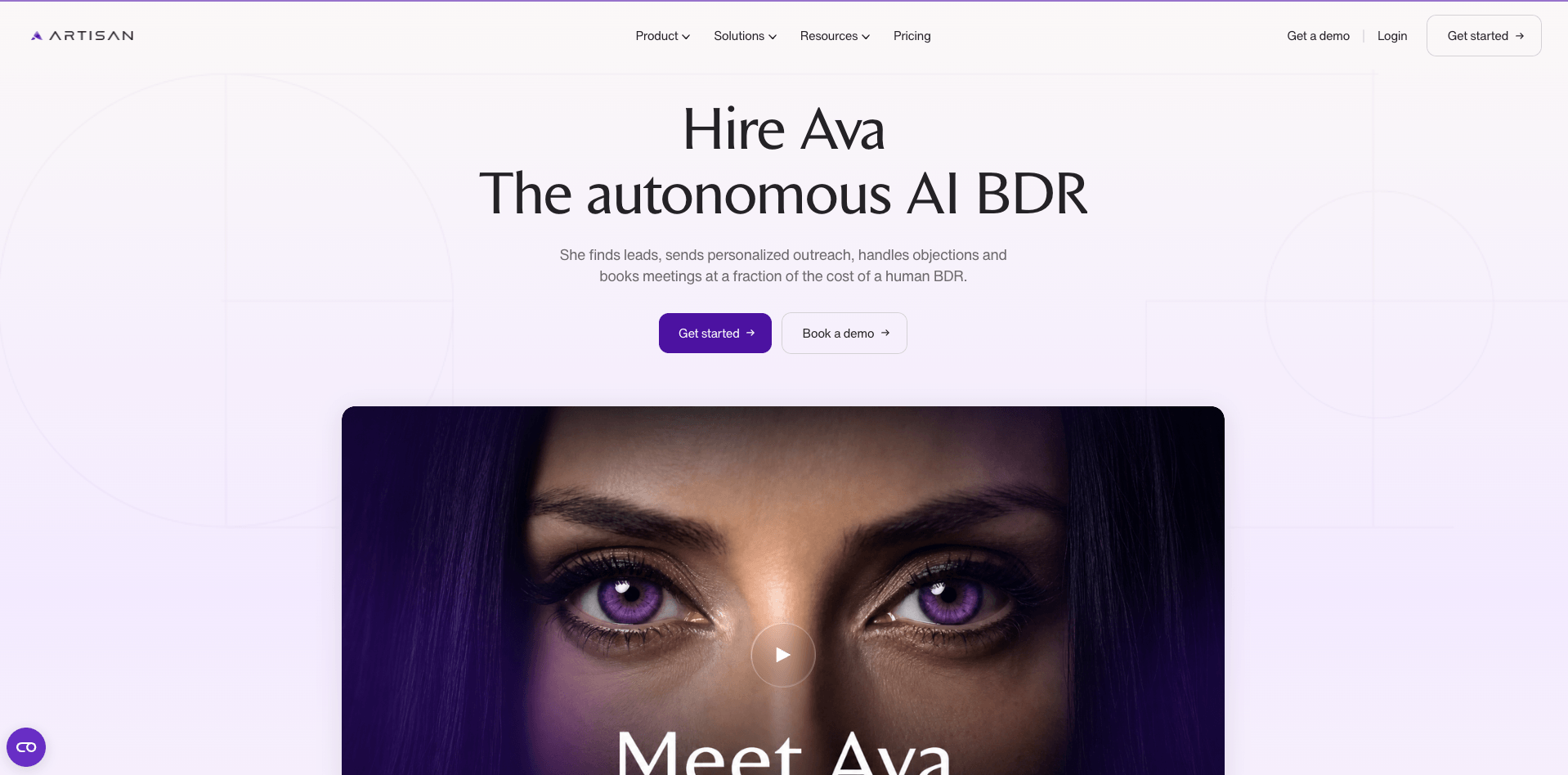
Artisan's Ava is built for high-volume autonomous outbound, positioned as a full digital BDR rather than a single-feature tool. It researches prospects, writes personalized first-touch messages, and manages multi-step follow-up sequences without a rep initiating any step.
Pros
- Handles prospecting, writing, and follow-up end-to-end
- Large built-in contact database
- Accessible entry-level pricing tier
Cons
- Outbound-focused, limited inbound qualification
- No CRM-native data layer, runs as a separate tool
Pricing:
3. Clay
Source: clay.com
Clay focuses on prospect enrichment rather than autonomous outreach, pulling data from over 100 sources to build detailed company and contact profiles. It drafts personalized messages based on that enriched data but leaves the decision of when and how to use it to a human.
Pros
- Enrichment from over 100 data sources
- Strong fit for pre-outreach research and segmentation
- Works alongside most existing sales tech stacks
Cons
- Not an autonomous SDR, requires human decision-making at every step
- Advanced features locked behind enterprise pricing
4. 11x.ai
Source: 11x.ai
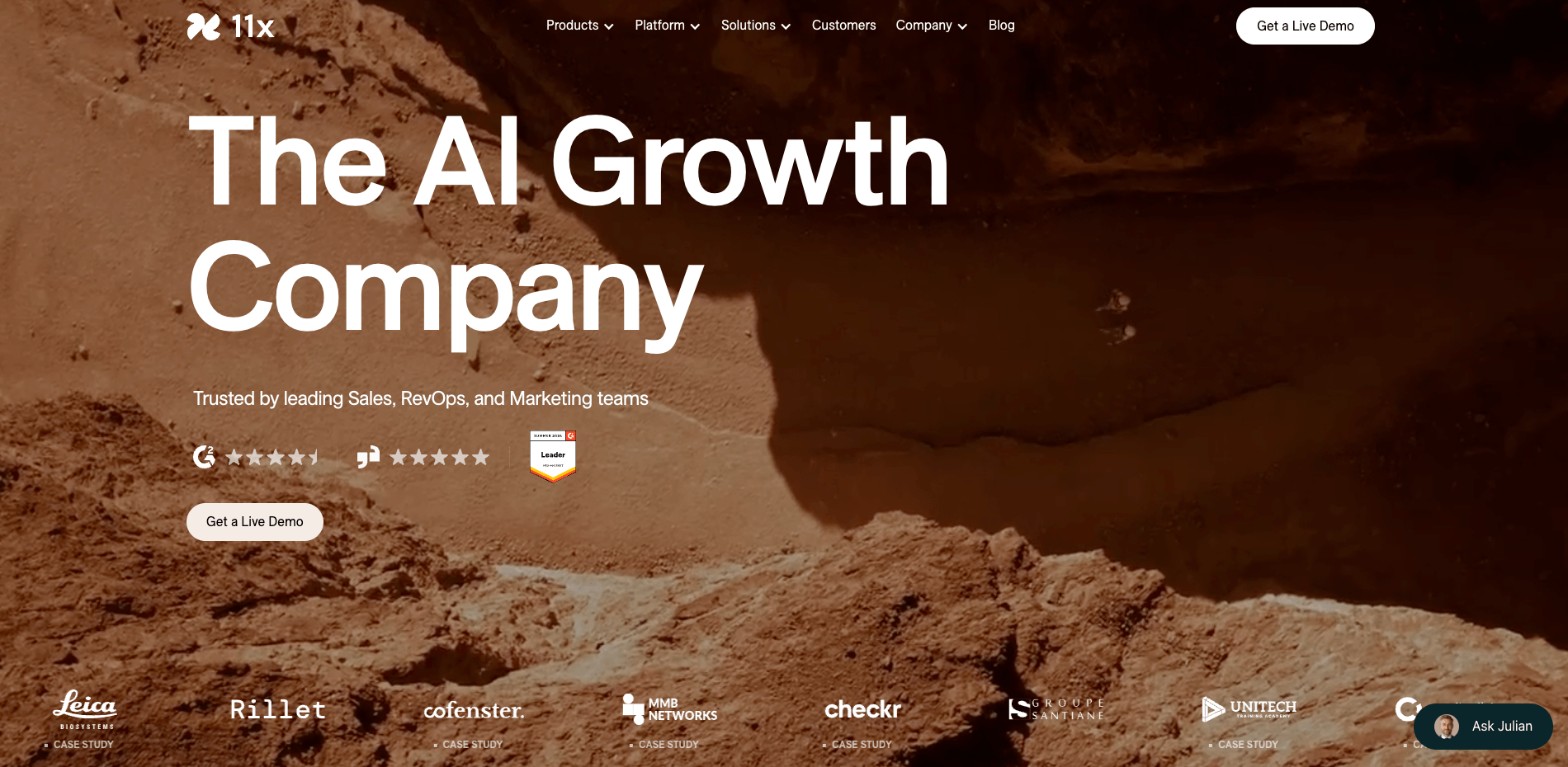
11x.ai is built for enterprise teams running high-volume outbound across email, LinkedIn, and phone against a large, well-defined total addressable market. Its agent handles prospect research, message writing, and meeting booking end-to-end.
Pros
- Full end-to-end outbound automation across three channels
- Voice outreach included via a dedicated calling agent
- Built for scale without adding headcount
Cons
- Premium pricing tier, one of the most expensive tools in this list
- Performance depends heavily on data quality and ICP precision going in
5. Warmly
Source: warmly.ai
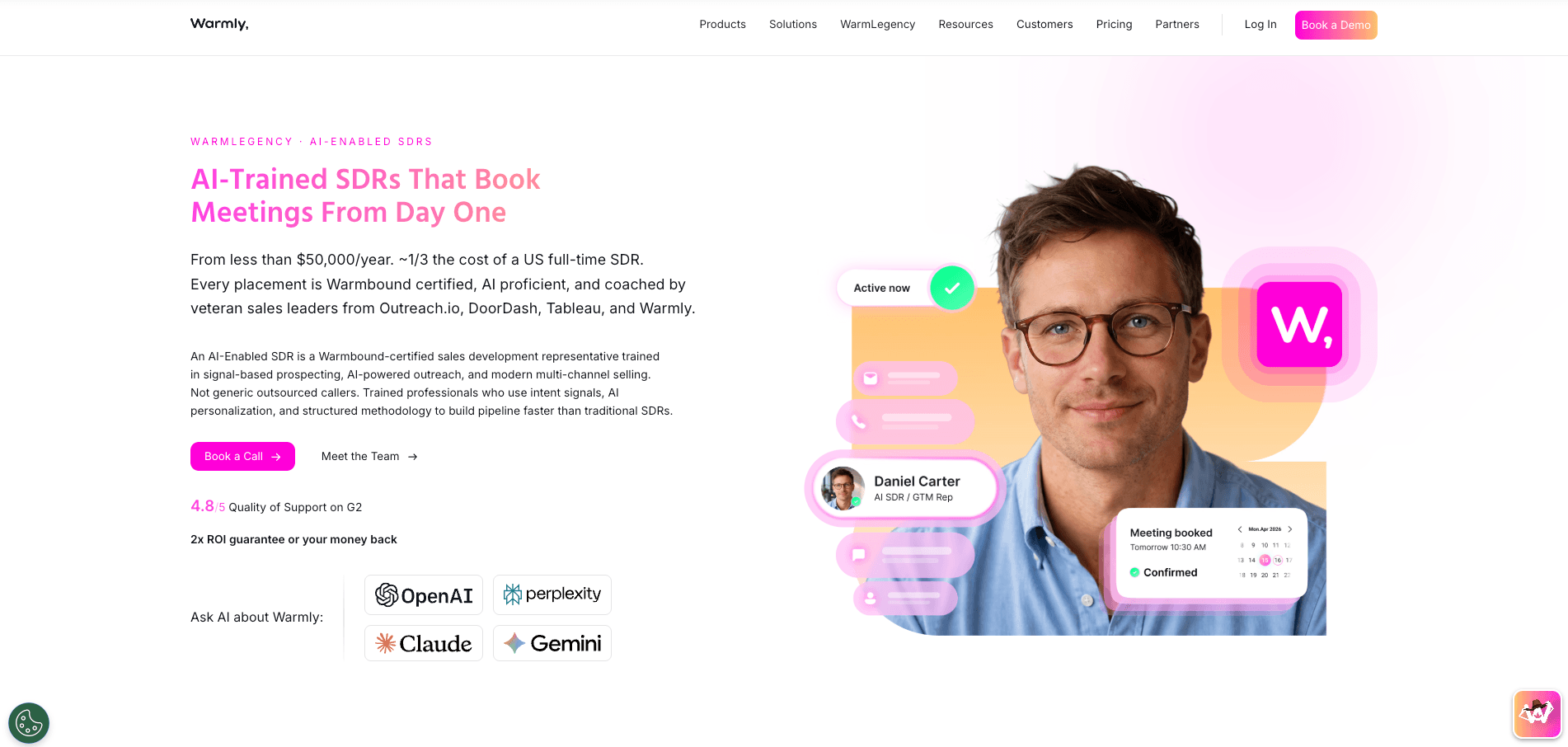
Warmly de-anonymizes anonymous website traffic and automatically enrolls identified visitors into AI-driven outreach sequences. It's built specifically to catch buying intent before a visitor ever fills out a form. This makes it a strong fit for intent-based warm outreach, though it isn't a full-funnel qualification or CRM-native platform on its own.
Pros
- Identifies and engages anonymous website visitors automatically
- Strong for catching intent before a form-fill
- Straightforward setup via webhooks into existing tools
Cons
- Not a CRM-native platform, requires a separate CRM to complete the loop
- Narrower scope than full-funnel outbound or inbound tools
6. Creatio
Source: creatio.com
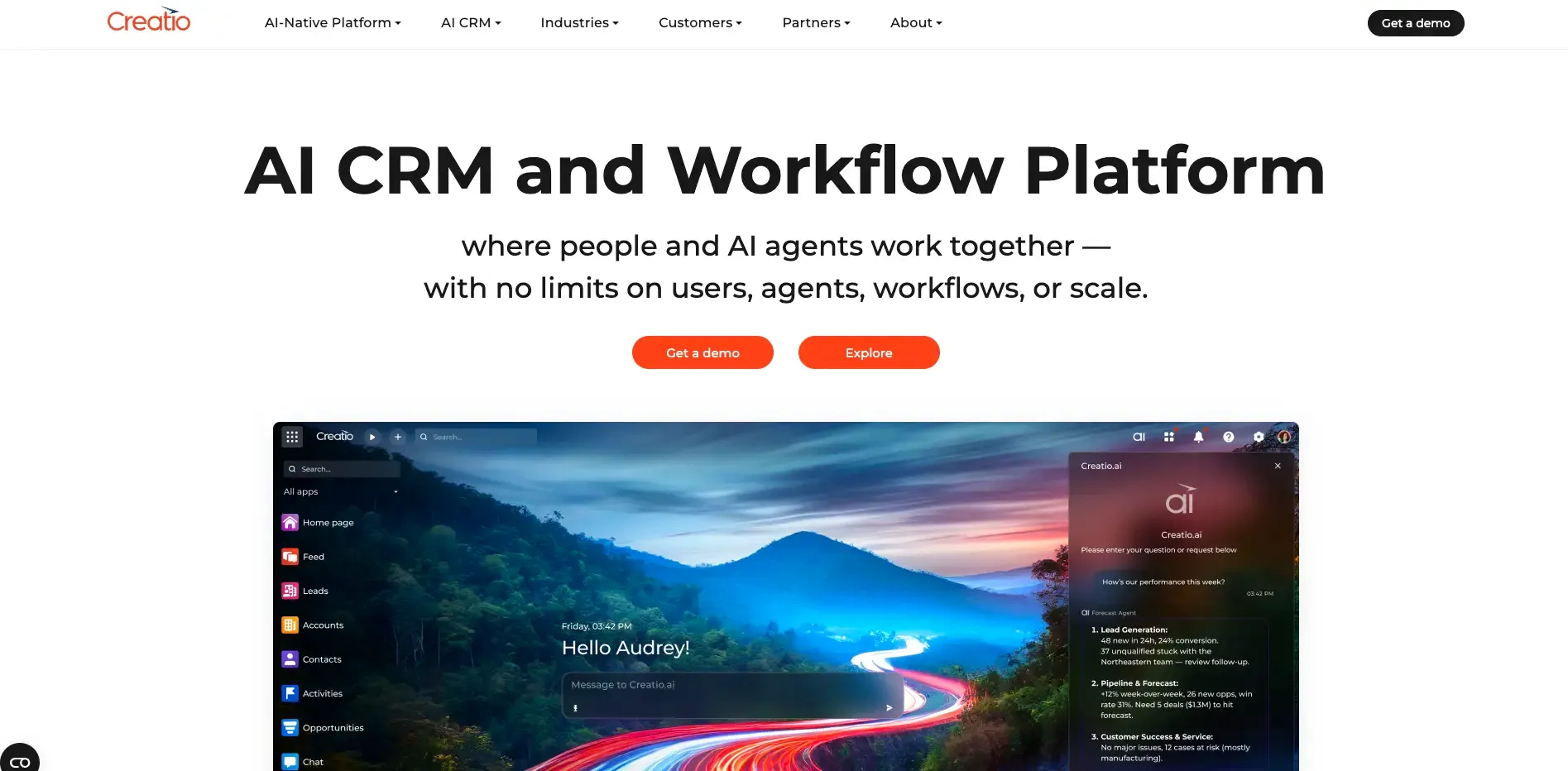
Creatio is built for teams that want to build custom agent workflows without developer resources, using a no-code builder. Pre-built agents cover lead generation, territory assignment, quote generation, and forecasting, and can be extended or combined.
Pros
- No-code builder allows fully custom multi-step agent workflows
- Wide range of pre-built agents across the sales process
- Human-in-the-loop model gives teams control over autonomy level
Cons
- Higher starting cost than most tools in this list
- Steeper setup curve, most value requires active workflow-building
7. Gong (AI Agents)
Source: gong.io
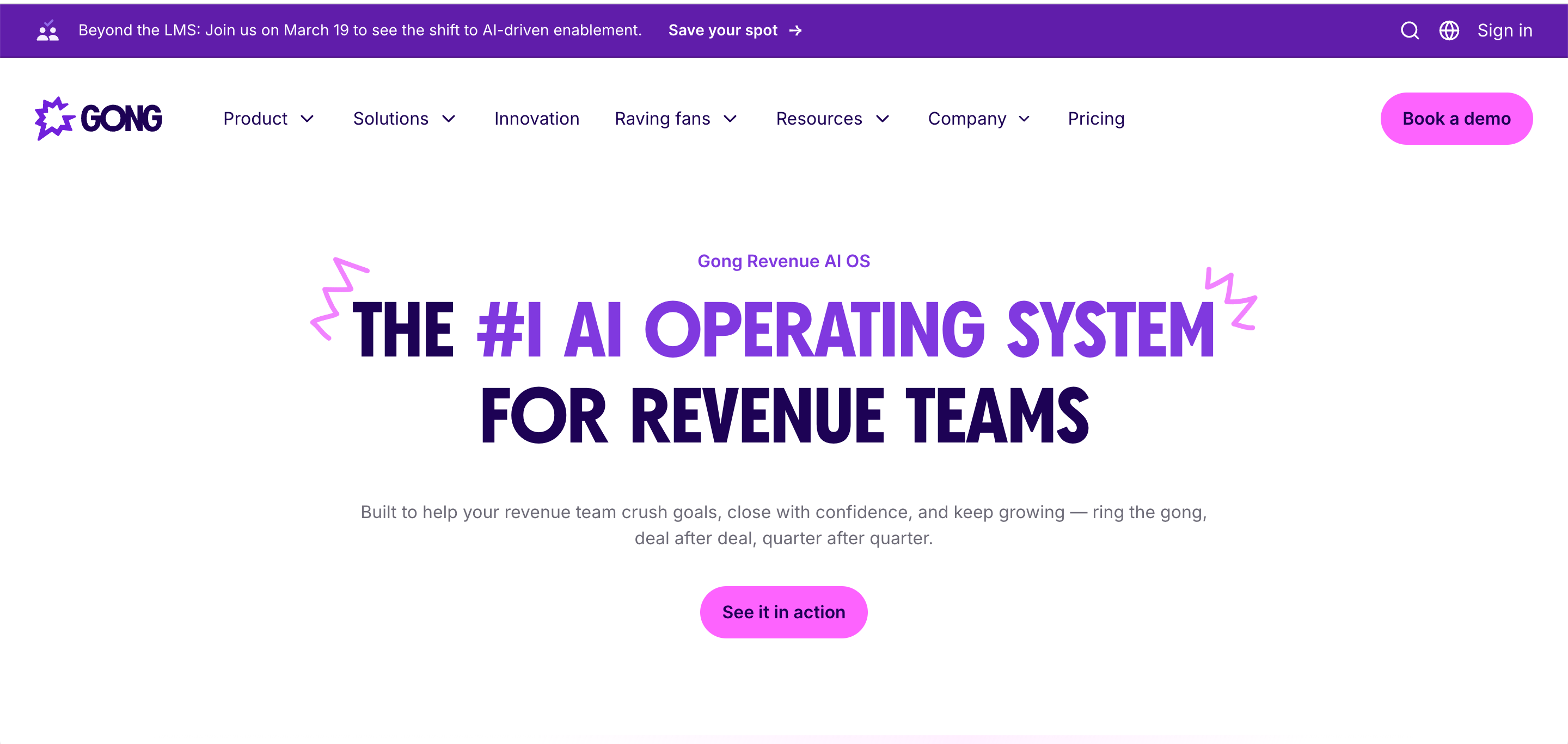
Gong's AI agents focus on call coaching, deal inspection, and forecasting rather than outbound prospecting. They transcribe and analyze calls, auto-fill CRM data from conversations, and flag deal risk based on conversation patterns rather than CRM fields alone.
Pros
- Strong conversation intelligence and call analysis
- Auto-fills CRM data directly from call content
- Large, well-established review base
Cons
- Premium price point
- Not a CRM-native platform; deal management still lives elsewhere
How do AI sales agents work?
AI sales agents run a continuous four-step loop across every connected data source: CRM platform, inbox, calendar, call transcripts, and website activity. This integrated approach to AI sales automation enables seamless sales workflows across the entire sales pipeline.
Step 1: Data ingestion and context building
The agent reads signals from every connected system in real time. CRM records, email threads, call transcripts, calendar events, and website visits all of this customer data feeds into a live context layer that the agent uses to understand where each deal and contact stands at any given moment.
Step 2: NLP reasoning and intent detection
Using natural language processing, the agent interprets what is actually happening in your sales conversations. It detects buying intent, identifies objections, spots competitor mentions, and flags disengagement from the actual language being used in emails and calls, not just from CRM field updates. This conversation intelligence capability enables a deeper understanding of customer interactions.
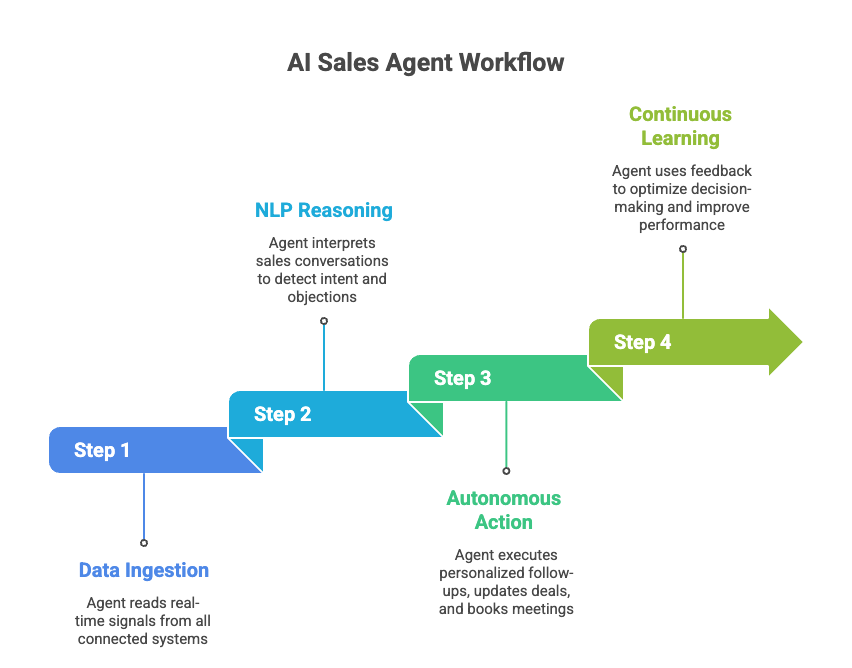
Step 3: Autonomous action execution
Based on what it detects, the agent acts. It sends a personalized follow-up, updates the deal stage, enrolls a contact into a sequence, flags a risk to the rep, or books a meeting without waiting for a human to trigger any of it. This level of sales automation dramatically improves sales efficiency.
Step 4: Continuous learning and self-optimization
Every action generates a feedback signal. Which emails got replies? Which sequences resulted in booked meetings? Which risk flags were accurate? The agent uses this sales data to sharpen its own decision-making over time, a capability that static rule-based workflows fundamentally cannot replicate. This continuous improvement drives better sales performance across the entire sales tech stack.
From first touch to close, automate your entire sales pipeline with AI
Key capabilities of AI sales agents
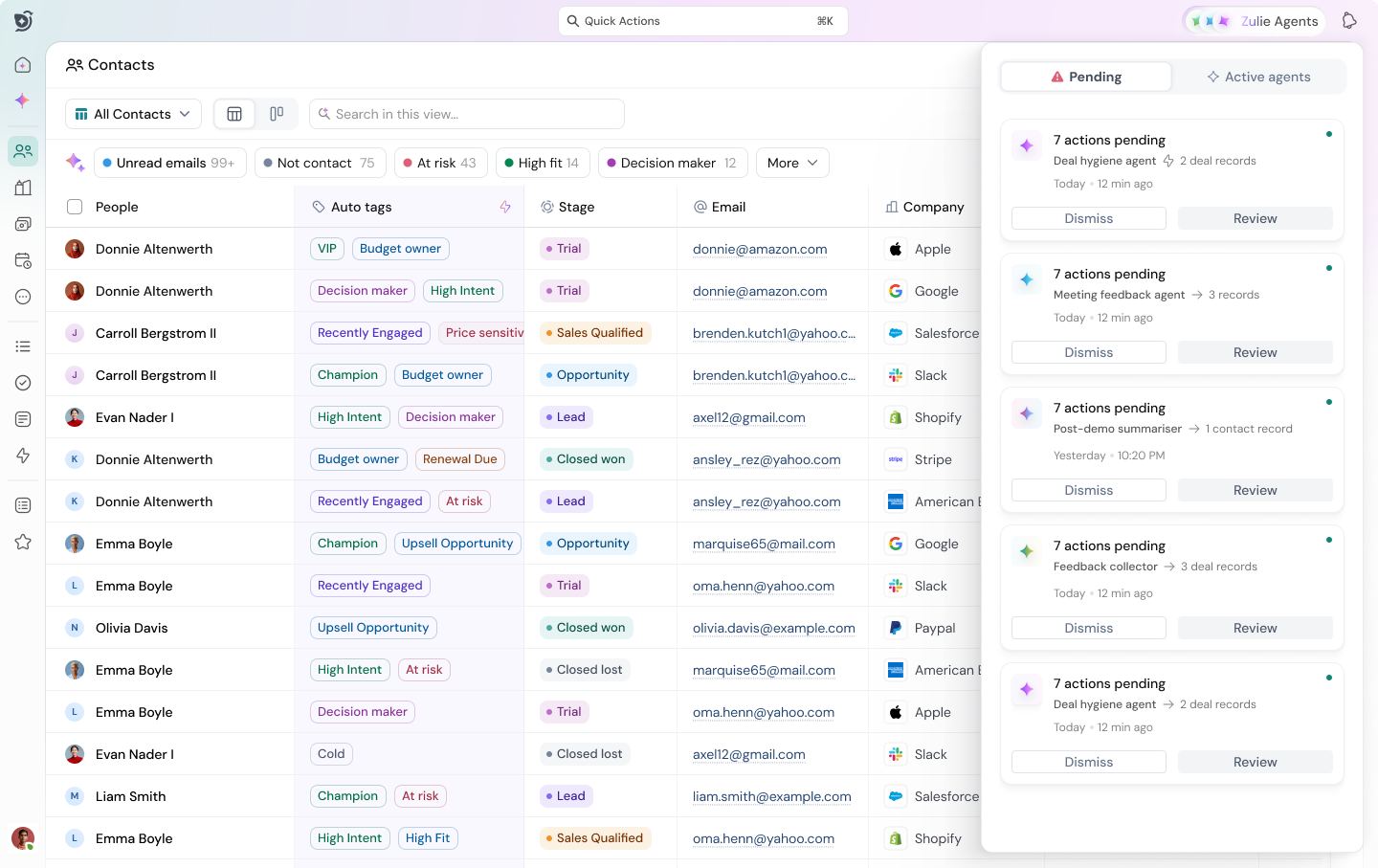
1. Lead qualification and AI scoring
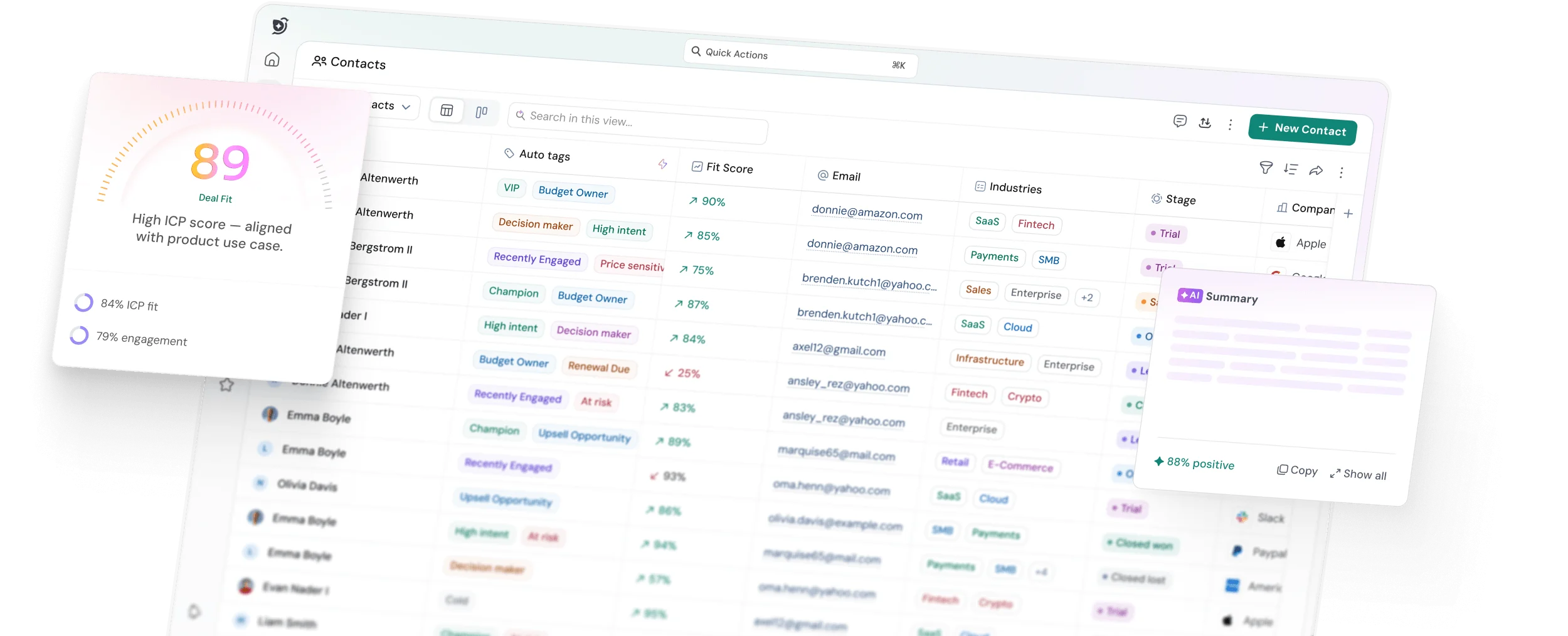
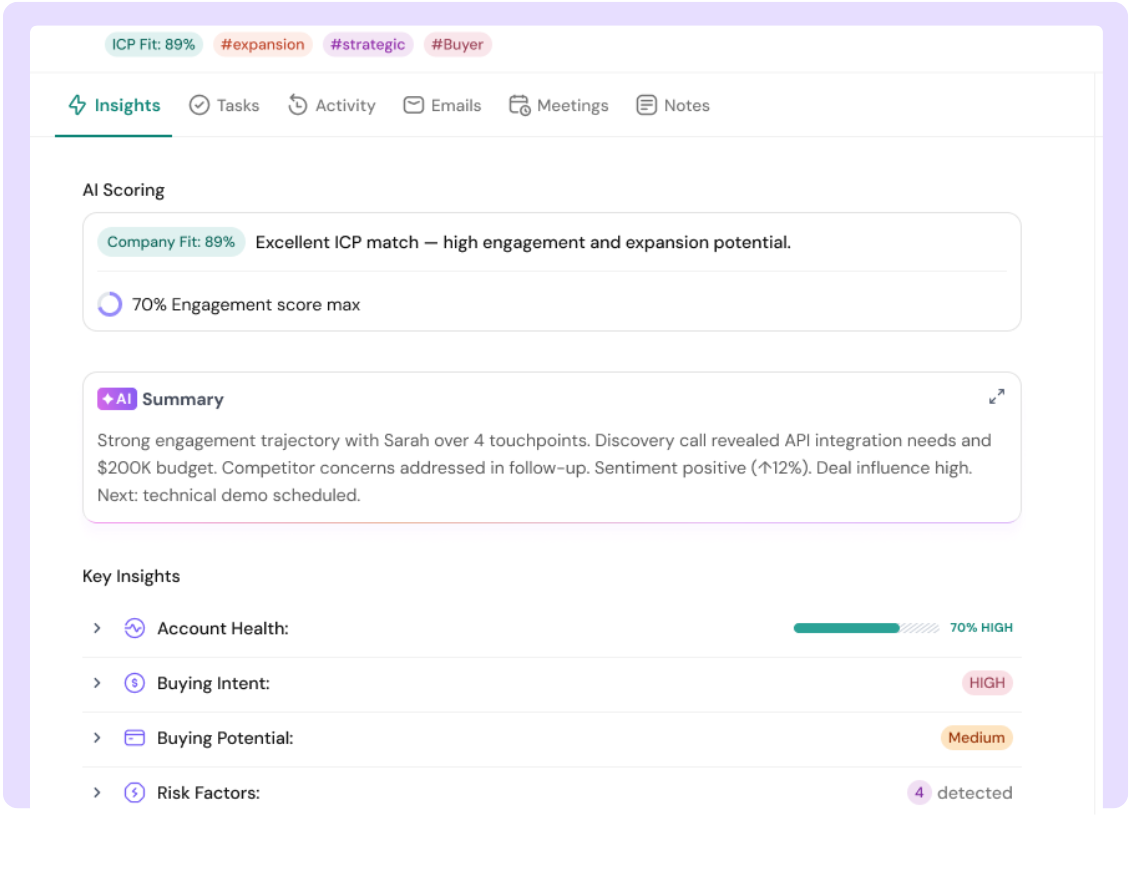
AI agents score every contact against your ICP in real time using job title, company size, industry, engagement behavior, and buying signals. In SparrowCRM, the AI scoring widget surfaces an ICP fit percentage, engagement score, and buying intent level on every contact record, so reps always know who to prioritize without pulling manual reports. This capability is essential for effective lead generation and lead nurturing.
2. Personalized outreach at scale
Rather than generic templates, AI agents build personalized messages using role, company context, recent activity, and pain point signals. The same agent who qualifies 500 leads can produce 500 contextually distinct emails without a rep opening a spreadsheet. This level of personalization improves customer engagement and response rates in AI sales outreach campaigns.
3. Autonomous meeting scheduling
When an agent detects booking intent, a reply asking about pricing, repeated demo page visits, or a positive shift in email sentiment, it can trigger a scheduling sequence without any manual step required. This automation of sales meetings accelerates the sales pipeline and improves rep productivity.
Prefer a visual summary? This short video breaks down exactly how AI sales agents handle inbound qualification, deal risk detection, and post-meeting follow-up — so your reps can focus entirely on closing.
4. Real-time deal intelligence and risk detection
AI agents monitor deal activity continuously. When a deal goes quiet for 12 days, a competitor is mentioned in an email, or a key contact changes roles, the agent flags it immediately. SparrowCRM surfaces these as risk factors directly on the deal record before they derail the opportunity. This sales intelligence capability is critical for maintaining deal velocity and achieving quota attainment.
5. Call intelligence and post-meeting actions
After every call or meeting, the agent transcribes the conversation, extracts key topics, identifies commitments made, and generates next actions automatically. With call intelligence, sales teams can capture insights from every conversation without manually taking notes. This improves sales coaching opportunities and ensures consistent follow-up.
6. CRM data hygiene and enrichment
AI agents continuously update contact and company records, fill missing fields, remove duplicates, and flag data quality issues. Clean customer data is what makes every other AI feature work reliably, and autonomous enrichment removes that burden from the team. This ensures accurate sales analytics and better sales metrics across the organization.
Key benefits of AI sales agents for sales teams
The productivity case for AI sales agents is well-documented. Salesforce's State of Sales report confirms that reps spend 70% of their time on non-selling activities, while McKinsey's State of AI research points to agentic AI delivering 3–15% productivity gains for revenue teams alongside 20–40% reductions in cost-to-serve.
AI-driven digital workers are gaining traction in sales teams. For example, platforms like 11x report 200+ companies already using AI sales agents to automate prospecting and outreach. Gartner projects that by 2028, 33% of enterprise software applications will include agentic AI, enabling 15% of day-to-day work decisions to be made autonomously. This is rapidly becoming a baseline expectation for modern sales platforms, not a competitive advantage.
Beyond the research, six concrete benefits show up consistently across sales teams running AI agents:
- Faster speed-to-lead: Agents respond to inbound signals in seconds, not hours, directly improving conversion rates on high-intent prospects and accelerating revenue growth.
- Higher pipeline quality: Automated lead scoring means reps engage with fewer wrong-fit prospects and more ICP-matched opportunities, improving overall sales performance.
- Consistent follow-up: Agents never forget a step, never drop a deal because a rep had a busy week, and never send a generic chase email when context is available. Teams that combine this with structured AI sales campaigns see the biggest gains in pipeline consistency.
- Better forecast accuracy: Real-time deal intelligence gives managers a cleaner view of pipeline health without relying on manually entered CRM data, improving sales strategy decisions.
- Faster rep ramp: New reps backed by AI agents reach full productivity faster because the agent handles the high-volume, mechanical parts of the job. This accelerates sales training and sales enablement efforts.
- Fewer deals lost to inaction: Most deals are lost to slow response or dropped follow-up. AI agents eliminate both, improving sales efficiency and quota attainment rates.
The productivity shift is not theoretical. Sales leaders running AI agents in production are reporting exactly this
“Revenue-generating time for reps can hit 70 to 80 percent with AI. Right now most reps spend only 20 to 30 percent of their time on actual revenue-generating activity. AI automation is what closes that gap.”
Real-world result: how EAB increased demo requests by 120% with a conversational AI agent
EAB, a research and technology partner serving thousands of education institutions across the US, deployed a conversational AI agent (built on Drift, now part of SalesLoft) across their website to handle inbound visitor qualification at scale.
The problem they were solving was straightforward: the BDR team could not manually engage every site visitor, and high-intent visitors were leaving without converting. The AI agent handled free-text conversations with visitors, no button-response menus, qualifying intent, answering questions, and routing high-value prospects to the sales team.
The results after deploying AI:
120% increase in demo requests, 95% conversation accuracy after training on real visitor interactions. Same-day or same-hour scheduling for qualified visitors, down from multiple BDR touchpoints. BDR team shifted focus entirely to high-intent prospects, while the AI handled volume
"The time from when the individual site visitor first reaches out through the chatbot to the time that they're actually having a conversation with our salespeople is much quicker. Fewer pieces of outreach are needed from our BDR team," said the EAB digital marketing team.
What made the difference was not the AI replacing the sales team; it was the AI handling qualification at every hour of the day, so the human team could focus entirely on conversion. This is the practical model: AI owns volume and speed, humans own relationship and closeness.
SparrowCRM's buying intent detection and AI scoring work on the same principle. When a contact hits your CRM, from a form, a meeting booking, or an email reply, the ICP fit score, engagement score, and buying intent level are already calculated before a rep opens the record. The qualification work is done before the rep conversation begins.
Turn pipeline data into clear next actions
How to choose the right AI sales agent for your team
The right AI sales agent depends on where your team’s biggest bottleneck is, not on which platform has the most features. Use this five-question framework before evaluating any platform.
5 questions to ask before choosing an AI sales agent
- What is the primary bottleneck? Identify whether the problem is prospect volume, outreach personalization, lead qualification speed, follow-up consistency, or pipeline visibility, then look for agents built for that specific job.
- Does it fit your sales motion? High-volume outbound, inbound qualification, and enterprise ABM require very different agent capabilities. Confirm the tool is designed for how your team actually sells.
- How deep is the CRM integration? Agents that operate natively inside your CRM have richer data access and fewer sync errors than tools connected through APIs. Always ask where the data actually lives.
- What level of autonomy does it support? Some tools suggest actions for humans to approve. Others act fully independently. Define how much oversight your team needs before committing.
- How will you measure outcomes? Evaluate on qualified leads generated, meetings booked, and pipeline created — not on seats, feature count, or email volume.
If you want AI embedded inside your CRM rather than bolted on through integrations, platforms like SparrowCRM offer full agentic AI natively across contacts, deals, companies, and pipeline without additional tools or API maintenance.
Challenges of implementing AI sales agents (and how to avoid them)
Data quality determines everything
AI agents are only as accurate as the data they work with. If your CRM has incomplete records, stale company data, or duplicate contacts, the agent will make poor decisions at scale. Audit your CRM data quality before deploying any AI agent and establish enrichment protocols as part of the rollout.
Over-automation damages the prospect experience
Teams that automate every touchpoint without human review risk sending tone-deaf outreach at high volume. The most effective model is a hybrid AI that handles research, volume, and mechanical execution, while humans own relationship-critical moments, complex negotiations, and anything that requires genuine judgment.
Integration friction slows adoption
Agents that require API connections between your CRM, email platform, and outreach tools create ongoing maintenance and data sync issues. CRM-native AI agents have a structural advantage here; fewer integration points mean fewer failure points and faster team adoption.
Rep resistance needs to be addressed upfront
Sales reps sometimes view AI agents as a threat to their role. Frame the rollout around time saved and quality improved. Show reps concrete data on what the agent handles versus what they can now spend more time on, such as conversations, relationships, and closing.
Final thoughts
AI sales agents are not a future-state technology. They are in production at hundreds of sales teams right now, handling outreach, qualification, follow-up, and pipeline monitoring at a scale no human team can match manually.
The most important distinction when evaluating them is not which platform has the longest feature list; it is where the AI actually lives. Agents embedded natively inside your CRM operate with richer context, fewer integration errors, and lower ongoing maintenance than external tools synced through APIs.
If your team is losing deals to slow follow-up, inconsistent outreach, or poor pipeline visibility, an AI sales agent addresses all three simultaneously. SparrowCRM's agentic AI layer gives sales teams lead scoring, buying intent detection, deal risk alerts, and next action recommendations — all embedded natively inside the CRM, with no additional tooling required. Explore how it fits alongside your broader AI sales automation strategy or see how it compares in our AI-powered CRM guide.