OUTREACH
What Are Sales Sequences? A Step-by-Step Guide With Real Examples

By Ganesh Ravi Shankar
Last updated on May 26, 2026
Explore this blog to understand what sales sequences are, how to build one step by step, and the 7-stage sales process they are designed to move prospects through, from first contact to closed deal.
- What is sales sequence?
- Sales Sequences vs. Marketing Drip Campaigns
- Why Sales Sequences Matter in Modern Outreach
- Key Components of a Sales Sequence
- The Sequence of a Sales Process: 7 Stages Every Rep Follows
- Stage 4: Needs Assessment
- Essential Elements Every Sales Sequence Needs
- How to Build a Sales Sequence: Step-by-Step Guide
- Real Sales Sequence Examples You Can Use
- Best Practices for Sales Sequencing Success
- Avoid Common Sales Sequence Mistakes
- Final Thoughts
Cold emails have a 0.9% response rate. Then it takes 8 touches to start a conversation. But most sales reps give up after just two attempts...
You're doing everything right, reaching out to the right audience, following up regularly and switching channels when needed. But the replies? Still cold.
Sales sequences make the difference here. A structured sales outreach strategy with the right timing, channels and messaging can boost response rates and turn cold prospects into conversations.
I'll show you how to build high-performing outreach sequences that work in this piece.
What is sales sequence?
A sales sequence is a series of touchpoints that use multiple communication channels to connect with a specific prospect over a set period. It's a scheduled series of sales activities that include phone calls, emails, social messages, and SMS messages delivered at pre-defined intervals. The goal? Generate conversations with qualified prospects and set meetings for further discussions.
The keyword here is series. Data shows it takes an average of 8-12 touches to book a meeting with a cold prospect. Sales sequences solve this by automating follow-up and ensuring no lead falls through the cracks.
Sales Sequences vs. Marketing Drip Campaigns
Sales sequences and marketing drip campaigns serve different purposes. A marketing drip is passive and operates as a one-to-many broadcast that educates a large audience over a long period. It doesn't care if you reply. It just wants you to click.
A sales sequence is aggressive, in contrast. It's a one-to-one outreach that provokes a response now. Here's how they differ:
Aspect | Marketing Drip Campaign | Sales Sequence |
|---|---|---|
Goal | Nurture, education, brand awareness | Book meetings, spark conversations |
Audience | One-to-many; thousands of leads | One-to-one; specific qualified prospects |
Channels | Email only; usually HTML-heavy | Email, phone, LinkedIn, SMS |
Format | Polished, branded design with images | Plain text, personal, conversational |
Exit Trigger | Unsubscribe or campaign ends | Reply, meeting booked, or bounce |
Sales sequence emails are sent from your connected inbox and thread in your recipient's inbox just as a regular one-to-one email would. This helps prevent them from being marked as spam or marketing. Automated sales emails are often more personalized and are from one person to another.
Why Sales Sequences Matter in Modern Outreach
Sales sequences increase lead generation by establishing a clear and consistent process. They ensure each lead is approached in a timely manner that works. This systematic follow-up maximizes conversion opportunities and creates a positive customer experience.
Sequences improve sales team productivity as well. Salespeople know exactly what to do at each stage of the sales process with a defined structure. This reduces time spent on strategizing and allows salespeople to focus on execution.
Sequences also allow you to collect data on what messaging, timing, and platforms work best to get a desired response. This information is generated without manual effort, so you and your team can pivot to optimize the process continuously.
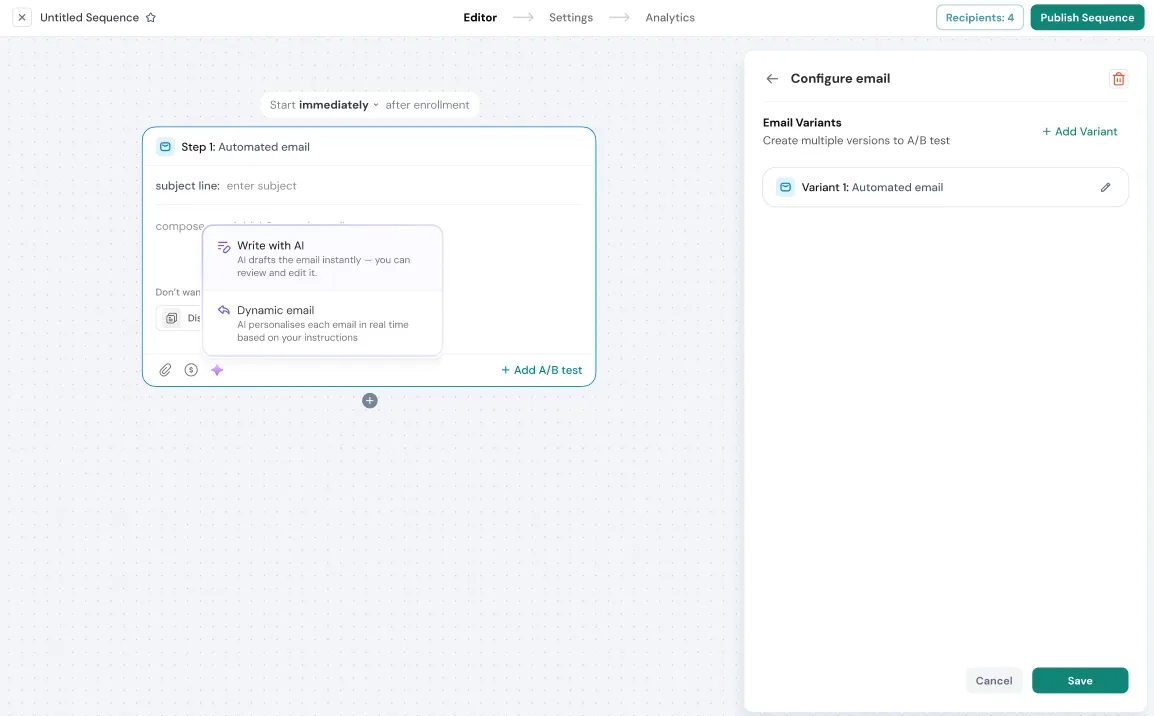
In SparrowCRM, each sequence step tracks engagement in real time. The Sequence Analytics tab shows open rate, reply rate, click rate, drop-off per step, and A/B test results, giving teams a clear picture of what's driving replies and what's killing them
Key Components of a Sales Sequence
Every successful sales sequence contains specific elements. Never start a sequence without a reason. Signal-based triggers can be a hiring burst for a specific role, a Series B funding round, a new C-level executive joining the company, or a competitor's tech installation.
Email's average reply rate is in the low single digits (1-3%). High-performing sales sequences use the triple tap: hitting the prospect on three channels within a 24-hour window, such as call, email, and LinkedIn. This creates a 'surround sound' effect that makes you harder to ignore.
Cadence breathes with Fibonacci-like spacing: heavy intensity upfront with touches on Days 1, 2, and 4, spaces in the middle with touches on Days 8 and 12, and a final push with touches on Days 15 and 20.
Content must move from 'me'-centric to problem-centric. Personalization uses their name, but relevance speaks to their pain.
The sequence needs to stop when a prospect replies. Nothing kills a deal faster than a prospect replying "Let's chat Tuesday" and then receiving an automated "Just bumping this" email 20 minutes later.
The Sequence of a Sales Process: 7 Stages Every Rep Follows
A sales sequence automates your outreach, but it still lives inside a larger selling framework. The sequence of a sales process is the ordered chain of actions that moves a prospect from first contact to closed deal. Before you build touchpoints, you need to understand the 7 stages your sequence must support, because each stage requires a different message, a different channel, and a different call to action.
Stage 1: Prospecting
Finding qualified potential buyers who match your ideal customer profile. In a sequence, this is the trigger point. You enroll a prospect only after confirming they fit firmographic and intent criteria. Poor prospecting is the single biggest reason sequences fail to generate replies regardless of message quality.
Stage 2: Preparation and Research
Before the first touchpoint goes out, you research the prospect's company news, LinkedIn activity, tech stack, and known pain points. This reconnaissance is what separates a contextual first touch from a generic cold email. Preparation transforms token personalization (name, title) into real personalization (specific trigger, relevant challenge).
Stage 3: Initial Contact and Outreach
The opening move in your sequence. This is usually a short, plain-text email or a LinkedIn connection request anchored to a specific reason for reaching out. The goal is not to pitch, it is to earn a reply by demonstrating relevance. Sequences that lead with product features at stage 3 almost always underperform.
Stage 4: Needs Assessment
Once a prospect responds or engages, the sequence pauses and a human conversation begins. The rep asks discovery questions to understand budget, decision-making authority, specific pain points, and timeline. The outputs of this stage directly shape the pitch in stage 5. Automating past this point is the most common sequence mistake.
Stage 5: Presentation and Pitch
A tailored demonstration or proposal based on what the discovery conversation revealed. This is not a features walkthrough, it is a solution frame. The sequence may include a follow-up touchpoint after the pitch to confirm next steps or share relevant case studies that address objections heard during the presentation.
Stage 6: Handling Objections
Most deals stall here. Objections about price, timing, internal stakeholders, or competitor alternatives are predictable and should be pre-mapped. Your post-demo follow-up sequence can address the most common objections proactively with social proof, ROI data, or case studies before the prospect raises them formally.
Stage 7 : Closing and Follow-Through
The close is not a single event, it is the final stage where agreement is reached and next steps are formalized. A post-close sequence handles onboarding hand-off communication, contract follow-up, and early engagement touchpoints that reduce churn risk and set up expansion conversations.
Essential Elements Every Sales Sequence Needs
Building a sales sequence that works requires more than stringing together random touchpoints. Each element serves a purpose. Missing even one can tank your response rates.
Clear Trigger and Goal
Never start a sequence without a reason. Signal-based triggers indicate the prospect might need your help right now. A hiring burst for a specific role, a Series B funding round, a new C-level executive joining the company, or a competitor's tech installation all qualify as examples.
Your outreach is spam without a trigger. The goal determines everything from messaging to channel mix to sequence length. A sequence targeting inbound demo requests should look different from one targeting cold outbound prospects or re-engaging stalled opportunities.
Multi-Channel Mix
Email-only sequences are dead. Multi-channel outreach that combines email and phone increases response rates by 287% compared to single-channel approaches. Email's average reply rate sits in the low single digits at 1-3%. Relying on email alone ignores how humans communicate.
Senior executives often prefer LinkedIn and phone over email. Product managers might respond better to email. The practical approach: segment by phone intent before choosing channels. High phone intent prospects get phone-heavy sequences. Low phone intent prospects get email and LinkedIn with occasional calls.
Strategic Cadence and Timing
The sweet spot is 4-7 touchpoints spaced 3-4 days apart. Under 4 gives up too early. Beyond 7 shows diminishing returns and risks higher spam complaints. 80% of deals require 5+ touches to close, yet 44% of reps give up after just one attempt.
Timing between touches matters. Space them 2-3 business days apart for cold prospects. Touch too frequently and you look desperate. Touch too infrequently and prospects forget you between steps. The best times to reach out are Tuesdays through Thursdays between 10:00 AM and 11:30 AM. These times show a 46% higher connection rate than late afternoon calls.
Value-Driven Content
Each touchpoint should provide new value or approach the problem from a different angle. Follow-ups build on the previous interaction by adding context or addressing a likely next question rather than restating the same value proposition.
Personalization uses their name. Relevance speaks to their pain. Recent company news, a known pain point, or a relevant milestone helps outreach feel grounded in the buyer's reality. Real personalization doubles response rates. 71% of buyers expect personalized interactions and 76% get frustrated when they don't receive them.
Exit Criteria and Automation Rules
Sequences should pause automatically when a prospect replies, books a meeting, or takes another positive action. Default exit conditions include all steps executed, email unsubscribed, email replied to, or email bounced.
Configure sequence templates that flag sales reps to review or step in when specific events occur. Multiple stakeholders engaging, repeated content views, or replies that introduce new context all warrant attention. Nothing kills deals faster than automated emails landing after a prospect already responded.
Discover sales sequences that convert leads
How to Build a Sales Sequence: Step-by-Step Guide
Creating sales sequences that convert requires a methodical approach. Here's your framework for building outreach sequences that book meetings.
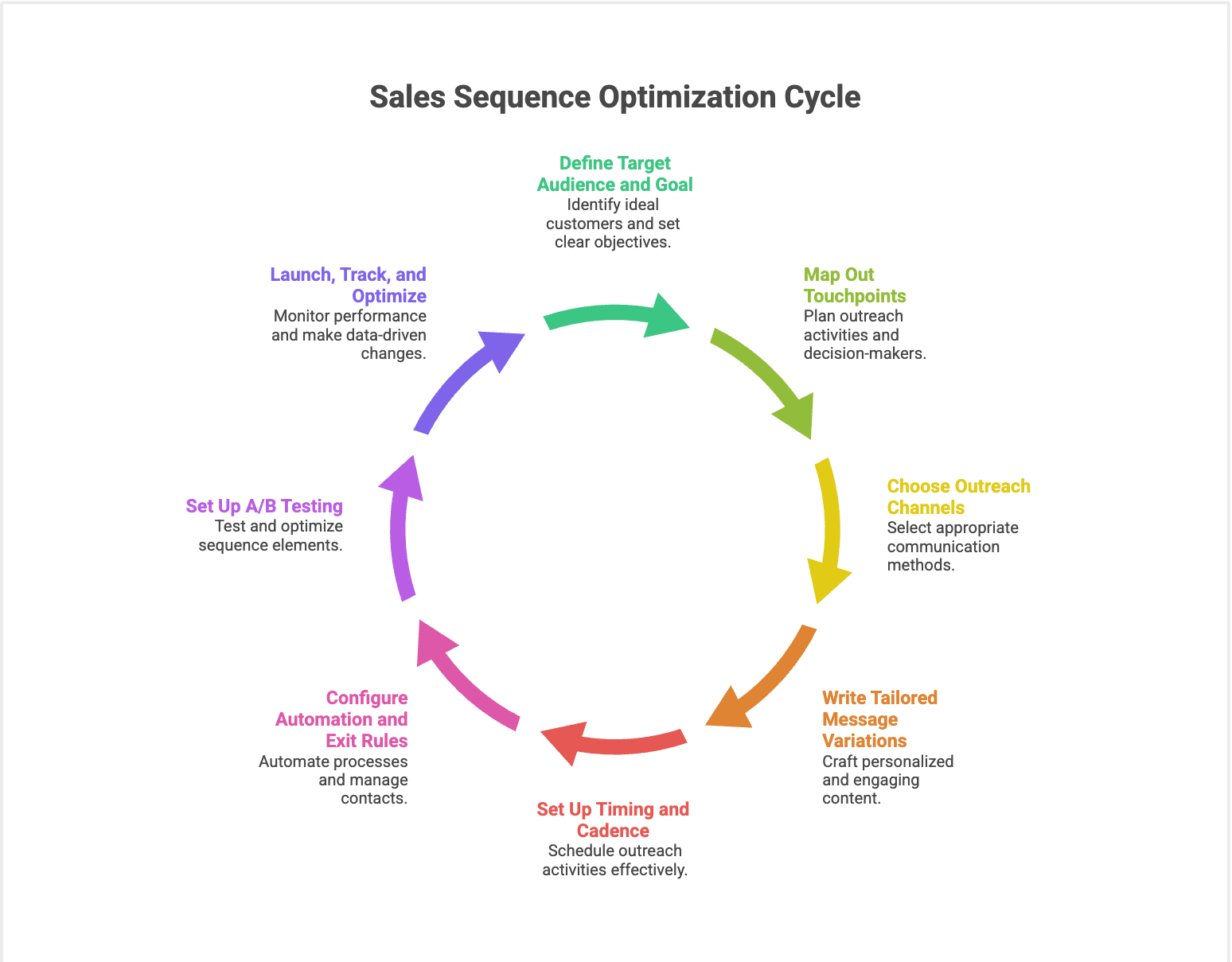
Step 1: Define Your Target Audience and Goal
Start with your ideal customer profile. Define firmographics: industry, company size, revenue, location, number of employees and market trends. Demographics matter too—age, occupation and education level of your contact.
Set a specific, measurable goal. Skip broad objectives like "increase sales." You want concrete metrics such as "schedule 5 new demos weekly" or "increase qualified leads by 20%". Your sequence won't appeal to anyone without clarity on who you're reaching and why now.
SparrowCRM's AI Filters on the Contacts and Companies pages help you segment by ICP fit score, engagement level, and buying intent, so you're enrolling the right prospects into each sequence from the start, not guessing.
Step 2: Map Out Your Touchpoints
Research prospects before enrollment. Check their company's recent news. Understand pain points typical of their role and review recent LinkedIn activity. This reconnaissance allows you to customize your opening touchpoint and reference relevant triggers.
Map your sales process to identify key decision-makers and potential roadblocks. Determine how many touchpoints you need: warm inbound leads need 3-5 touches, while cold outbound sequences require 5-8 touchpoints to establish trust.
Step 3: Choose Your Outreach Channels
Match channels to your buyer's priorities. Senior executives often prefer LinkedIn and phone over email. Product managers might respond better to email. A practical outreach plan treats channels like a portfolio: a few core channels combined so one doesn't carry the whole quota burden.
Anchor on three core channels for most B2B motions: email, phone and LinkedIn. Once the core produces meetings predictably, layer an accent channel like opt-in SMS for high-intent moments.
Step 4: Write Tailored Message Variations
Keep emails under 80 words. Your first touchpoint must grab attention, establish relevance and inspire action. Lead with a specific insight or ask a provocative question tied to their role.
Vary messaging across touchpoints. Each step should provide new value or approach the problem from a different angle. Reference role-based personalization that connects a known trigger to a relevant outcome.
Step 5: Set Up Timing and Cadence
Run 8-12 touches over 10-14 days for cold outbound. Space touchpoints 2-3 business days apart at first, then expand to 4-5 days as you progress. Send emails during morning windows, 9-11 AM local time.
Step 6: Configure Automation and Exit Rules
Set default exit conditions: all steps executed, email unsubscribed, email replied to, or email bounced. Contacts should unenroll automatically when they reply to any email or book a meeting.
Step 7: Set up A/B testing
Test one variable at a time; subject line, opening line, CTA, or length. Run tests to statistical significance before making decisions. The three distribution methods in SparrowCRM's sequence A/B testing are:
- Round-robin: Equal sends per variant — good for clean comparison
- Weighted distribution: Assign different send volumes to each variant
- Performance-based: System identifies the top performer and shifts sends automatically
Step 8: Launch, track, and optimize
Don't optimize based on gut feel. Track reply rate (aim for 3–5% for cold, 12–15% for warm), meetings booked per sequence, and bounce rate (keep below 2%). Check the analytics after 50–100 sends before making changes.
Make one change at a time so you know what's actually driving improvement.
Real Sales Sequence Examples You Can Use
Working examples beat theory. Here are four proven sales sequence templates you can adapt to your outreach strategy.
Example 1: High-Value Prospect Sequence
This 8-step sequence targets decision-makers and champions requiring maximum personalization. Use the "Show Me You Know Me" framework: craft a subject line unique to the recipient, start with an authentic intro rather than niceties, transition to your pitch with logic, identify their specific challenge, present your value proposition, address hidden objections, and close with a clear call to action. Skip calendar links in your first email.
Mix outreach types across remaining steps. Participate on LinkedIn and send handwritten notes to cut through noise. One seller mailed over 1,000 handwritten notes and booked over 100 sales calls using this approach.
Example 2: Signal-Based Outbound Sequence
Trigger events like funding announcements, leadership changes, or competitor tool installations require action right away. Structure this sequence with Day 1 email referencing the specific signal, Day 3 LinkedIn interaction, Day 6 case study email, Day 10 follow-up call, and Day 14 transition to nurture.
The strategy is value-heavy because you're educating prospects on problems they might not recognize yet. Signal-timed outreach converts 400% better than generic cold outreach, and leadership-change outbound gets a 14% response rate versus 1.2% for standard cold calls.
Example 3: Inbound Lead Follow-Up Sequence
When prospects request demos or download high-intent content, respond with intensity. Day 1 requires instant call and email. Day 2 sends LinkedIn connection request plus voice note. Day 3 follows up on questions, and Day 5 transitions to nurture. High-value inbound leads need manual task-based sequences that allow personalization at each touchpoint.
Example 4: Multi-Channel Engagement Sequence
Combine LinkedIn profile visit, connection request with personalized note, and email follow-ups if they don't accept within 7 days. Space emails 2-3 days apart: first expresses their problem with added value, second uses social proof inviting discovery calls, third sends a breakup email to qualify interest.
Best Practices for Sales Sequencing Success
Most sales teams think inserting a first name counts as personalization. Token personalization that uses simple merge tags like name, company, or title reads generic. True personalization references something unique to that person or account, such as recent hiring announcements, LinkedIn activity about specific challenges, or company news tied to relevant pain points. Personalized emails see 26% higher open rates, and 41% of buyers respond more to personalized messages.
Personalize Beyond First Names
Personalization works best in tiers. Tier 1 prospects deserve contextual intelligence that references their technology stack, competitive landscape, or hiring signals. Tier 2 gets behavioral personalization based on content engagement or pages visited. Avoid surveillance-level detail; mentioning someone visited your pricing page three times feels invasive.
Use Strategic Gaps Between Touchpoints
The ideal interval between email touchpoints is 3-5 days, with response rates dropping by a lot after 5 days. Limit emails to 50% or less of total sequence steps to reduce spam risk, as anything above a 0.1% report rate triggers filtering. SMB contacts need 5-8 touchpoints spread over 30 days; enterprise sequences need 10-18 touches across 30-60 days.
Track the Right Metrics
Stop obsessing over open rates. A healthy positive reply rate sits at 3-5%. Keep bounce rates under 2%; hitting 3-5% means stop sending immediately. Track meeting booked rate as your outcome metric.
Avoid Common Sales Sequence Mistakes
Companies using AI to segment audiences see a 15% sales increase. Repetitive cadences miss testing opportunities. Diverse communication channels yield better results than email alone.
Final Thoughts
You now have everything you need to build sales sequences that convert. The difference between reps who close deals and those who struggle comes down to structured follow-up. Multi-channel outreach and strategic timing beat random cold calls.
Start with one sequence. Test your messaging, track the right metrics and refine based on what drives replies. Consistency matters more than perfection.
Set up your first sequence this week, enroll your top prospects and watch your meeting rate climb. Sales sequences work when you work them.