SALES STRATEGY
What is pre-sales? Role, process, metrics, tools, and AI use cases

By Ganesh Ravi Shankar
Last updated on Oct 29, 2026
Explore the article to understand the pre-sales functionalities, metrics, processes, and how they contribute to the business revenue.

Ganesh Ravi Shankar
Updated on Oct 29, 2026
A sales deal rarely starts with a sales pitch. Before a prospect signs a contract, they may need product demonstrations, technical answers, solution recommendations, and proof that your product can solve their problems. This is where pre-sales comes in.
In this guide, we'll explore what pre-sales is, how it contributes to business revenue, where it fits into the sales process, the metrics and tools teams use, and how AI is changing pre-sales workflows.
What is pre-sales?
Pre-sales / noun
Pre-sales is the process of understanding potential customers' needs, evaluating their requirements, and demonstrating how a product or service can solve their problems before they make a purchase.
It involves activities such as product demonstrations, technical consultations, solution recommendations, and answering customer questions to help prospects evaluate whether the solution is the right fit.

Does pre-sales help improve your team's deal conversion rate?
How does it contribute to business revenue?
Pre-sales is the start of the sales process for various companies, which means it is the foundation for revenue for business from the sales.
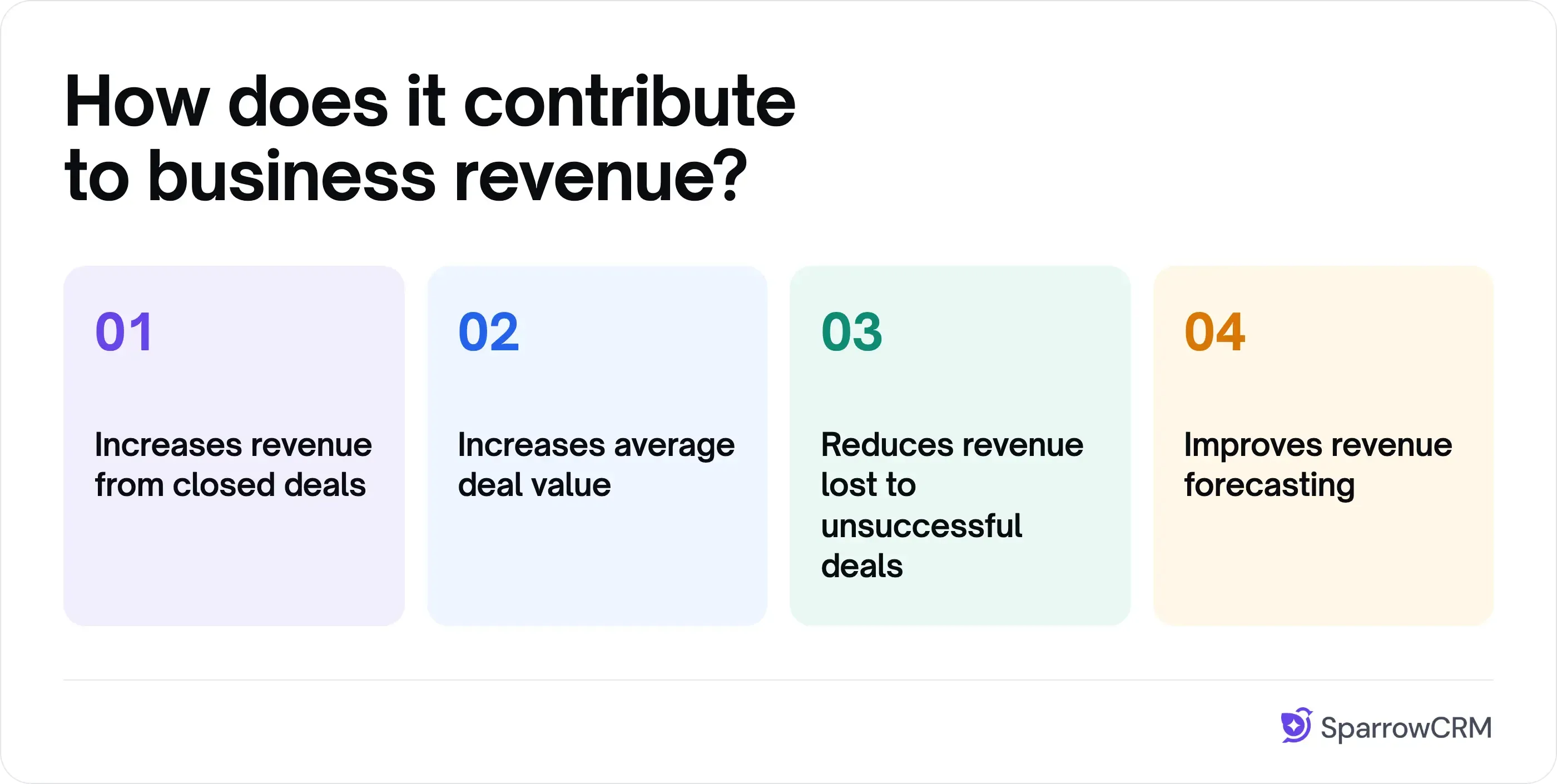
- Increases revenue from closed deals: Pre-sales helps prospects understand how a product solves their business problems, giving sales teams a stronger case to win deals and convert qualified opportunities into paying customers.
- Increases average deal value: By identifying customer requirements and recommending relevant features, integrations, or higher-tier plans, pre-sales can help businesses secure larger deals when those solutions match the customer's needs.
- Reduces revenue lost to unsuccessful deals: Technical validation and product demonstrations help identify mismatches early, address objections, and reduce the risk of deals being lost because the proposed solution doesn't meet customer expectations.
- Improves revenue forecasting: Pre-sales provides insights into technical feasibility, product fit, and unresolved customer concerns. Sales teams can use this information to assess which opportunities are more likely to close and make more informed revenue forecasts.
Who needs a pre-sales function?
Businesses that can benefit from a dedicated pre-sales function include:
- B2B SaaS companies: Businesses selling CRM, ERP, marketing automation, or other software products that require product demonstrations, integration discussions, or customized workflows.
- Companies with complex products: Businesses offering technical solutions that require feasibility assessments, proof of concepts (POCs), or specialized product knowledge before a customer commits.
- Enterprise sales teams: Organizations selling high-value contracts involving multiple decision-makers, security reviews, technical evaluations, and lengthy approval processes.
- IT services and consulting firms: Businesses that need to understand client requirements, prepare solution proposals, estimate project scope, and validate technical capabilities before signing contracts.
- Businesses with long sales cycles: Companies where prospects evaluate multiple vendors and need ongoing support to compare solutions, resolve concerns, and make purchasing decisions.
Where pre-sales fits in the sales process
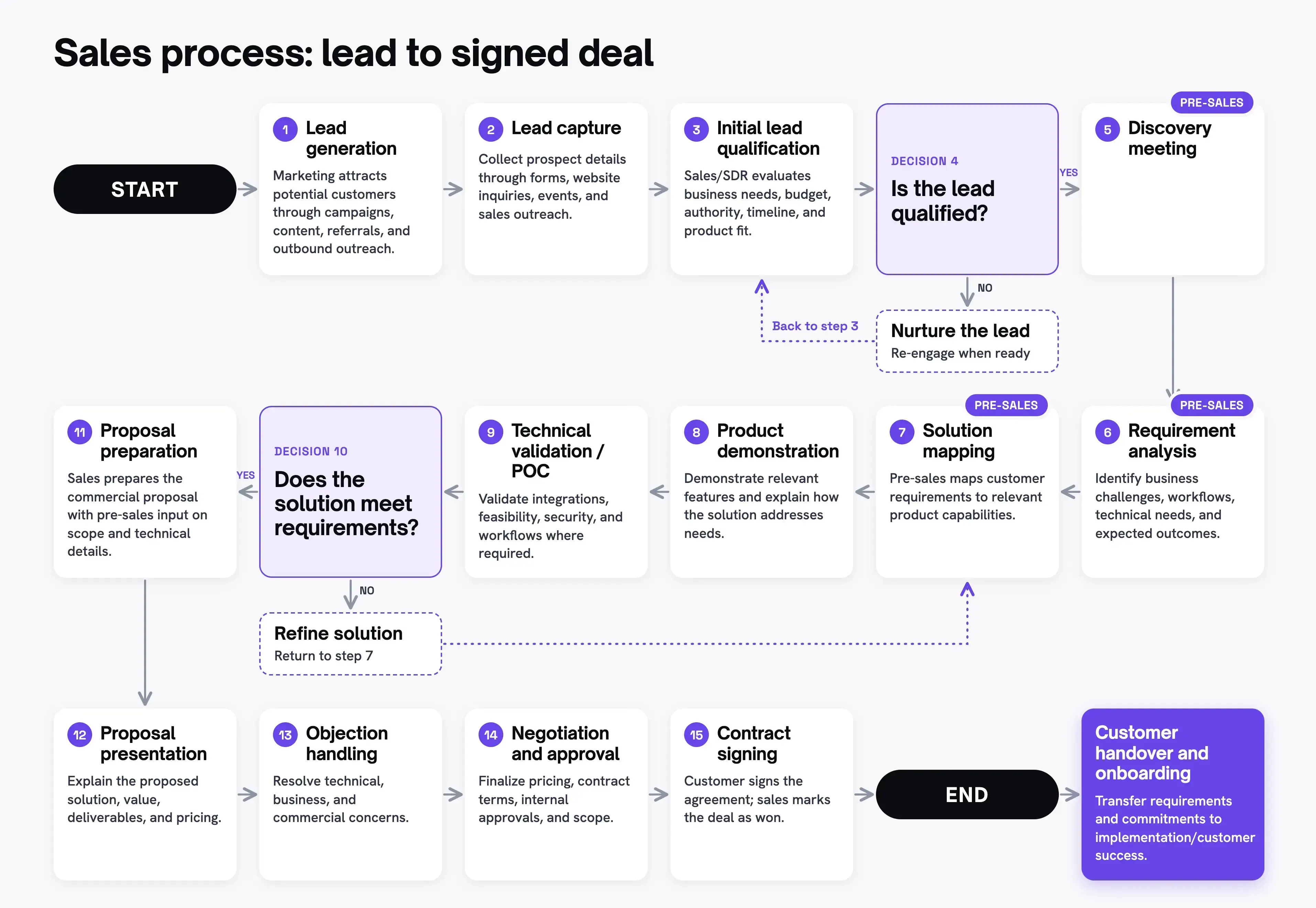
As shown in the sales process flowchart below, pre-sales typically gets involved during the discovery meeting, where the team understands the customer's business challenges, requirements, and expectations.
They then map these requirements to suitable product capabilities, conduct product demonstrations, and validate whether the proposed solution meets the customer's needs.
Pre-sales also supports technical validation, proof of concepts (POCs), and proposal preparation by providing the technical details needed to demonstrate the solution's feasibility.
This helps the sales team address customer concerns, build confidence in the proposed solution, and move the opportunity closer to contract signing.
Pre-sales vs. sales vs. account management
Factor | Pre-sales | Sales | Account management |
|---|---|---|---|
Primary goal | Validate product fit and demonstrate the solution | Convert prospects into paying customers | Retain customers and grow existing accounts |
When they get involved | Usually during discovery, evaluation, and technical validation | From lead qualification through negotiation and deal closure | Typically after the deal closes |
Key responsibilities | Requirement analysis, product demos, solution mapping, technical validation, and POCs | Relationship building, pricing, negotiation, and contract signing | Relationship management, renewals, upselling, cross-selling, and customer satisfaction |
Customer focus | Whether the product meets technical and business requirements | Whether the customer is ready to buy and under what terms | Whether the customer continues to receive value and remains a customer |
Revenue contribution | Helps improve deal conversion by validating the solution | Generates new revenue by closing deals | Protects recurring revenue and generates expansion revenue |
Key performance metrics | Technical validation success, demo-to-opportunity conversion, and win-rate contribution | Revenue closed, quota attainment, and win rate | Customer retention, renewal rate, churn, and account expansion |
Example | Demonstrates how a CRM can automate lead management and validates required integrations | Negotiates the CRM subscription and closes the contract | Helps the customer renew the subscription and expand usage across more teams |
Pre-sales management: How to build and run the team
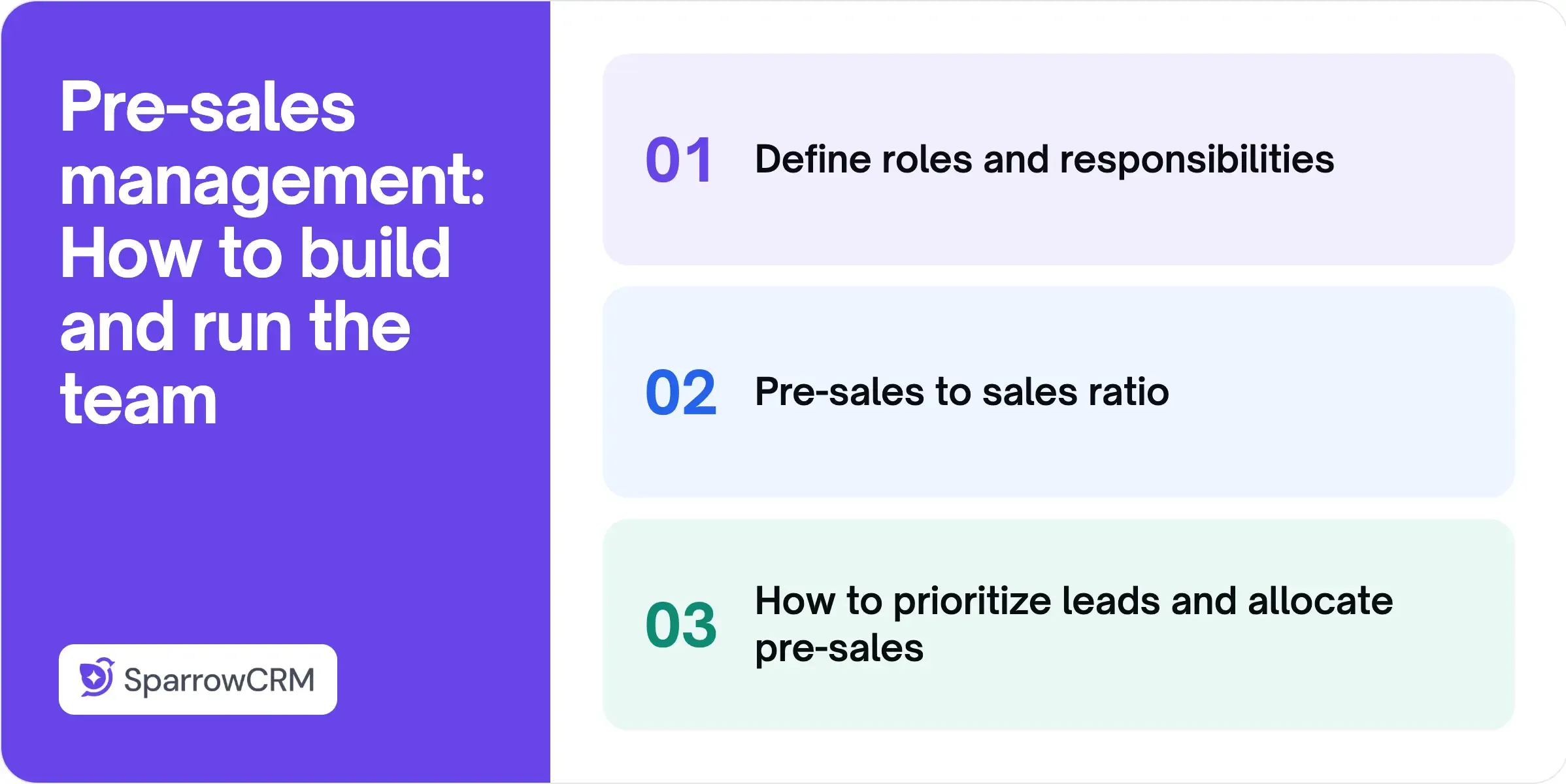
1. Define roles and responsibilities
Clearly defining roles and responsibilities is essential for effective lead qualification and solution mapping. Establish guidelines for how quickly the team should respond to new leads, which questions to ask during discovery, and how to assess whether a prospect is ready to move forward.
Also, define when pre-sales should involve the sales team, when to prepare a proposal, and how qualified leads should be handed over. Setting clear criteria for lead handoffs and an appropriate ratio of pre-sales specialists to sales representatives helps teams manage workloads, avoid delays, and keep opportunities moving through the sales pipeline.
For example, how we set up in our organization
Once we receive a lead through inbound or outbound channels, we need to make the first contact within 24 hours. Otherwise, we pass the lead to another pre-sales representative.
The discovery call should last no more than 20–30 minutes to understand the customer's needs, pain points, and urgency, and to help the pre-sales team ask the right questions.
The solution call needs to be scheduled within 3–5 business days after the discovery call. During this period, the team prepares the deck or demo for the solution. We also include the salesperson in the solution call so they can understand the customer's requirements.
At the end of the solution call, the pre-sales representative introduces the salesperson to the customer, and the team continues to support the process until the proposal is prepared for the customer.
2. Pre-sales to sales ratio
This ratio defines how well the ratio matches; the better the match, the better the outputs from the pre-sales to sales team.
In our team, we follow the 1:5 ratio, which is one pre-sales person to five sales team members. This supports efficient for the small to medium size business. If you are an enterprise, you can have a 1:3 ratio.
3. How to prioritize leads and allocate pre-sales
Leads can be assigned to pre-sales representatives through round-robin lead assignment or based on specific criteria, such as the team's availability, workload, and expertise. Lead prioritization should focus on the potential revenue impact of each deal and the likelihood of closing it quickly. This helps the team focus on high-value opportunities while ensuring leads receive timely support.
In our team, leads are allocated based on each pre-sales representative’s expertise in specific industries and use cases. Each representative focuses on two industries, which helps them build deeper industry knowledge and take a more consultative approach to the sales process.
How to measure pre-sales?
These are measures we calculate to understand how the pre-sales team performs alongside your core sales metrics.
Metric | Calculation | Why it needs to be measured |
|---|---|---|
Lead response time | Total time taken to respond to leads ÷ Total leads received | Measures how quickly the pre-sales team responds to new leads and helps identify delays in the initial contact process. |
Discovery-to-demo conversion rate | (Number of leads that move from discovery to demo ÷ Total discovery calls completed) × 100 | Shows how effectively the team identifies qualified opportunities and moves them to the solution demonstration stage. |
Demo-to-win conversion rate | (Number of deals won after a demo ÷ Total demos completed) × 100 | Helps measure how effectively product demonstrations contribute to closing deals. |
Pre-sales win rate | (Number of deals won that received pre-sales support ÷ Total deals that received pre-sales support) × 100 | Measures how often opportunities supported by pre-sales result in closed deals. |
Average sales cycle length | Total days taken to close won deals ÷ Total deals won | Helps identify whether pre-sales support contributes to faster deal closures. |
Solution validation rate | (Number of solutions approved by prospects after technical validation ÷ Total solutions technically validated) × 100 | Measures how often the proposed solution meets customer requirements during technical validation or a proof of concept (POC). |
Proposal turnaround time | Total time taken to prepare proposals ÷ Total proposals prepared | Helps identify delays in proposal preparation and ensures prospects receive proposals on time. |
Pre-sales workload | Total discovery calls, demos, POCs, and other pre-sales activities completed per representative | Helps managers understand workload, allocate leads fairly, and determine whether the team needs additional resources. |
Sales team satisfaction | Average score from feedback collected from sales representatives | Shows how effectively pre-sales supports sales representatives with product knowledge, demos, and technical expertise. |
Revenue influenced by pre-sales | Total revenue from won deals that received pre-sales support | Helps assess the revenue contribution of pre-sales activities and their impact on business growth. |
AI in pre-sales: Use cases that save hours every week
These are use cases we use for the pre-sales team to improve productivity in the sales process.
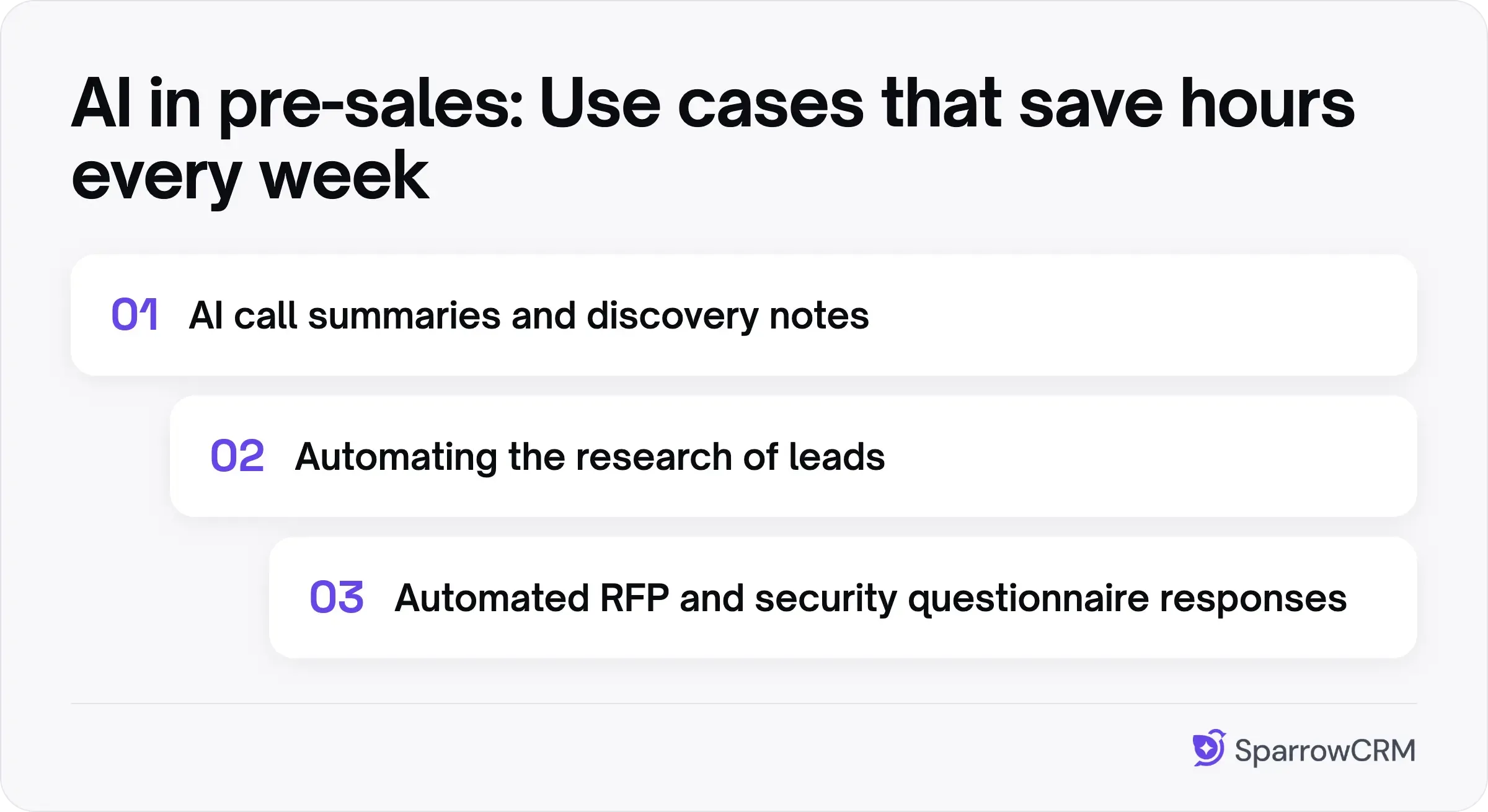
1. AI call summaries and discovery notes
We as a team felt we spent so much time updating the notes, call summaries, reminders, and competitor-mentioned notes by customers. We use the tool Fireflies for the notes over the call summaries, and our CRM has capabilities to highlight competitor mentions during the call and update them in the notes.
2. Automating the research of leads
Understanding a lead before the first interaction is important. In our team, we have automated this process by connecting Claude to our CRM. Whenever a new lead comes in, Claude analyzes the lead and company details and sends a summary to our Slack channel, helping us understand the prospect before reaching out.
3. Automated RFP and security questionnaire responses
An RFP lands on Friday with 200 questions and a deadline on Wednesday. Half the questions are ones your team has answered a dozen times before. The other half need an engineer, and that engineer is already booked on three demos.
AI-assisted RFP response means using AI to draft answers from your approved content library, so your team only writes and reviews what’s new. A security questionnaire works the same way. It’s a buyer’s checklist of data protection, compliance, and access-control questions that IT must approve before a deal can close.
Bottom line
Pre-sales is more than just product demos and technical support. It helps businesses understand customer needs, recommend the right solutions, build buyer confidence, and move deals closer to closing. With clear processes, the right lead prioritization, effective collaboration with sales, and measurable performance metrics, your pre-sales team can improve conversion rates, shorten sales cycles, and contribute to revenue growth.