SALES STRATEGY
Sales process: Definition, 7 steps, examples, and common mistakes

By Ganesh Ravi Shankar
Last updated on Aug 25, 2026
Explore this blog to learn the 7 core stages of an effective sales process, see a real B2B example, and get a step-by-step plan for building and avoiding common mistakes in your sales process.

Ganesh Ravi Shankar
Updated on Aug 25, 2026
The sales process is a strategic outline for every sales team to follow, which will improve the deal close rate and stabilize your sales team.
That's why having a structured sales process is critical. In this piece, we'll break down what the sales process is and walk you through the 7 steps. You'll see sales process examples and mistakes to avoid.
Key takeaways
- A well-defined sales process helps teams improve consistency, increase win rates, and deliver a better buyer experience.
- The seven core stages of a sales process guide prospects from lead qualification to a successful close.
- Standardized sales stages improve forecasting by providing clear visibility into pipeline health and deal progress.
- Tracking conversion rates at each stage helps identify bottlenecks and uncover opportunities to improve sales performance.
- The right CRM supports your sales process by automating routine tasks, improving data accuracy, and helping reps focus on selling.
What is a sales process?
A sales process is a framework that takes your sales team from identifying the prospects to closing the deals and beyond.
A well-defined sales process creates consistency at each phase of the sales cycle. Whether you're onboarding new team members, launching a new product, or entering a new market, your sales team has a shared understanding of what works and how to execute it.
📌 Did You Know?
50% of buyers choose the vendor that responds first, highlighting the importance of timely lead qualification and follow-up.
Why is a sales process important?
Sales teams are important for every business; without a defined process operate in chaos. Each rep invents their own approach. Deals move through pipelines inconsistently, and managers struggle to identify why some opportunities close while others stall.
1. Consistency across your team
A standardized sales process ensures every sales rep follows the same steps from qualification to closing. New hires ramp up faster, experienced reps maintain quality, and customers receive a consistent experience regardless of who manages the account.
2. Accurate revenue forecasting
Clear sales stages help managers understand where every opportunity stands and estimate future revenue with greater confidence. By tracking conversion rates between stages, sales leaders can identify pipeline bottlenecks, forecast revenue more accurately, and make informed decisions about hiring, budgeting, and growth.
3. Faster onboarding and training
A documented sales process gives new reps a clear roadmap instead of relying on trial and error. Structured training around each stage helps them understand what to do, when to do it, and how success is measured. This reduces ramp time and enables managers to focus on coaching rather than correcting mistakes.
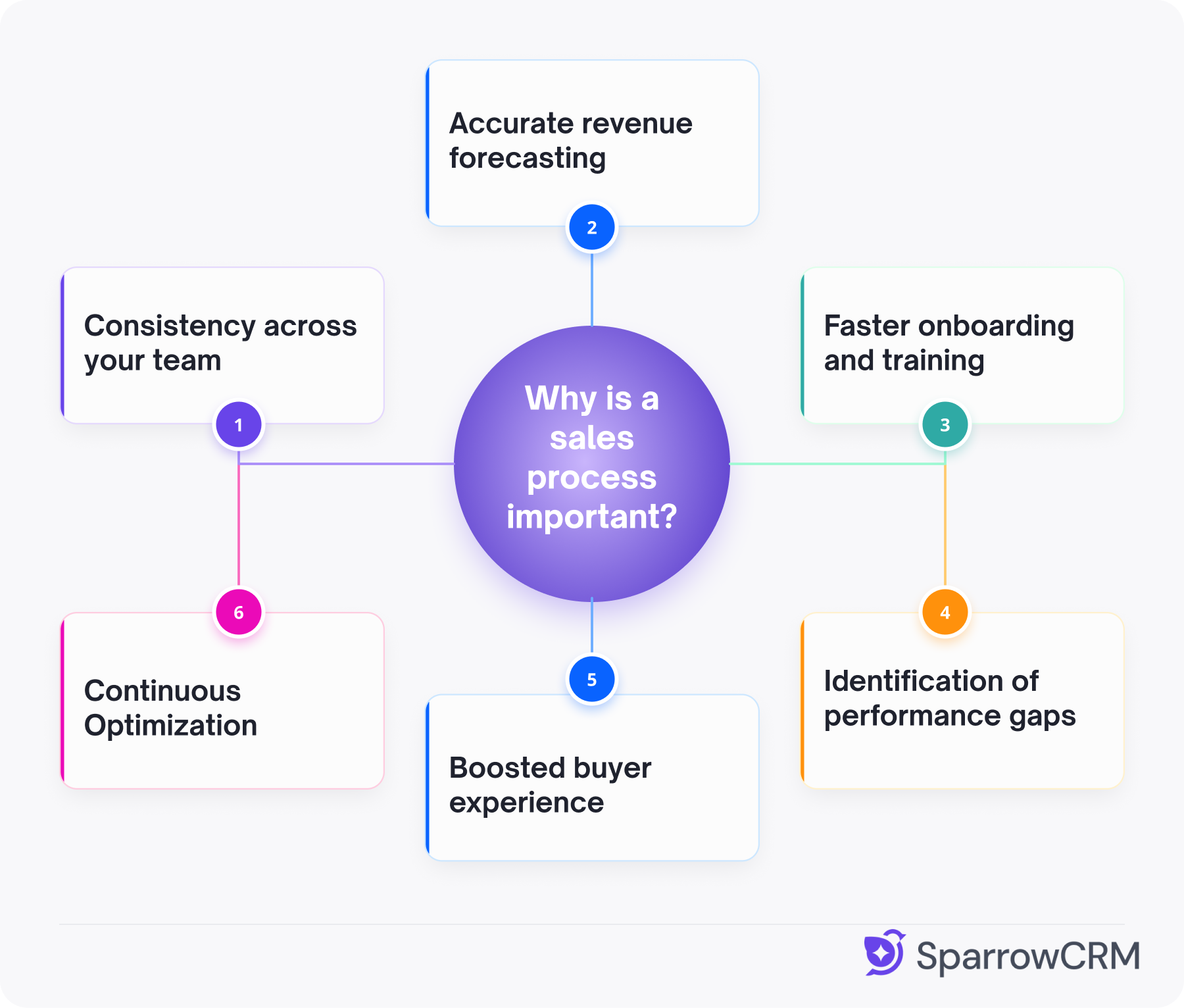
4. Identification of performance gaps
Tracking performance at every sales stage helps identify where deals are being lost. Managers can coach reps on specific skills such as qualification, discovery, or negotiation, instead of offering general feedback. Over time, successful techniques from top performers can be standardized and shared across the entire team.
5. Boosted buyer experience
A structured sales process ensures prospects receive the right information at the right time. It keeps conversations relevant, aligns multiple stakeholders, and creates a smoother buying journey. A professional, organized experience also builds trust and increases the likelihood of winning the deal.
6. Continuous optimization
A documented sales process makes it easier to test new strategies and measure their impact. Teams can optimize messaging, qualification criteria, or sales activities based on performance data. Regular updates ensure the process evolves with changing buyer expectations and market conditions.
Start Free with 3 Seats and Unlimited Records

7 steps of the sales process
Most successful B2B sales processes rely on the following seven steps as their backbone, though you may adapt them based on your specific market and product complexity.
1. Prospecting
Prospecting identifies potential customers who match your ideal buyer profile and market size. You begin by developing buyer personas that outline characteristics of companies likely to need your product and relevant roles within those organizations. This targeting prevents wasted effort on poor-fit accounts.
2. Lead qualification
Lead qualification helps sales teams focus on prospects who are most likely to become customers instead of spending time on low-quality leads. The goal is to determine whether a prospect is a good fit based on their needs, budget, authority, and buying timeline.
Start by researching the prospect's company, industry, size, and potential use case. Then connect through email, phone, or LinkedIn to understand their challenges and assess whether your solution is the right fit. Qualification frameworks such as BANT, CHAMP, and MEDDIC provide a structured way to evaluate opportunities consistently.
.png?2026-08-06T09:49:38.608Z)
3. Discovery or demo call
Discovery calls happen after prospects show interest, converting from cold leads to warm opportunities. These conversations determine whether customers are right for your product while uncovering pain points that help you close the sale.
4. Proposal
Proposals represent the formal step between sales conversations and contract signing. This document presents your offer for products or services along with purchase terms, building credibility through clear and professional language. Cover the total cost of your solution, including original implementation, onboarding, and ongoing maintenance.
5. Negotiation
Negotiation begins when the prospect discusses pricing, contract terms, or specific conditions before making a purchase decision. At this stage, the goal is to address objections, find mutually beneficial terms, and build confidence without compromising the value of your solution. Preparation is key, whether you make the first offer or respond to the prospect's proposal.
6. Closing
Closing happens when prospects agree to deal and sign the contract. Many salespeople give up before reaching yes, even though prospects often say no multiple times before committing.
Closing happens throughout the sales process, not just at the end. You're closing for next steps, closing for meetings, and closing for stakeholder access. The final signature is a natural conclusion to consistent progress, not a single high-pressure event.
Have a quick watch: The 7-step sales process
A quick video walkthrough of the seven key stages, from prospecting and qualification to negotiation and closing.
Sales process example (B2B SaaS)
B2B SaaS companies face unique challenges that require tailored approaches to their sales process stages. Here is one of the B2B sales process examples.
.png?2026-08-06T10:25:53.397Z)
How to build a sales process?
Building an effective sales process requires methodical planning before you define stages or set targets. Start with research and data analysis to create a framework that lines up with how your buyers actually purchase.
1. Define your ICP
Your ideal customer profile describes the buyer who's a perfect fit for your products or services. An ICP helps you narrow down which prospects are most likely to become paying customers rather than chasing every lead.
2. Map buyer trip
Understanding how buyers move from problem recognition to purchase decision shapes your entire sales approach. Map each stage they go through from awareness to purchase and tailor your actions at every touchpoint.
Catalog possible interaction points between prospects and your business. These include website visits, content downloads, sales calls, and product demos.
3. Identify sales stages
Define 3-5 sales funnel stages matched to your prospect's buying process. Each stage acts as both a mile marker and building block. This allows you to structure and measure your sales process.
Common stages include prospecting, qualification, discovery, and proposal. The stages you use must line up with your prospects' buying process so your sales team's activities match buyer needs at each phase.
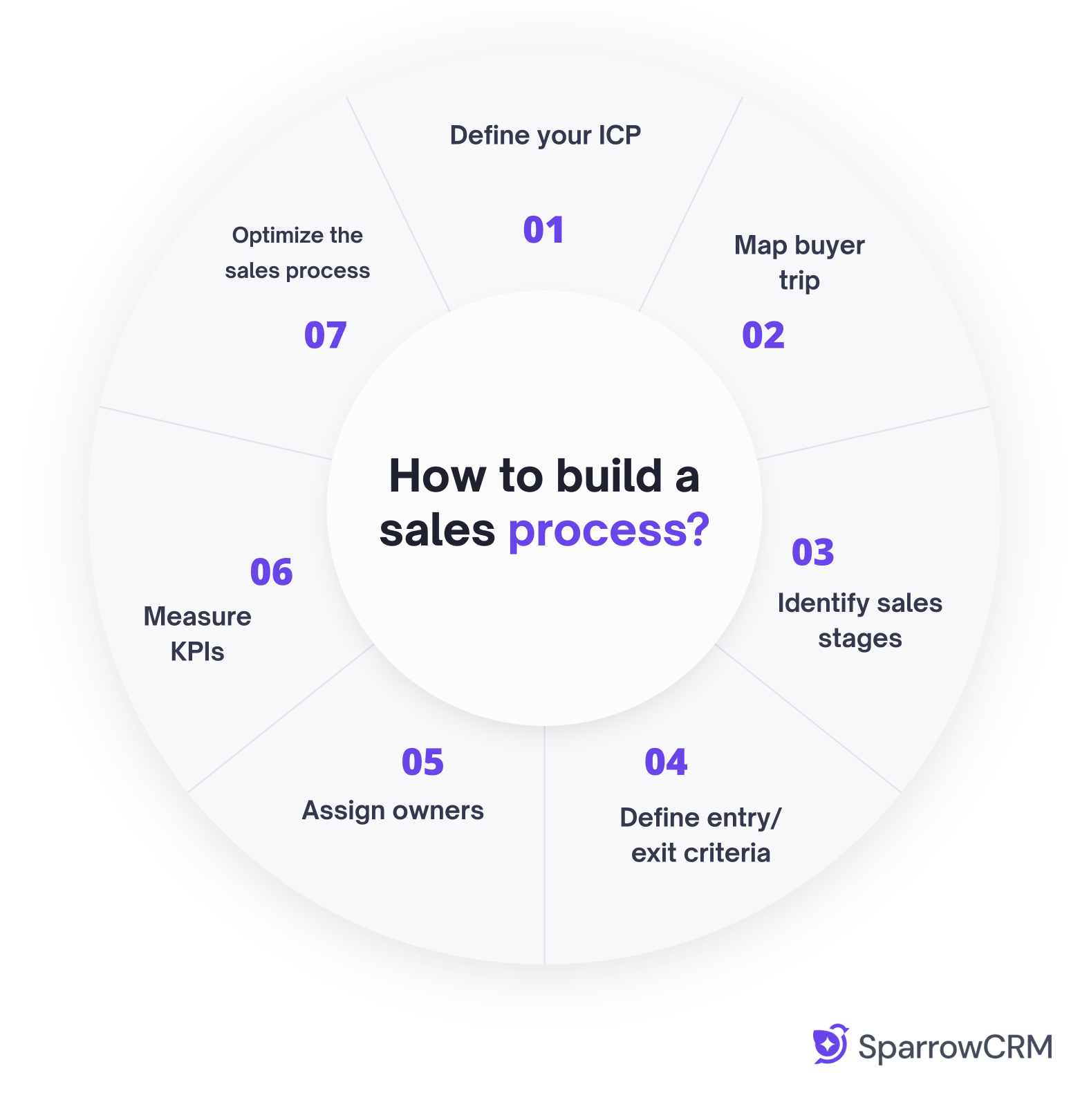
4. Define entry/exit criteria
Create clear exit points for each stage with specific actions that must happen before deals move forward. Entry criteria define what qualifies a deal to enter a stage. Exit criteria confirm readiness to advance.
Use objective, observable criteria tied to real buyer progress. "Buyer confirmed our solution works for them" proves more effective than vague rules like "buyer seemed interested." Each stage needs documented evidence showing meetings logged or proposals shared.
5. Assign owners
Assign records to specific users so everyone knows who manages which customer relationships. Each record can have one selected owner. This creates accountability throughout your pipeline.
6. Measure KPIs
Track key performance indicators that measure how closely your team's performance tracks to predetermined goals. Use CRM dashboards to monitor metrics like lead conversion rate and average sales cycle length. Choose KPIs that are specific, measurable, and relevant.
7. Optimize the sales process
Review each stage to identify where inefficiencies creep in regularly. Exploit data and analytics for clear pipeline pictures. Track deal stage progress and time spent in each phase. Gather feedback from sales reps and customers to adapt your process based on frontline challenges and buyer needs.
Common sales process mistakes
Mistakes in executing your sales process undermine even the strongest frameworks. Four common errors account for most pipeline problems and lost revenue.
1. Poor qualification
67% of sales fail to close because reps don't qualify leads before starting the sales process. Sales teams waste time on opportunities that will never convert without clear qualification criteria arranged to your ideal customer profile. Reps must establish structured frameworks like BANT or MEDDIC that verify budget, authority, need, and timeline before advancing deals.
2. Too many sales processes
A sales process should contain between three and seven stages. More stages make the framework harder to memorize and internalize. Each stage should reflect a specific goal related to moving the sale forward, not individual activities.
3. Generic demos
Demos fail when reps skip discovery and show every feature. Lack of discovery means you have no insight into customer needs and pain points. Weak discovery creates generic demos that could apply to anyone and reduces buyer participation while creating cognitive overload.
4. No CRM adoption
CRM implementations often fail because of poor user adoption rather than the technology itself. When sales reps view the CRM as extra administrative work instead of a productivity tool, they avoid using it. As adoption declines, data becomes incomplete, forecasting suffers, and the CRM loses its value for the entire team.
Free CRM with AI Deal Scoring & Copilot
Final thoughts
You now have everything needed to build and execute a sales process that drives predictable revenue growth. The seven steps provide a repeatable framework that transforms chaotic selling into systematic conversion. Best practices ensure your team qualifies well, discovers what matters, and closes deals.
Note that your sales process isn't static. Markets change, buyer priorities evolve, and competitors adapt. Continuous optimization based on conversion data and rep feedback keeps your framework relevant and effective.
Start by defining clear stages with objective entry and exit criteria. Train your team on qualification frameworks that focus effort where it matters most. Companies that win are those that execute their process while remaining flexible enough to meet individual buyer needs.
Your structured approach will compound results over time.

Frequently Asked Questions (FAQs)
Related Articles
11 Apr, 2025
9 best b2b sales software tools for growing teams in 2026

29 Aug, 2025
101 sales statistics (2026): benchmarks across AI, B2B, funnel, enablement, and more

25 May, 2026