SALES STRATEGY
15 sales objections examples & how to handle them like a pro

By Geethapriya
Last updated on Jul 31, 2026
Explore this blog to understand the 15 most common sales objections, why prospects raise them, and how to respond with questions and frameworks that move deals forward.

- What is a sales objection?
- The B-T-N-U framework: Root causes behind every sales objection
- 15 sales objections at a glance
- What the experts say about handling sales objections
- The 15 most common sales objections and how to handle them
- The objection nobody writes about: "How can I trust you? You're new in the market."
- Final thoughts
There is always a tense moment during a sales conversation when the prospect is hesitant to close the deal for numerous kinds of reasons. Many sales representatives experience a decline in confidence and a drift in their pipelines.
However, objections do not indicate that a deal is at risk. Research shows that around 60% of customers say no four times before they say yes. Prospects who raise concerns are actively evaluating the decision for purchase.
This guide covers 15 of the most common sales objections, including one that almost no published resource addresses: the trust objection that new products face in outbound-first selling. Each section breaks down what the objection actually means and how to respond in a way that builds momentum.
What is a sales objection?
A sales objection is any concern, hesitation, or barrier a prospect raises that prevents them from moving forward with a purchase. It is a signal that more work remains before the deal can close.
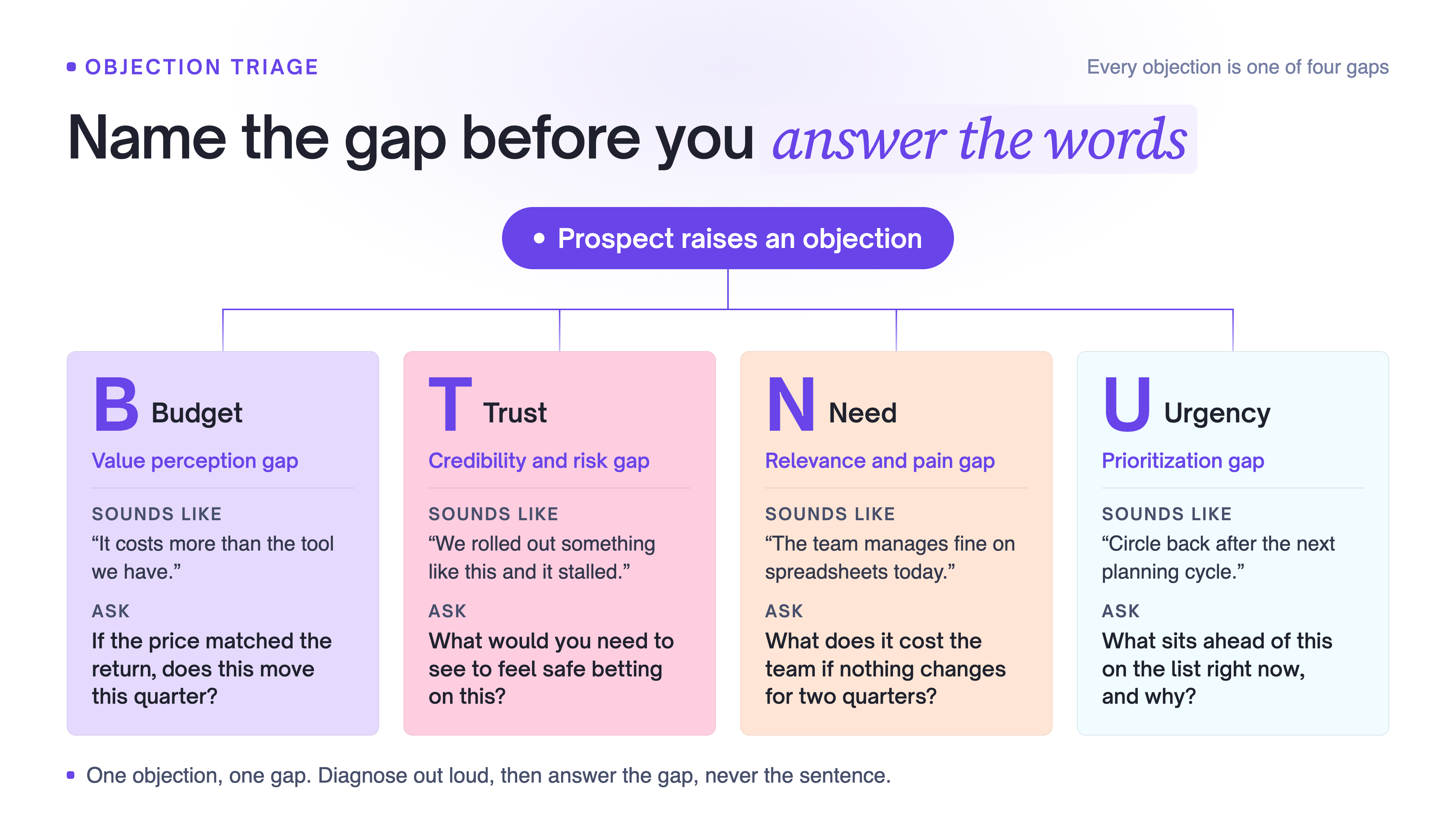
The B-T-N-U framework: Root causes behind every sales objection
Objections fall into four root causes: lack of budget, lack of trust, lack of need, or lack of urgency. Understanding which root cause is driving the objection entirely changes how you respond. We call this the B-T-N-U Framework:
15 sales objections at a glance
Use this table as a quick reference before any sales call or objection-handling session.
Objection | What It Really Means | Core Handling Strategy | Example Approach |
|---|---|---|---|
It's Too Expensive | They don't see enough value for the price | Pause for 3–5 seconds, ask "Too expensive compared to what?", then explain the ROI | Show the cost of staying with the current approach |
We Don't Have the Budget | Other business priorities come first | Acknowledge it, ask how budgets are decided, and explain the cost of waiting | Connect the discussion to their budget planning cycle |
I Need to Think About It | They have an unanswered concern or aren't ready to decide | Pause for 4 seconds and ask what they want to think about | Help them identify the real concern |
We're Already with a Competitor | They already have a solution but may not be fully satisfied | Ask what they like and dislike about their current solution | Identify gaps where you can provide more value |
I Need to Talk to My Boss | The person you're speaking with can't make the final decision | Ask who else is involved and offer to join the discussion | Help them prepare for the internal conversation |
We Don't Need This Right Now | They don't see how your solution solves a current problem | Ask about their priorities and connect your solution to them | Show how your solution supports their goals |
Competitor Has Better Price | They're comparing products mainly on price | Ask what's included in the competitor's offer and compare the overall value | Compare the total cost, not just the price |
Not Sure It Will Work for Us | They're worried the solution won't fit their business | Ask what's causing the concern and share relevant customer success stories | Show results from a similar company |
We've Had Bad Experiences | They've lost trust because of past vendors | Listen carefully, ask what happened, and focus on how your approach is different | Understand what went wrong before responding |
I Don't Have Time | They're busy or trying to end the conversation | Respect their time, give a short reason for your call, and schedule a follow-up | Suggest a quick five-minute conversation later |
We're Under Contract | They can't switch providers right now | Discuss what they'd ideally want and plan for their renewal period | Compare the benefits with the cost of switching later |
Missing Key Features | They're focused on features they may rarely use | Ask how often those features are actually needed and refocus on your strengths | Explain why your product prioritizes core workflows |
Never Heard of Your Company | They don't know or trust your brand yet | Share customer results, testimonials, or offer a pilot | Build trust with real examples |
Seems Too Complicated | They're worried the product will be difficult to use | Confirm the value first, then show how simple the setup is | Walk them through a live setup example |
Send Me Some Information | They may be trying to end the conversation politely | Agree, then ask what information would be most helpful | Turn the request into a more meaningful discussion |
How Can I Trust You? You're New. | They're unsure about choosing a new company | Share customer success stories and build credibility step by step | Use a proof ladder: early customers → case studies → well-known customers |
What the experts say about handling sales objections
Two practitioner perspectives worth anchoring before diving into individual objections.
“The biggest mistake salespeople make is answering the objection that was stated rather than the one that was meant. Your job is to listen past the words to the emotion underneath”
Jeb Blount's framework focuses on the emotional objection, the real concern hiding behind the stated one. A prospect who says "it's too expensive" is often expressing fear that the investment will not pay off, not that they genuinely lack funds.
“The best closers do not overcome objections. They prevent them. The earlier you earn trust and establish relevance, the fewer objections you face at the decision stage.”
Weinberg's principle reinforces something practitioners learn the hard way: most late-stage objections are early-stage qualification failures. The price objection at the end of a demo usually means value was never established at the beginning.
The 15 most common sales objections and how to handle them
1. "It's too expensive."
What it really means: A gap in perceived value, not necessarily a budget problem. Hidden concerns include: will this work for us, will we see enough ROI, is now the right time, or can we get this cheaper elsewhere?
Pause for three to five seconds after they finish speaking. This silence often prompts the prospect to reveal the real concern without you needing to push.
How to respond: "May I ask what aspect of the pricing concerns you most? And, too expensive compared to what? Let me show you what continuing with the current situation costs your team over the next twelve months."
2. "We don't have the budget right now."
What it really means: A timing objection, not a value objection. Budgets shift when priorities shift. When a prospect says there is no budget, they are often saying: " You have not yet justified moving money from somewhere else to this.
Ask about their priority-setting process rather than accepting the constraint. Connect the delay to cost; every month without the solution is a month of the problem continuing.
How to respond: "I understand. When does your next planning cycle begin, and what would need to be true for this to make the list?"
3. "I need to think about it."
What it really means: Usually one of three things: not interested and wants to exit politely, needs internal buy-in or budget approval, or has an unresolved concern they have not named. This phrase accounts for a large share of deals that stall.
Pause for four seconds, then ask: "Can you help me understand what specifically you will be thinking over?" If they stay vague, name three possibilities and ask which fits.
How to respond: "That makes complete sense. What are the one or two things you need to feel confident moving forward?"
4. "We're already working with a competitor."
What it really means: The prospect has already decided they need a solution in your category. They have buy-in and allocated budget. The question is only whether your solution is better than what they have.
Raise the competitor before they do: "I imagine a company your size is already using something to handle this." This opens a natural conversation about satisfaction gaps rather than creating a defensive moment.
How to respond: "That's great; it means we're solving the same problem. What's working well with what you have, and where do you find yourself working around it?"
5. "I need to talk to my boss first."
What it really means: You are speaking with someone who can veto the decision but cannot approve it alone. B2B purchases typically involve multiple stakeholders, and this person is the evaluator, not the economic buyer.
Offer to be part of the conversation rather than accepting a handoff. Ask: "Would it be useful if all three of us connected so I can understand their priorities directly?"
How to respond: "Of course. Help me prepare you for that conversation. What criteria does your boss typically use, and what objections do you think they'll raise?"
6. "We don't need this right now."
What it really means: The prospect cannot connect your solution to a problem they are actively feeling. This is a relevance problem, not a rejection. They may be stretched across competing priorities and have not had time to evaluate whether your solution applies.
Explore what they are focused on instead of pitching harder. Their answer will either reveal a connection to your solution or confirm there is no current fit; both outcomes save time.
How to respond: "What are the two or three problems your sales team is trying to solve this quarter?"
7. "Your competitor offers a better price."
What it really means: They are treating solutions as interchangeable commodities. Lower prices frequently reflect missing onboarding support, fewer integrations, or reduced customer success resources, but that difference is invisible until the prospect looks closely.
Ask about what is included rather than defending your price: "Does their proposal include implementation support, data migration, and ongoing customer success? Those differences tend to show up in the first sixty days, not on the proposal."
How to respond: "When you factor in implementation, support coverage, and time-to-value, how do the full-year costs compare?"
8. "I'm not sure this will work for us."
What it really means: Uncertainty about fit is almost always emotional, not technical. The prospect is protecting itself from a failed implementation, and the internal credibility hit that comes with it.
Ask: "What specifically makes you uncertain?" Address the exact concern. Case studies from companies in their exact vertical with specific outcome numbers are far more persuasive than general capability claims.
How to respond: "I hear that. Can you help me understand what part you're uncertain about? I'd like to show you how a company with a similar setup worked through this and what they saw in the first ninety days."
9. "We've had bad experiences before."
What it really means: Deep skepticism built from real disappointment, overpromising vendors, failed implementations, and products that underdelivered. The fact that they are still in the conversation means they have not written off the category entirely.
Write down the statement and pause before responding. Never minimize their experience or get defensive. Ask: "Can you walk me through what happened?" The more they talk, the less defensive the conversation becomes.
How to respond: "I appreciate you raising that directly. Understanding what went wrong is the only way I can show you why this would be different. Walk me through it?"
10. "I don't have time for this."
What it really means: Often a polite brush-off rather than a genuine scheduling problem. Cold calls catch people mid-task. Prospects use this phrase because it ends conversations quickly, and most salespeople accept it without challenge.
Acknowledge the interruption directly: "I realize I caught you in the middle of something. Can I take thirty seconds to tell you why I called, and you can tell me if it's worth following up?"
How to respond: "If I could show you how similar companies reduced [specific problem] by 30%, would that be worth five minutes when you're less stretched? I can send two specific times."
From first touch to close, automate your entire sales pipeline with AI
11. "We're under contract with another vendor."
What it really means: A real contractual barrier with latent interest. The phrase implies: if the contract were not there, I might be listening. The financial concern is the early termination cost or the sunk-cost feeling of a long-term commitment.
Explore what they would do without the constraint: "If the contract expired tomorrow, how would you want to move forward?" Then run an ROI analysis comparing break costs against the savings your solution delivers.
How to respond: "When does the contract come up for renewal, and would it be worth mapping out what the next decision looks like?"
12. "Your product is missing key features."
What it really means: Usually, a procurement checklist concern rather than a genuine deal-breaker. Someone built a comparison spreadsheet, your solution did not check a box, and now it is a stated barrier, even if that feature affects less than ten percent of daily work.
Ask about usage frequency first: "How often would your team actually use that feature?" The answer often reframes the conversation from must-have to nice-to-have.
How to respond: "We don't build that natively. Our platform focuses on [core job] because teams get to [result] faster. How often would that specific feature come up in your daily workflow?"
13. "This seems too complicated."
What it really means: An emotional concern rooted in fear of change or memories of a previous painful implementation. The prospect is asking: Will this be another project that burns time and does not deliver?
Confirm value before addressing complexity: "If the implementation were simple, would you be ready to move forward?" Then demonstrate simplicity live during the call rather than claiming it.
How to respond: "What specifically looks complicated? Let me show you how we set this up for a similar company in under twenty minutes on our last call. Would seeing that help?"
15. "Send me some information."
What it really means: The easiest exit from the conversation without sounding rude. Sending generic materials rarely leads anywhere; the prospect does not read them, and the salesperson follows up in silence.
Use their momentum: "Absolutely. Just so I send you the most relevant thing, are you more interested in [specific use case A] or [specific use case B]?" This small redirect turns a brush-off into a qualifying conversation.
How to respond: "Happy to send something over. Was there a specific question you had, or would a fifteen-minute conversation be more valuable than a PDF?"
The objection nobody writes about: "How can I trust you? You're new in the market."
This objection does not appear on most lists. But for any team selling an early-stage product through outbound, it is one of the most common barriers they face, and unlike price or timing, there is no quick reframe that makes it disappear.
The problem
Most objection-handling advice assumes a baseline of credibility. When a prospect says, "I've never heard of you" or "you're too new," that baseline does not exist.
For outbound-first products, this is the default starting condition. You are calling people who did not come looking for you. You have no inbound volume, no review site presence, and no brand recognition. The trust objection surfaces in the first two minutes of a cold call, and if it is not handled well, the conversation ends there.
The situation
In the early stages of selling a new product, this question came up constantly. Prospects, VPs of Sales, RevOps leads, and founders at 10-to-50-person teams had already been burned by products that over-promised. They did not want to be a test case for a startup that might not exist in eighteen months.
The specific challenge: the only social proof available was from small companies. Mid-size prospects would hear a testimonial from a five-person team and discount it entirely. "That's a different situation from ours." Trying to land mid-size companies without mid-size references created a credibility gap that no amount of demo polish could close.
The solution
The answer was not a single technique. It was a sequenced proof ladder, built deliberately, one tier at a time.
Stage | Who You Target | Proof You Use | What You Unlock |
|---|---|---|---|
Niche Win | Small company with specific pain | Free or supported pilot | First case study with real numbers |
Growing Brand | Fast-growing company that values being early | Niche win + AI-native differentiator | Mid-market reference logo |
Mid-Market Reference | Mid-size company needing credibility proof | Growing brand logo + outcome data | Reference call available |
Enterprise Conversation | A larger company is evaluating the category | Mid-market logo + category narrative | RFP inclusion or serious evaluation |
Stage one was the hardest and the most important. Identify small companies with a highly specific version of the problem, outbound-heavy teams of two to eight people who had outgrown spreadsheets but did not need enterprise CRM. Offer pilots with active implementation support, not just a free trial. Stay close, resolve every issue fast, and turn the outcome into a case study with numbers.
Stage two targets companies that are growing fast and self-identify as early adopters. They are not looking for the safest choice; they want the best tool for where they are going. The AI-native angle resonated strongly here.
Stage three is the turning point. With a small set of mid-market logos and outcome data, the trust objection in outbound calls shifts. The conversation changes from "why should I trust you" to "tell me more about what you did for them."
Final thoughts
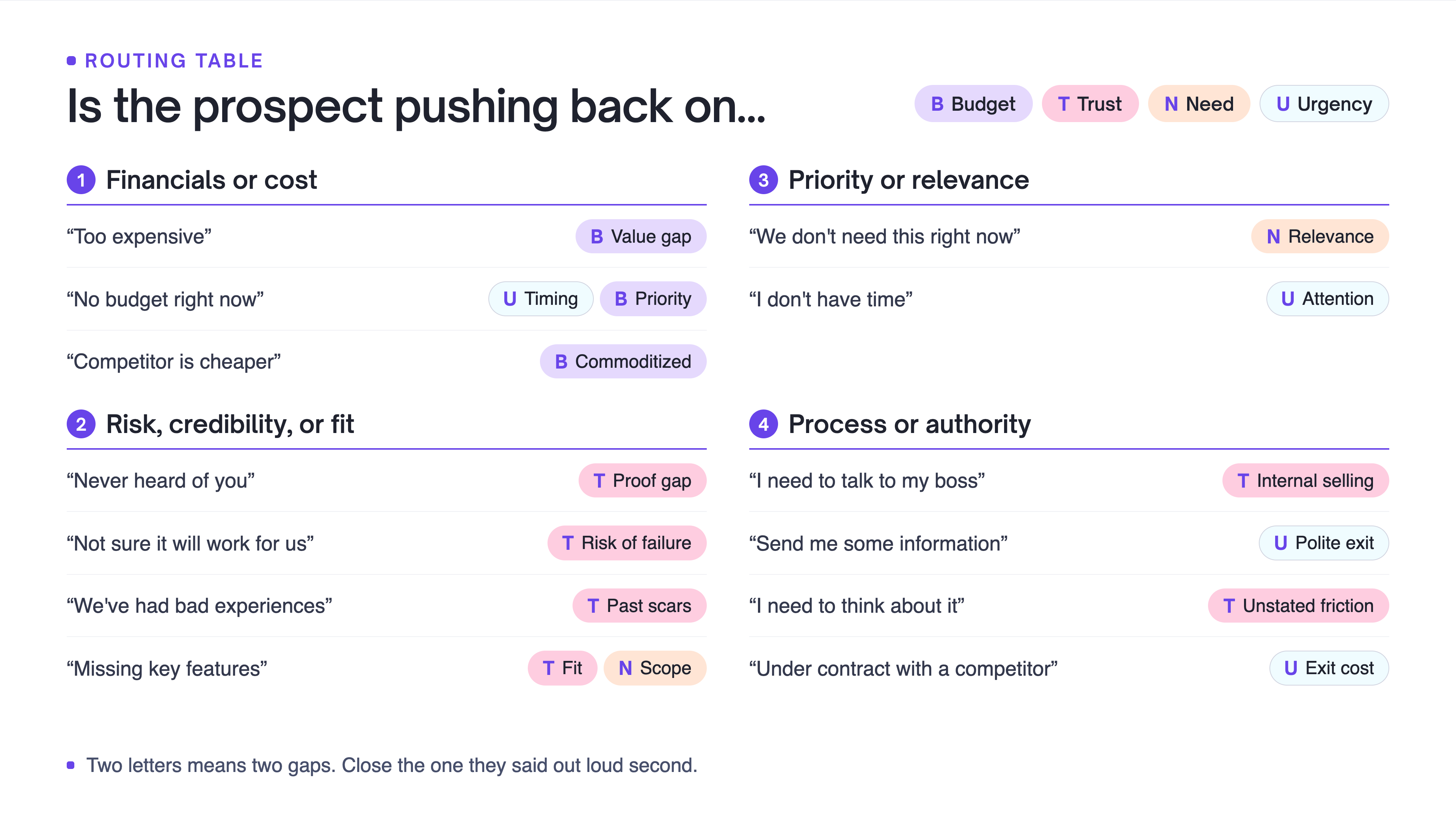
Sales objections are not barriers to closing; they are signals about where a prospect is in their decision-making process. The fifteen standard objections covered here each map to one of four root causes: budget, trust, need, or urgency. Identifying the root cause changes the response.
The sixteenth objection to the trust question that new products face in outbound cannot be handled with a reframe. It requires a proof ladder built over time, and a willingness to be transparent about where you are in your market journey while showing what you have already delivered.
Pick the three objections you hear most in your current pipeline. Map them to a root cause. Rehearse the response, not as a script, but as a framework. The difference between reps who close consistently and those who stall is almost always how well they respond when a prospect pushes back.