LEAD MANAGEMENT
Lead management: The complete guide to capturing, qualifying, and converting leads

By Ganesh Ravi Shankar
Last updated on Sep 14, 2026
Explore this blog to build a complete lead management system, from first capture to closed deal, with frameworks, scoring models, and automation playbooks your sales team can use today.
.webp)
- What is lead management?
- Why does lead management determine your revenue ceiling?
- The five stages of the lead management process
- Key components of a lead management system
- Lead management best practices
- Common lead management mistakes and how to fix them
- Lead management software: what to look for
- How to evaluate b2b lead management solutions?
Think about all the people we meet across different channels and conversations in business. Some of them may have a problem our product can solve, while others may simply be a good fit for what we offer. Once we identify that potential, we call them prospects or leads.
But finding a lead is only the beginning. We need a systematic way to organize, track, nurture, and follow up with these leads so we can turn the right ones into customers. That process is what we call lead management.
This guide helps you understand lead management, the process, what it is, why it is needed, and all the business impacts.
Key takeaways
- Lead management covers the entire journey from capturing and qualifying a lead to nurturing and converting them into a customer.
- Qualifying leads helps sales teams focus on the right opportunities based on factors such as ICP, needs, and buying intent.
- A consistent process matters more than manual effort, with clear qualification, follow-ups, handoffs, and lead tracking.
- The right lead management solution can improve conversions by keeping lead data organized, automating repetitive tasks, and showing teams what to do next.
What is lead management?
Lead management is the process of handling potential customers, or leads, from the moment they show interest in your product. It involves capturing their details, qualifying them to understand whether they’re a good fit, and nurturing them with the right follow-ups until they’re ready to become customers.
This entire process, from capturing a lead to converting them into a customer, is called lead management.
Why does lead management determine your revenue ceiling?
Your revenue doesn’t depend only on how many leads you generate. It also depends on what happens to those leads after they enter your pipeline.
A lead can be a perfect fit for your product and still never become a customer if your team responds too late, forgets to follow up, or sends the wrong message at the wrong time. That’s where lead management directly affects revenue.
- Speed matters: Responding within five minutes can make a lead 21× more likely to convert than responding after 30 minutes. When leads sit unattended, their interest can disappear before sales even gets a chance to engage.
- Nurturing matters too: Structured lead nurturing can generate 50% more sales-ready leads at 33% lower cost. Instead of treating every lead the same, teams can use lead information and behavior to decide who needs more education, who is ready for sales, and who needs another follow-up.
- Follow-up is another common leak: Only 8% of sales reps make five or more follow-up attempts, even though 80% of deals require five or more touches without a process that reminds reps who to contact and when, promising leads can easily fall through the cracks.
- The quality of your data also matters: Incomplete or inaccurate lead information makes it harder to prioritize prospects, personalize outreach, and route leads to the right person. Poor data quality can cost organizations an average of $13 million a year.
And when marketing and sales work from the same lead information, the impact becomes even clearer. Organizations with strong sales and marketing alignment are 106% more likely to exceed their quota.
So, lead management isn't just about keeping your CRM organized. It creates a repeatable path from first interaction to revenue. The better that path is managed, the fewer opportunities your team loses along the way.
The five stages of the lead management process
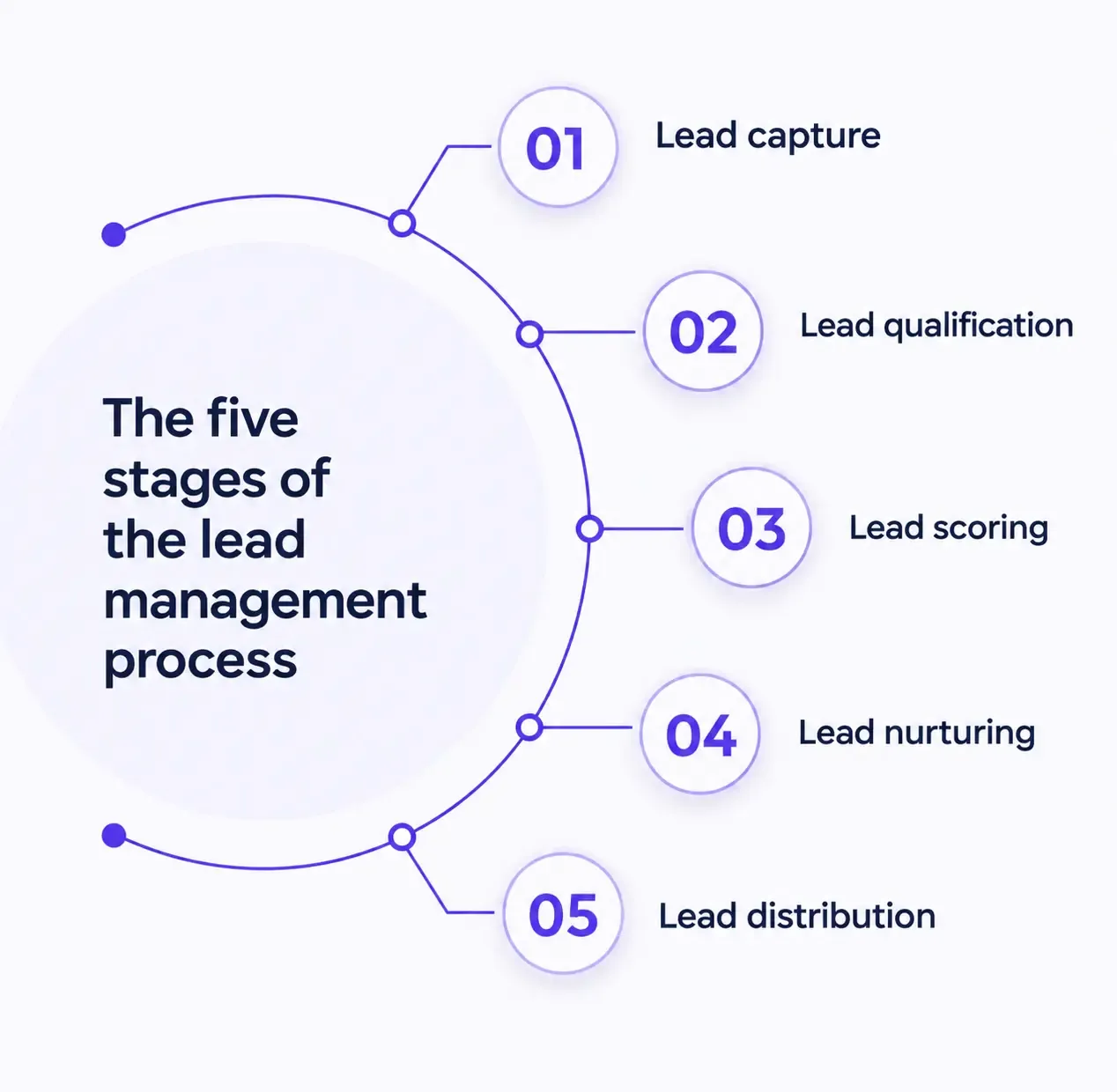
Every lead management process, regardless of company size or tech stack, moves through five distinct stages. Skipping or shortcutting any one of them is where revenue leaks.
1. Lead capture
Capture is where the process starts. Leads come in through web forms, demo requests, trial signups, inbound calls, LinkedIn messages, and event registrations. The capture stage collects contact and contextual information and immediately triggers routing or qualification.
For a deeper dive into capture strategies and tools, see our guide on lead capture strategies.
2. Lead qualification
Lead qualification is the process of identifying the most promising opportunities from the leads you’ve captured. Instead of treating every lead the same, you evaluate them against predefined criteria such as industry, company size, use case, and needs. These criteria together help define your Ideal Customer Profile (ICP).
The most widely used qualification framework is BANT: Budget, Authority, Need, and Timeline. It is fast, simple, and works well for straightforward B2B sales cycles. For more complex deals, MEDDIC (Metrics, Economic Buyer, Decision Criteria, Decision Process, Identify Pain, Champion) provides more rigour at the cost of speed.
3. Lead scoring
Scoring assigns a numerical value to each lead based on two dimensions: fit (how closely they match your ideal customer profile) and behaviour (how actively they are engaging with your content and product).
A basic scoring model might look like this:
- Job title match (VP or above): +20 points
- Company size in target range (10–200 employees): +15 points
- Pricing page visit: +25 points
- Demo requested: +40 points
- Email unsubscribed: −30 points
- Free email domain: −20 points
Leads that cross a defined threshold (say, 60 points) automatically route to sales. Those below the threshold stay in a nurture track. For a full breakdown of scoring approaches, read our guide on lead scoring models.
4. Lead nurturing
Lead nurturing is the process of building a relationship with leads who aren’t ready to buy yet. Instead of pushing for a sale, you keep them engaged by sharing relevant information, addressing their concerns, and building trust until their buying intent increases.
Effective nurturing goes beyond sending the same newsletter to everyone. It uses a lead’s actions and interests to decide what to send and when.
For example, someone who downloads a pricing guide may need a different follow-up from someone who only reads a top-of-funnel blog. The goal is to deliver the right information at the right time and gradually move the lead closer to a purchase.
5. Lead distribution
Once a lead is qualified and scored above your sales threshold, it needs to reach the right rep, fast. Distribution logic typically follows one of three models:
- Round-robin: leads are assigned sequentially across the team, good for even workload distribution
- Territory-based: leads assigned by geography or industry, good for specialised reps
- Skill-based: leads matched to reps with relevant product or vertical expertise, good for complex deals
Manual assignment introduces delay and inconsistency. Automated distribution, triggered by your scoring threshold, ensures a qualified lead hits a rep's queue within minutes of reaching that threshold. Read more on lead routing and assignment rules.
Turn more leads into revenue with AI-powered lead management.
Key components of a lead management system
A good lead management system brings together the processes and tools your team needs to capture, qualify, nurture, and convert leads. The key components include:
 (1).webp?2026-09-14T15:45:15.069Z)
1. ICP and lead identification
Before you can qualify leads, you need to know who is most likely to become a customer. Your Ideal Customer Profile (ICP) defines the characteristics of your target customers, such as industry, company size, use case, and decision-maker. This gives your team a clear basis for identifying and prioritizing the right leads.
2. CRM as the central hub
A CRM keeps your lead information and interactions in one place. Instead of searching through spreadsheets, emails, and different tools, your team can see lead details, conversations, activities, and follow-ups from a single system. It also gives sales teams the visibility they need to manage leads as they move through the pipeline.
3. Marketing automation
Automation takes care of repetitive follow-ups and keeps leads engaged without requiring your team to handle every interaction manually. For example, a lead who requests a demo can automatically receive a follow-up, while someone who repeatedly visits your pricing page can be added to a more relevant sequence.
4. Analytics and performance tracking
You need to know what happens to your leads after they enter your funnel. Tracking metrics such as lead-to-MQL conversion, MQL-to-SQL conversion, lead response time, and SQL-to-close rate helps you identify where leads are dropping off and which parts of your process are contributing to revenue.
Lead management best practices
Good lead management is less about adding more tools and more about creating a consistent process for handling leads. These practices can help your team keep that process simple and effective.
.webp?2026-09-14T15:46:10.295Z)
1. Define clear lead qualification criteria
Set clear criteria for what makes a lead worth pursuing. Consider factors such as industry, company size, job role, use case, and buying intent. Having these criteria in place helps sales and marketing prioritize the same types of leads and makes handoffs easier.
2. Keep sales and marketing aligned
Both teams should agree on what a qualified lead looks like and what happens after a lead is handed over to sales. Regularly reviewing lead quality, conversion rates, and pipeline performance together can help both teams identify gaps and improve the process.
3. Keep lead data clean and up to date
Accurate lead information helps your team qualify, prioritize, and follow up with prospects effectively. Regularly check for duplicate, outdated, or missing information, and use validation and enrichment where possible to keep your database reliable.
4. Create a consistent follow-up process
Decide when and how your team should follow up after a lead takes an action. A clear follow-up cadence makes sure promising leads don't get forgotten and gives reps a consistent process to work from rather than relying on memory.
5. Track how leads move through the funnel
Don't only measure how many leads you generate. Track how many move from one stage to the next and how long they spend in each stage. This helps you identify where leads are getting stuck and where your process needs improvement.
Common lead management mistakes and how to fix them
Even with a lead management process in place, small gaps can cause good leads to slip through. Here are some common mistakes to watch for:
.webp?2026-09-14T15:47:06.515Z)
1. Treating every lead the same
A lead who requests a demo is showing more intent than someone who downloads a general guide. Giving both leads the same priority can waste sales time and delay follow-ups. Use lead scoring and qualification criteria to prioritize leads based on fit and buying intent.
2. Leaving lead handoffs unclear
When marketing and sales don't have a clear agreement on when a lead should be handed over, leads can get stuck between the two teams. Define the criteria for a sales-ready lead and make the handoff process clear.
3. Relying on manual follow-ups
When follow-ups depend entirely on individual reps remembering who to contact and when, some leads will inevitably be missed. Use reminders, tasks, and automated sequences to keep follow-ups consistent while allowing reps to step in when personal outreach is needed.
4. Letting inactive leads disappear
Not every lead is ready to buy today. Removing or ignoring leads simply because they aren't ready can mean losing potential opportunities later. Keep relevant leads in a nurture or re-engagement process and revisit them when their needs or buying intent change.
Lead management software: what to look for
The right lead management tool depends on your team size, sales motion, and how your marketing and sales systems currently interact. The categories to evaluate:
1. CRM platforms with native lead management
Most CRMs include lead capture forms, scoring fields, pipeline stages, and basic automation. SparrowCRM, HubSpot, and Zoho CRM all fall into this category. For small B2B sales teams, a well-configured CRM is often sufficient without adding a standalone lead management layer on top.
2. Marketing automation platforms
Platforms like Marketo, HubSpot Marketing Hub, and Pardot handle lead nurturing at scale, multi-channel campaign orchestration, behavioural scoring, and automated MQL-to-SQL handoffs. These make sense when your marketing volume is high enough to justify the complexity and cost.
3. Dedicated lead routing and enrichment tools
Tools like LeanData, Clearbit, and Apollo.io focus on specific parts of the lead management stack, routing logic and data enrichment, respectively. They plug into your CRM rather than replacing it. Useful when your CRM's native routing or data quality falls short at scale.
When evaluating tools, start with process requirements, not feature lists. Define your scoring model, routing rules, and handoff criteria first. Then identify which gaps your current stack cannot cover. That gap analysis is your buying criteria.
How to evaluate b2b lead management solutions?
When evaluating a B2B lead management solution, focus on how well it supports your actual sales process rather than how many features it offers. Look for a solution that can:
- Capture leads from the channels your team already uses.
- Qualify and prioritize leads based on your ICP, fit, and buying intent.
- Automate follow-ups without making communication feel impersonal.
- Keep lead information organized so sales and marketing work from the same data.
- Track lead activity and pipeline movement to identify where opportunities are being lost.
- Integrate with your existing tools such as email, marketing platforms, and other sales systems.
- Scale with your team without becoming unnecessarily complex or expensive.
The right solution should make it easier for your team to know which leads to focus on, what to do next, and when to follow up, not create another system that reps have to spend their time managing.