CRM SOFTWARE
Close CRM Pricing 2026: Plans, Costs, and Hidden Fees Explained

By Geethapriya
Last updated on Jul 17, 2026
Explore every Close CRM pricing plan for 2026, including features, hidden costs, and add-ons. Find out what your team will actually pay before choosing the right plan.
Geethapriya
Updated on Jul 17, 2026
The pricing page for Close CRM has a straightforward feature list, four plans, and a single-seat fee. However, the number on your invoice is rarely the same as the number on that site.
This guide breaks down every Close CRM pricing plan for 2026, what each tier includes, what's billed separately, and what a team of five, ten, or fifteen people actually spends after usage begins. If you're evaluating close crm pricing plans against other options, this is the total-cost picture.
Quick Take:
Close CRM is a solid fit for outbound sales teams with fewer than 50 reps.
While the Solo and Essentials plans cover the basics, most teams will need the Growth plan to unlock automation, workflows, and the Power Dialer. There’s no free plan, but you can try a free trial without a credit card.
Close CRM pricing: all four tiers at a glance
Plan | Monthly price (per user) | Annual price (per user) | Best for | AI credits included |
Solo | $19 | $9 | Solo founders and reps | 500 / month |
Essentials | $49 | $35 | Small teams needing a CRM foundation | 1,000/user, up to 10,000/month |
Growth | $109 | $99 | Teams ready for automation and Power Dialer | 1,500/user, up to 15,000/month |
Scale | $149 | $139 | Larger orgs needing governance and coaching | 2,000/user, up to 20,000/month |
Numbers above come directly from Close's own pricing page, current as of 2026. Paying annually saves close to 50% compared to monthly billing on every tier. For a broader breakdown of how CRM platforms structure pricing across the market, the best CRM software compared guide breaks down tiers and total cost by category.
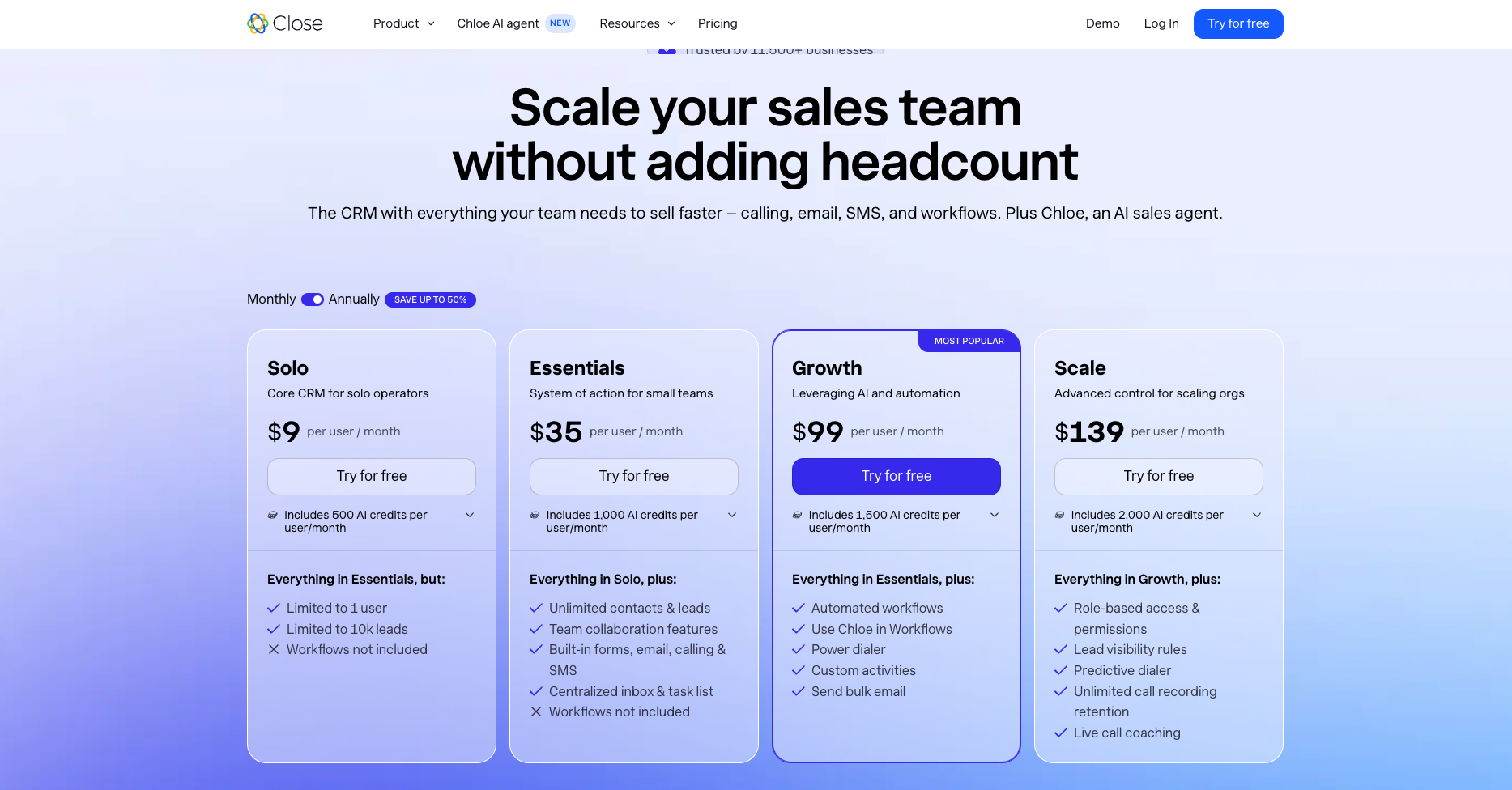
Source: close.com
Close CRM Solo plan explained
Solo costs $9 per user per month billed annually, or $19 billed monthly per user. It includes up to 10,000 leads, a basic kanban pipeline, contact timelines, built-in calling and SMS, and 500 AI credits a month.
The limitation on the plan is no workflow automation, no bulk email, and no follow-up reminders, features that even a two-person team will want within the first month or two.
Solo makes sense for a solo founder or independent rep who wants a real CRM instead of a spreadsheet. It's an entry point into close crm pricing, not a long-term home.
Close CRM Essentials plan explained
Essentials runs $35 per user per month annually, or $49 monthly per user. You get unlimited contacts and leads, team collaboration features, built-in forms, a centralized inbox, and a shared pool of 1,000 AI credits per user, up to 10,000 a month total.
This is the plan most small teams start on. It covers the core CRM job pipeline visibility, calling, and email, without paying for automation you're not using yet.
The Limitations: workflows, the Power Dialer, and bulk email are still locked at this tier.
Close CRM Growth plan explained
Growth costs $99 per user per month annually, or $109 monthly. Everything in Essentials carries over, plus automated workflows, Chloe (close crm's AI agent) usable inside those workflows, the Power Dialer, custom activities, and bulk email. AI credits jump to 1,500 per user, shared up to 15,000 a month.
The Growth plan is where Close CRM starts to show its real value. Features like the Power Dialer can save a significant amount of time for reps making dozens of calls each day by automatically dialing through contact lists.
You also get 90-day call recording retention and support for up to 10 connected email accounts instead of just three. For most growing outbound sales teams, this is the plan where Close becomes much more than a basic CRM.
Close CRM Scale plan explained
Scale is priced at $139 per user per month annually, or $149 monthly. Everything in Growth is included, plus role-based access permissions, lead visibility rules, the predictive dialer, unlimited call recording retention, and live call coaching.
AI credits rise to 2,000 per user, shared up to 20,000 a month, and custom objects become available for teams that need to model data beyond standard leads and contacts.
Scale is a management and governance upgrade more than a calling upgrade within close crm pricing. It matters most for sales leaders overseeing multiple reps who need visibility rules, coaching tools, and predictive dialing at real volume.
Add-ons and hidden costs in Close CRM
The seat price is the floor, not the ceiling. None of the items below show up in the headline plan price, but most active teams end up paying at least one or two of them.
Add-on | Cost | What it does |
Calling usage | ~$0.02/minute | Outbound call minutes billed on top of the seat price |
Phone number rental | From $1/month per line | Base line rental before any premium routing features |
Premium Phone Numbers | $19/month per line | Lead-based call routing, phone menu (IVR), round-robin routing |
Call Assistant | $50/month per org + $0.02/min usage | AI transcription, recording, and call summaries |
Additional organizations | $50/month per org (1 free on Growth & Scale) | A separate secondary org for multi-brand or multi-team setups |
SMS / A2P 10DLC | Usage-based, plus carrier registration | Texting US numbers requires A2P 10DLC registration |
Reviewers who've tested Close at real calling volume report that add-ons and usage can push the effective per-user cost 40 to 75 percent above the sticker price.
What Close CRM actually costs by team size
Team size | Base cost ($99 Growth, annual) | Estimated usage add-ons | Estimated monthly total | Estimated annual total |
5 reps | $495 | $100–150 | $595–645 | $7,140–7,740 |
10 reps | $990 | $200–300 | $1,190–1,290 | $14,280–15,480 |
15 reps | $1,485 | $300–450 | $1,785–1,935 | $21,420–23,220 |
These figures assume the Growth plan billed annually, since that's where most active outbound teams land, plus moderate daily calling and one or two premium numbers per team. Usage estimates are based on documented calling patterns from Close users, not officially published totals — model your own team's call volume before budgeting.
Who Close CRM is ideal for (and who should look elsewhere)
Ideal for
- Outbound-heavy inside sales teams of roughly 3 to 50 reps who spend most of the day calling and texting prospects
- Founders who want calling, SMS, and CRM in one place without stitching together separate tools
- Teams currently juggling a CRM, a separate dialer, and a texting tool who want to consolidate onto one platform
Not ideal for
- Teams that need heavy marketing automation or multi-channel campaign management
- Businesses built around inbound lead nurturing rather than outbound execution
- Teams that want a flat, predictable monthly bill — usage-based calling and SMS charges are the main variable in close crm pricing, and cost can swing month to month with outbound volume
Why SparrowCRM is a strong alternative to Close CRM
SparrowCRM takes a different approach to scaling sales teams. Rather than reserving automation and AI capabilities for higher-tier plans, it includes features like ICP fit scoring, buying intent signals, deal health tracking, and AI-powered next-best actions as part of the core product from the start.
Close CRM vs SparrowCRM: how the pricing compares
Dimension | Close CRM | SparrowCRM |
Entry price | $9/user/month (Solo, capped at 1 user) | $0/seat/month (Free, up to 3 seats) |
Where automation unlocks | Growth, $99/user/month annual | Growth, $19/seat/month |
AI access | Metered credits, scales with tier and seat count | Included from the Free plan onward, on every tier |
Calling and SMS | Usage-based on top of every plan | Not the core channel — sequences and email-led outreach |
Billing predictability | Seat price plus variable usage each month | Flat per-seat pricing, with optional credit top-ups |
Ease of use and AI depth
Close CRM's dialer-first design is excellent for outbound calling, but teams that also need buying committee mapping and deal health signals often end up piecing together extra tools alongside Close. SparrowCRM keeps that intelligence native to the CRM itself.
Specifically on AI depth, the difference is architectural rather than cosmetic. Chloe, Close's AI teammate, is genuinely useful for calling and qualifying leads, but her usage drains a monthly credit pool that scales with seat count. SparrowCRM's AI agents run on every plan, including Free, which makes budgeting more predictable as your team grows past 10 or 15 people.
If your team is weighing close crm pricing plans 2026 against SparrowCRM specifically, the numbers above cover Free through Pro — Enterprise is quoted directly since limits and terms are customized per team.
Sign Up Today and Get 3 Free Seats with AI Included.

Final thoughts
Close CRM's pricing is fair for what it delivers, but the seat price alone won't tell you what you'll actually pay. Model your team's real calling and texting volume, decide whether you need Growth for the Power Dialer and workflows, and factor in add-ons like Call Assistant and Premium Phone Numbers before you sign.
For most growing outbound teams, Growth billed annually is the realistic starting point in close crm pricing. Scale is worth the jump once you need role-based governance and coaching, not just more dialing power.

Geethapriya
Geethapriya is a Growth Marketer and Business Researcher who researches and writes about CRM, sales, marketing, and customer engagement. Her work focuses on understanding industry trends, customer and sales challenges, and how businesses can use technology to build more effective growth processes.