SALES PIPELINE
Sales funnel examples: B2B, B2C, and CRM-led funnels explained

By Geethapriya
Last updated on Aug 13, 2026
Explore this blog to understand how B2B, B2C, and CRM-led sales funnels work, with real-world examples, stage-by-stage breakdowns, and a practical guide to building a funnel that converts.
Geethapriya
Updated on Aug 13, 2026
Most sales teams generate leads. Few convert them consistently. The difference usually isn’t traffic volume or ad spend. It’s whether you have a clear, stage-by-stage funnel that tells every lead what to do next, and tells every rep where to focus.
In this guide, you’ll see how B2B, B2C, and CRM-led sales funnels actually work, with real company examples at each stage. If your funnel is leaking, the fix is usually in the examples.
TL;DR
A sales funnel is the path a prospect takes from first hearing about you to becoming a paying customer.
B2B funnels need multiple touchpoints across multiple stakeholders. A single champion saying yes is not enough — procurement, finance, and the end user all have different objections that need addressing at different stages.
B2C funnels live or die on friction removal. Cart abandonment averages 70% across industries. The first recovery email sent within one hour of abandonment, before any discount, consistently outperforms waiting.
A CRM does not build your funnel. It makes every stage visible. Without it, you are guessing where deals stall and why conversions drop.
The post-purchase stage is the most ignored and the most profitable. A 5% improvement in retention can increase profits by 25–95%. Most funnels end at close. That is where the biggest revenue opportunity sits.
What is a sales funnel, and how does it work?
A sales funnel represents the journey a prospect takes from first discovering your product to completing a purchase. It is called a funnel because many people enter at the top and progressively fewer move through each stage, filtering down to the prospects who are the right fit and are ready to buy.
The funnel shape is not just a diagram. It is a diagnostic tool. When you notice a drop-off spiking at a specific stage, you know exactly where to focus. Without a funnel, you are guessing at which part of your process is broken.
Sales funnel vs sales pipeline
A sales funnel charts the buying journey from the prospect’s viewpoint. A sales pipeline tracks how your reps engage with buyers, from the seller’s perspective. Both matter. Neither replaces the other.
Dimension | Sales Funnel | Sales Pipeline |
Perspective | Tracks the buyer’s journey and mindset — from awareness to purchase | Tracks the seller’s actions and deal progress — from contact to close |
Focus | How prospects think, feel, and behave at each stage | What the sales rep does: call made, proposal sent, demo booked |
Primary user | Marketing and demand generation teams | Sales reps and sales managers |
Stage naming | Awareness → Interest → Decision → Action | Lead → Contacted → Qualified → Proposal → Closed |
Measurement | Conversion rates between buyer stages, drop-off analysis | Deal velocity, win rate, average deal size, time-in-stage |
Best used for | Optimising marketing content, finding where leads drop off | Managing rep activity, forecasting revenue, tracking deal health |
Funnels help you understand your customers. Pipelines help you manage your sales team. Use both.
Understanding sales funnel stages (and why most people get them wrong)
Each stage represents a shift in how a prospect thinks about your solution. The mistake most businesses make is treating every stage the same way, sending the same message to someone who has just discovered the brand and someone who is ready to buy.
Here is what actually happens at each stage and what moves people forward. See how these map directly to your sales pipeline stages when you set up a CRM.
Top of funnel: Awareness and Interest
Prospects first discover you here, through search, social media, webinars, or word of mouth. Your job is not to sell. It is useful enough that they want to keep going.
Content marketing generates three times more leads than outbound marketing at this stage, and costs significantly less per lead.
What works at this stage:
- SEO-optimised blog posts that answer the questions your ICP is already asking
- Social ads that educate, not pitch
- Free guides, industry reports, and educational resources
- Webinars and short videos that demonstrate expertise without a product demo
How to implement: Match your content to what prospects are searching for. If someone searches ‘how to increase conversion rates’, answer that question first. The product mentioned comes later.
Middle of funnel: Consideration and Intent
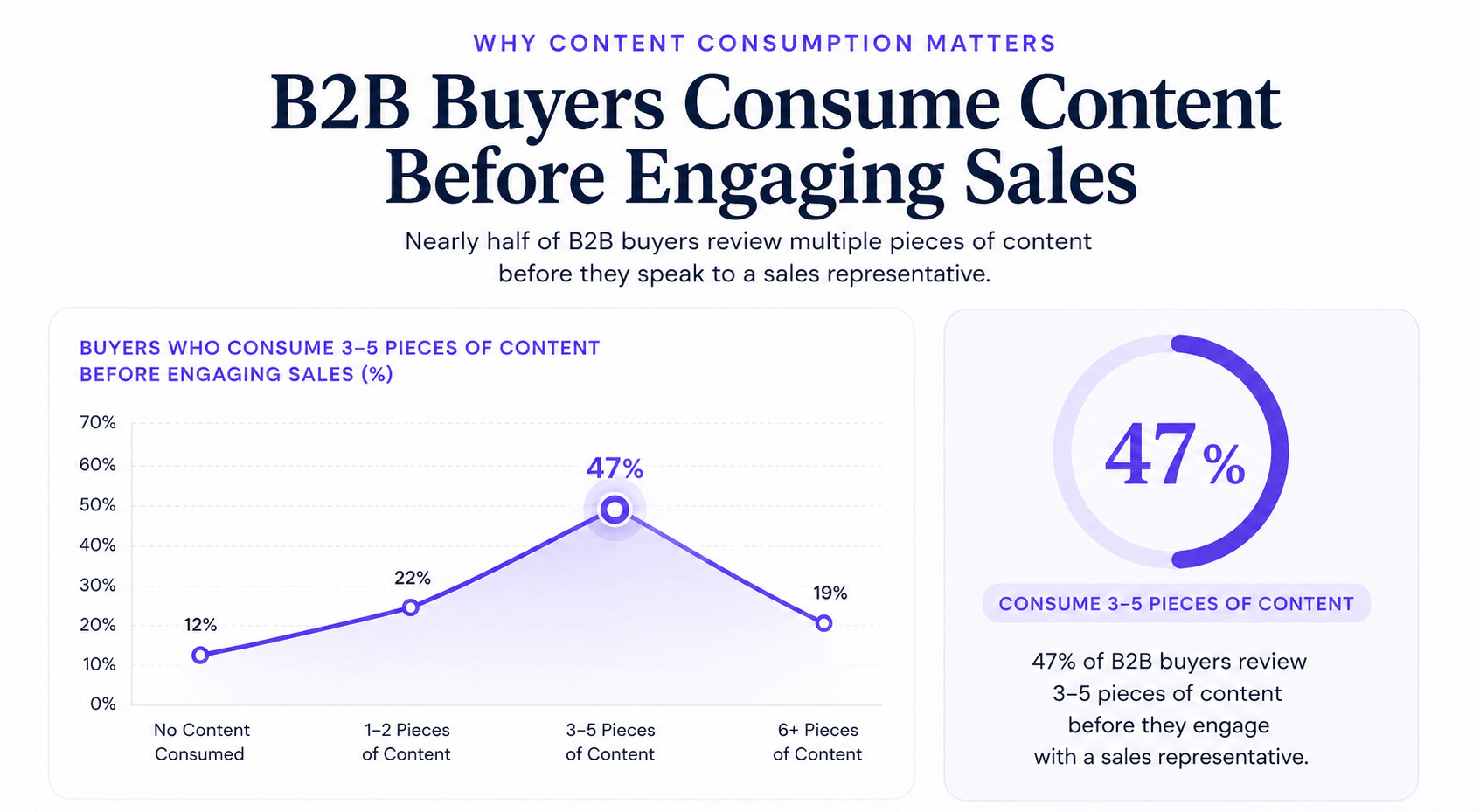
Prospects are now comparing options. They are digging into features, pricing, and implementation details. Research shows that 47% of B2B buyers view 3–5 pieces of content before speaking to a sales rep.
Intent signals to watch for:
- Signing up for a webinar or requesting a demo
- Downloading a comparison guide
- Visiting the pricing page more than once
- Requesting a trial or free assessment
What works here:
- Product demos tailored to specific use cases
- Customer testimonials from companies in a similar situation to the prospect
- Detailed case studies with ROI data
- Free trials or structured assessments
How to implement: Address objections before they ask. If implementation time is the common concern, show a 30-day setup process. Do not wait for them to raise it on a call.
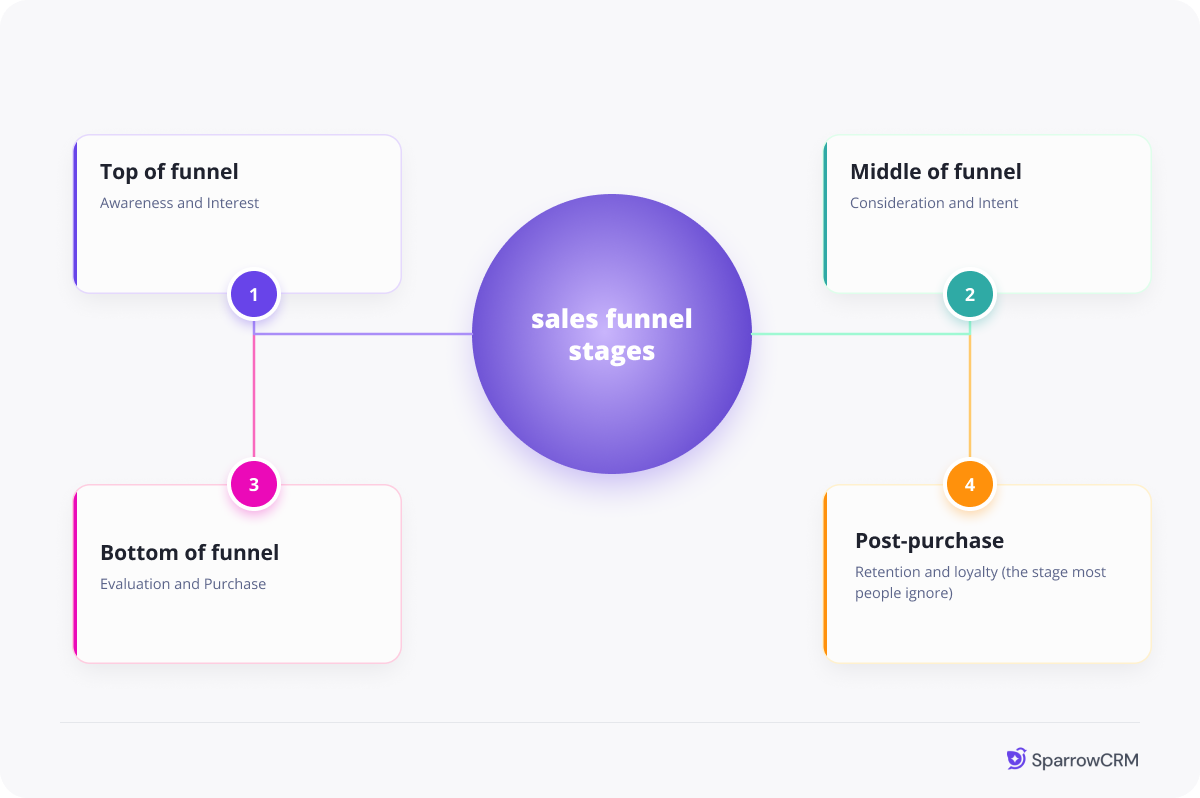
Bottom of funnel: Evaluation and Purchase
This is decision time. Prospects are evaluating your solution against competitors and managing the fear of making the wrong choice. Risk is the dominant factor here.
The Baymard Institute reports that nearly 70% of online shopping carts are abandoned. Most businesses lose prospects right at the finish line. Personalised experiences and clear risk-removal tactics are what separate teams that close from those that do not.
What works at this stage:
- Implementation guides that reduce uncertainty about getting started
- ROI calculators showing clear value in the prospect’s context
- Named customer references, not just logo walls
- Risk-reduction offers: guarantees, free setup, or a structured pilot
How to implement: Remove every possible source of friction. Simplify checkout, offer multiple payment options, and be explicit about what happens after they sign up.
Post-purchase: Retention and loyalty (the stage most people ignore)
This is where the real revenue is made. Increasing customer retention by just 5% can boost profits by 25–95%. Loyal customers spend 67% more than new ones.
Most funnels end at purchase. That is a structural mistake. Automating your post-purchase sales sequences based on customer behaviour, login activity, feature usage, and engagement patterns is what keeps customers and turns them into referrers.
What works for retention:
- Onboarding sequences that ensure the customer achieves early value
- Personalised recommendations based on usage data
- Loyalty programmes and referral incentives
- Proactive support triggered before a problem becomes a complaint
Turn more leads into revenue with SparrowCRM
B2B sales funnel examples
B2B funnels work differently from consumer purchases. The stakes are higher, timelines are longer, and you are dealing with multiple decision-makers who all need convincing. Research into B2B purchase decisions consistently shows that 10–14 stakeholders are involved in a typical enterprise purchase. Your funnel has to work for all of them.
SaaS company: freemium-led funnel (Slack)
Slack removed the biggest barrier in B2B sales: risk. Their freemium model lets small teams use the core product without budget approval or procurement cycles. As users get comfortable, Slack surfaces paid features through smart in-app prompts that show exactly what they are missing.
How the Slack funnel works:
- Awareness: Word of mouth, organic search, content about team productivity
- Interest: Sign up for the free tier, no credit card, no sales call needed
- Consideration: Rep reaches out after the team hits the free message limit
- Decision: ROI case built on time saved vs paid tier cost
- Retention: In-app nudges, admin dashboards, and team-level analytics keep users engaged
The insight: When your prospect is already getting results from your product, the sales conversation shifts from ‘prove it works’ to ‘help me get more of what’s already working.’
Enterprise software: relationship-led funnel (Oracle)
Oracle’s approach looks completely different because its deals are massive and complex. Free trials do not work when you are selling systems that take months to implement and require organisation-wide change.
How the Oracle enterprise funnel works:
- Awareness: SEO, whitepapers, industry events, and thought leadership content
- Interest: Sales team qualifies hard before investing time, deal size, timeline, and budget confirmed upfront
- Consideration: Customised product demos built around the prospect’s specific use case
- Decision: Stakeholder-by-stakeholder engagement, IT, procurement, finance, and the business user all have different concerns
- Close: Negotiation on terms, SLAs, and implementation support before contract sign-off
The insight: Enterprise buyers do not buy software. They buy risk reduction and certainty. Your funnel must address every stakeholder’s version of ‘what could go wrong’
B2B consulting services: conversation-led funnel
Consulting funnels follow a different logic because there is no product to demo. Trust and perceived expertise are the product. The funnel is: Lead → Conversation → Proposal → Win/Loss → Nurture.
Stage | What happens | What moves it forward |
Lead | Prospect finds you via content, referral, or outreach | Targeted content that identifies a specific pain point they recognise in themselves |
Conversation | The discovery call focused 80% on listening | Ask: What have you already tried? Why did it not work? |
Proposal | Formalise what you heard: problem → approach → outcome → cost | Mirror their language back. Show you understood their situation, not a generic one |
Win/Loss | Capture the reason for every outcome | Loss reasons feed directly into how you qualify the next prospect |
Nurture | Stay visible with prospects who said ‘not now’ | Timing is often the issue, not fit. A quarterly check-in keeps you front of mind |
Professional services: content-authority funnel
Law firms, accountancy practices, and specialist consultancies use a content-authority model. They cannot offer free trials. Their funnel runs on demonstrated expertise.
The funnel structure:
- Awareness: Thought leadership content, published articles, speaking engagements, LinkedIn presence
- Interest: Free initial consultation that delivers a specific diagnosis or audit
- Consideration: Case studies showing outcomes for clients in a similar situation
- Decision: Proposal with defined scope, timeline, and deliverables, not open-ended retainers
- Retention: Quarterly reviews that expand scope naturally as trust grows
B2C sales funnel examples
B2C funnels prioritise speed, emotion, and simplicity. A consumer does not have procurement teams or approval chains. They have a problem, a budget, and a tolerance for friction that is close to zero. The funnel must match that reality.
E-commerce: cart recovery funnel
Cart abandonment averages 70% across e-commerce. The standard fix is a three-step recovery sequence:
3-step cart recovery sequence:
- Email 1 (1 hour after abandonment): Reminder only. No discount. ‘You left something behind’ subject line. Many customers return here simply because they got distracted.
- Email 2 (24 hours): Address the likely objection. If it is a clothing brand, add a size guide. If it is software, add a one-line testimonial. Still no discount.
- Email 3 (72 hours): Limited-time offer only if needed. Keep urgency genuine — a made-up deadline destroys trust faster than it recovers the cart.
The insight: Most B2C teams jump straight to discounts. That trains customers to abandon carts on purpose. Objection removal before a discount offer converts better and protects the margin.
Subscription service: free trial funnel (Netflix model)
Netflix’s funnel is built around reducing every possible moment of hesitation:
- Awareness: Social media content, PR, word of mouth, platform integrations (Smart TV apps, gaming consoles)
- Interest: Homepage communicates one value proposition in eight words. No feature list. No pricing table. ‘Watch anywhere. Cancel anytime.’
- Decision: Free trial removes financial risk entirely for the sign-up moment
- Retention: Personalised recommendation engine creates a unique, progressively more valuable experience per user; cancellation means losing that personalised library
The insight: Netflix does not sell shows. It sells the feeling that the platform understands you better than any alternative. Every funnel stage deepens that perception.
.png?2026-06-22T06:37:57.357Z)
Mobile app: social proof funnel
Apps competing in crowded app stores cannot rely on organic discovery alone. Their funnel:
- Awareness: App Store SEO, social media content, influencer reviews
- Interest: Screenshots and preview videos that show the experience immediately — not features, but outcomes
- Decision: Star ratings and review volume. 80% of app downloads are influenced by ratings above 4.0. Prompt in-app review requests at the moment of highest satisfaction, not at random
- Retention: Push notifications triggered by inactivity, not by a calendar. Personalised re-engagement based on the last used feature
CRM-led sales funnel examples and best practices
A CRM does not replace your sales funnel. It makes your funnel observable and actionable. When you map funnel stages to CRM pipeline stages, every rep can see exactly where each prospect is and what needs to happen next, without a weekly pipeline review to figure it out.
For a practical look at how CRM is used at each stage of the funnel, see these CRM use cases in practice.
How a CRM maps funnel stages to pipeline stages
The table below shows how each funnel stage translates into a CRM pipeline stage and what the system should be doing at each point:
Funnel stage | CRM pipeline stage | What the CRM does here |
Awareness | Lead / New | Captures lead source, assigns ICP Fit Score, routes to the right rep automatically |
Interest | Contacted / Engaged | Logs email opens, call attempts, and content downloads. Flags lead going cold after 5 days of no activity |
Consideration | Demo Scheduled / Qualified | Records demo notes, surfaces the Buying Intent Score, and identifies which stakeholders have been contacted |
Decision | Proposal Sent / Negotiation | Tracks proposal views, flags competitor mentions detected in email threads, and alerts the rep to risk factors |
Purchase | Closed Won | Triggers onboarding sequence, assigns customer success owner, logs deal attributes for win/loss analysis |
Retention | Customer / Renewal | Monitors account health, flags engagement drop-off, and surfaces upsell signals based on usage patterns |
CRM-led B2B SaaS funnel: inbound demo request
NEW
Here is what a CRM-mapped B2B inbound funnel looks like in practice for a 15-person SaaS team:
- Step 1 — Lead captured: Prospect submits demo request form. CRM creates a contact record, pulls firmographic data, and assigns an ICP Fit Score based on company size, industry, and job title. High-fit leads go to the senior rep immediately.
- Step 2 — Sequence starts: If the rep does not respond within 4 hours, an automated follow-up email goes out. The CRM logs every open and click against the contact record.
- Step 3 — Demo held: Rep logs call notes. CRM auto-generates a deal summary. The Buying Intent Score is updated based on questions asked and pages visited before the call.
- Step 4 — Proposal sent: Proposal email tracked. CRM flags if the prospect has not opened it within 48 hours and prompts a follow-up. Competitor mentions in reply threads are surfaced automatically.
- Step 5 — Risk alert: If the deal goes quiet for 12 days, the CRM flags it as at risk. Rep receives an AI Next Action: suggested message based on last interaction context.
- Step 6 — Closed: Deal closes. Onboarding sequence triggers. Win attributes, deal size, industry, sales cycle length, and content consumed feed back into ICP scoring for the next lead.
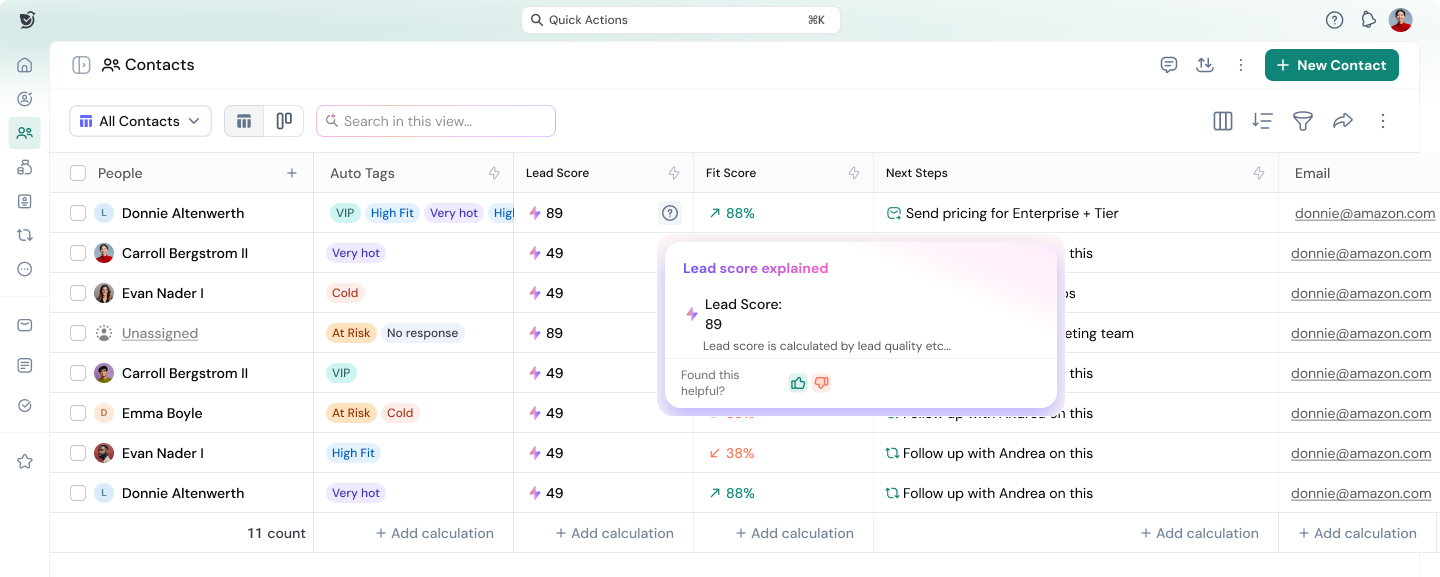
SparrowCRM is built to run this exact workflow natively. ICP Fit Score, Buying Intent Score, Competitor Mentions detection, AI Next Actions, and Deal Loss Analysis are all live on every deal record — no integrations required. Built for sales teams of 2 to 50 people who want pipeline visibility without manual CRM updates.
Get AI-powered insights, deal tracking, and funnel visibility with SparrowCRM.
Why most sales funnels fail (and how to actually fix them)
Most funnel failures are not strategy problems. They are execution and measurement problems. Here are the six most common reasons, and what to do about each.
Tracking your pipeline coverage ratio alongside funnel conversion rates is the fastest way to spot which failure mode is affecting your team right now.
1. No clear stage exit criteria
The problem: Reps move deals forward based on gut feel, not evidence. A prospect who attended a demo gets moved to ‘Proposal’ even though the budget has never been confirmed.
The fix: Define what must be true for a deal to leave each stage. Budget confirmed. Decision-maker identified. Timeline agreed. If those conditions are not met, the deal stays where it is.
2. Treating every lead the same
The problem: The same nurture sequence goes to an enterprise VP of Sales and a solo founder. Same timing, same messaging, same offer. Both disengage.
The fix: Segment by ICP fit and buying stage. Enterprise leads with a confirmed budget and timeline get a direct sales call. Early-stage SMB leads get a nurture sequence. The threshold for each path should be defined, not decided case-by-case.
3. No follow-up after proposals
The problem: A proposal goes out. The prospect does not reply. The rep waits. The deal dies quietly. Research consistently shows that most deals that close require five or more follow-up touches after the initial proposal.
The fix: Build a structured post-proposal sequence with defined intervals and escalating value. Email 1: Did you have questions? Email 2: Here is a relevant case study. Email 3: Is the timeline still on track? Never follow up with ‘just check in’.
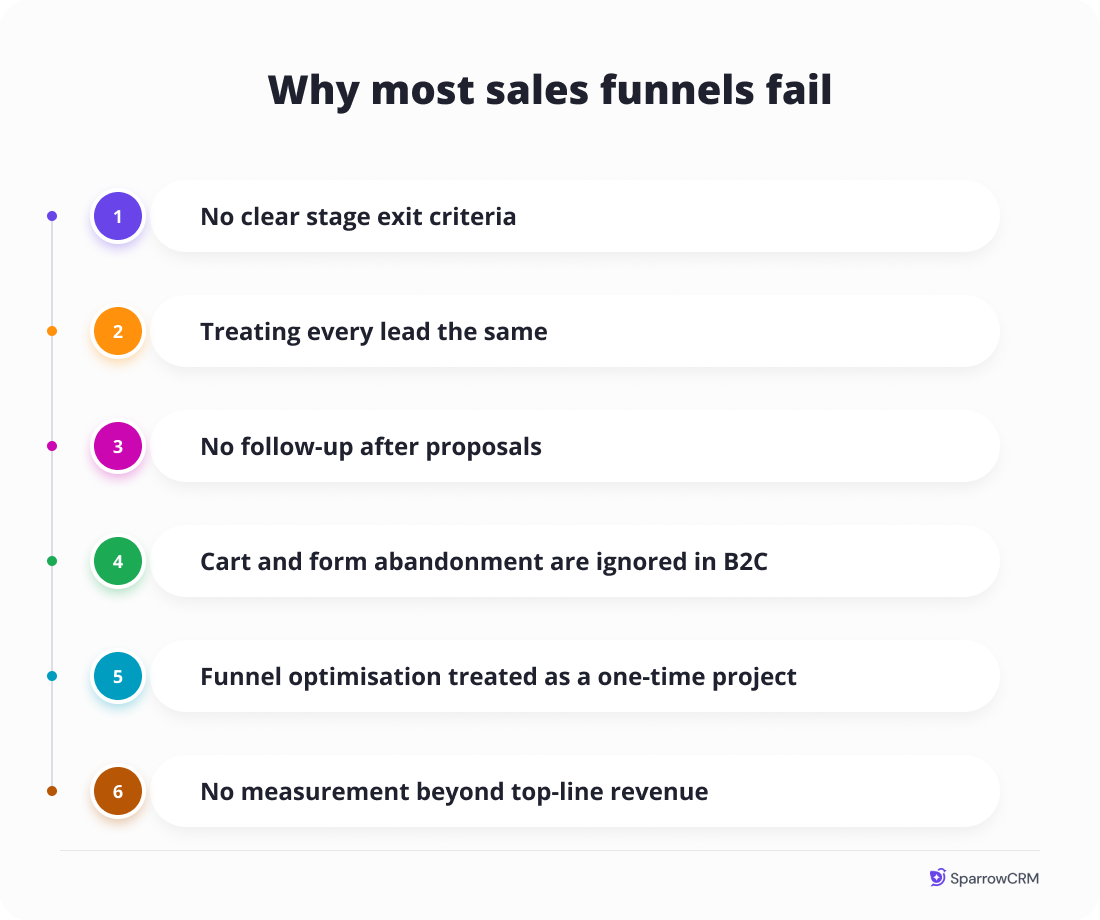
4. Cart and form abandonment are ignored in B2C
The problem: 70% of online carts are abandoned. Most e-commerce businesses either do not have a recovery sequence or trigger it too late.
The fix: Send the first recovery email within one hour of abandonment. Remove the objection before you offer a discount. Abandoned leads convert at higher rates than cold traffic — they already showed intent.
5. Funnel optimisation treated as a one-time project
The problem: The funnel gets set up, works reasonably well for a quarter, and then nobody touches it. Buyer behaviour changes. A competitor launches something new. Stage conversion rates quietly decline. Nobody notices until the miss is already significant.
The fix: Review stage-by-stage conversion rates monthly. Set a threshold for each stage. When a stage drops below the threshold, investigate before it becomes a revenue problem.
6. No measurement beyond top-line revenue
The problem: Teams track total revenue and total leads. Nobody tracks conversion rate between stages. So when revenue drops, nobody knows if the problem is lead volume, lead quality, MOFU drop-off, or BOFU friction.
The fix: Track these four numbers at a minimum: Lead to MQL rate, MQL to demo rate, demo to proposal rate, proposal to close rate. Each one points to a specific part of the funnel. Fix the lowest-performing stage first.
Final thoughts
A sales funnel is not a set-and-forget system. It is a diagnostic framework. The examples in this guide, Slack, Oracle, Netflix, cart recovery sequences, all work because the teams behind them measured what was happening at each stage and adjusted when something broke.
Whether you are running a B2B SaaS funnel with a 90-day sales cycle or a B2C e-commerce funnel that closes in 48 hours, the underlying principle is the same: know where your prospects drop off, fix that stage first, and then move to the next one.
A CRM does not build your funnel for you. But it makes every stage visible, every drop-off traceable, and every rep’s next action clear. That is the difference between a funnel that works and one you are always wondering about.

Geethapriya
Geethapriya is a Growth Marketer and Business Researcher who researches and writes about CRM, sales, marketing, and customer engagement. Her work focuses on understanding industry trends, customer and sales challenges, and how businesses can use technology to build more effective growth processes.
Frequently Asked Questions (FAQs)
Related Articles

10 Apr, 2025
What is Sales Forecasting: Challenges, Methods, and Best Practices
11 Apr, 2025
9 best b2b sales software tools for growing teams in 2026

12 Apr, 2025