CRM SOFTWARE
Attio pricing explained: Plans, real costs, and what you'll actually pay in 2026

By Ganesh Ravi Shankar
Last updated on Sep 3, 2026
Explore this blog to understand exactly what Attio costs across every plan, where the pricing gets complicated at scale, and whether it's the right CRM investment for your team size.
- Attio pricing at a glance
- Breaking down each plan in detail
- Annual vs. monthly billing: What you actually save
- Add-ons and hidden costs
- Attio startup program: Is it worth it?
- Attio is ideal for
- Attio is not ideal for
- How to negotiate Attio pricing
- Looking for a more affordable Attio alternative?
- Final thoughts: Is Attio worth the price?
Attio has become one of the most talked-about CRMs in the startup and SMB space. Clean interface, composable data model, genuine AI features; it checks a lot of boxes on paper. But when sales teams sit down to evaluate it seriously, the pricing conversation gets complicated fast.
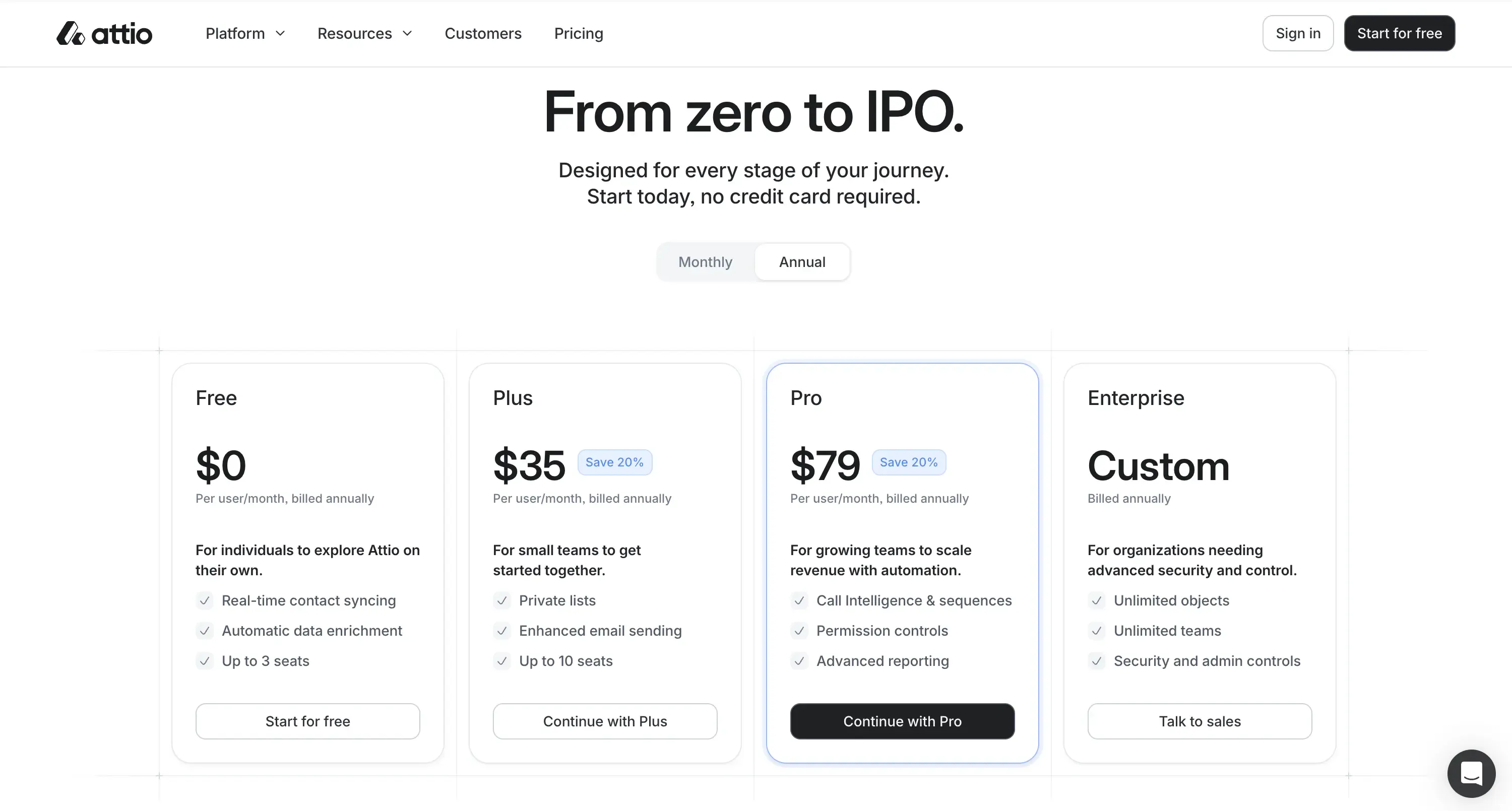
The headline numbers have recently changed, with Attio's Plus plan now starting at $35 per user per month and Pro at $79 per user per month when billed annually. Monthly pricing is $44 for Plus and $99 for Pro. What those numbers don't tell you is the credit layer sitting on top, which features are gated behind each tier, and what a 20- or 40-person team actually ends up paying as the cost scales.
This breakdown covers everything: plan structures, real-world cost math, hidden charges, community feedback, and the negotiation angles most teams never think to try.
Key takeaways
- Attio Free is a strong starting point for solo founders and early sales teams of up to 3 users, but growing teams will quickly face its seat and feature limitations.
- Plus and Pro become significantly more expensive as your team grows, so calculate the total annual cost, not just the advertised per-user price, before upgrading.
- Compare alternatives before committing: If Attio’s pricing or feature limits don’t fit your needs, consider SparrowCRM, Pipedrive, or Folk as lower-cost alternatives
Attio pricing at a glance
Source: attio.com
Attio currently offers four plans: Free, Plus, Pro, and Enterprise. Unlike the previous pricing structure, Attio now offers both monthly and annual billing for its paid plans. Annual billing is 20% cheaper than monthly pricing.
Plan | Annual Price | Monthly Equiv. | Seats | Best For |
Free | $0 | $0 | Up to 3 | Solo founders, testing the platform |
Plus | $35/user/mo | $44/user/mo | Up to 10 | Small teams |
Pro | $79/user/mo | $99/user/mo | Unlimited | Growing teams |
Enterprise | Custom | Custom | Unlimited | Larger organizations |
Breaking down each plan in detail
Free plan: What you actually get
Attio’s Free plan supports up to 3 users and 50,000 records, with core CRM features such as contact and company management, activity tracking, email and calendar syncing, basic reporting, automatic enrichment, and access to Attio’s AI features through included credits. For a small team, that’s enough to build a real CRM workflow and test whether Attio’s flexible data model fits your sales process.
The main limitations are scale and advanced sales functionality. Reporting, email sending, credits, and object access are limited, while features such as sequences, Call Intelligence, and advanced permissions require a paid plan. So, the Free plan works well for getting started, but teams with heavier outbound or automation needs will likely outgrow it.
Is Attio Free worth it?
Yes, especially for solo entrepreneurs and early-stage sales teams of up to three people. If you want a modern CRM to manage contacts, companies, deals, emails, and activities without immediately committing to a paid subscription, the Free plan gives you enough functionality to get started.
However, the 3-user limit makes it more of a starting point than a long-term plan for growing sales teams. If your team expands or you need sequences, advanced reporting, automation, or Call Intelligence, you’ll need to upgrade.
Our take: Attio Free is worth trying if you’re a founder or early sales team validating your CRM setup.
Plus plan: Best for growing teams
Attio Plus costs $35/user/month when billed annually or $44/user/month when billed monthly. It includes private lists, enhanced email sending, basic access permissions, and higher limits for records, objects, reporting, and credits. However, Plus is capped at 10 seats, so it works best for small teams that have outgrown the Free plan but don't yet need enterprise-scale capacity.
The jump from Free to Plus mainly supports a larger team and gives users more flexibility to collaborate. You still won't get features such as Call Intelligence, sequences, advanced permissions, or advanced reporting; these are available on Pro.
So, if your team is likely to grow beyond 10 users or your sales process depends heavily on calling and automated outreach, Plus may only be a temporary step before moving to Pro

At what point does Attio become too expensive for your team?
Pro plan: Where it gets expensive
Attio Pro costs $79/user/month when billed annually or $99/user/month when billed monthly. It removes the 10-seat limit and adds the capabilities more active sales teams are likely to need, including Call Intelligence, sequences, advanced permissions, richer reporting, higher enrichment limits, and 2 email accounts per user. It also increases the record limit to 1 million and provides significantly higher workspace and seat credit allowances.
The higher per-user cost becomes more noticeable as your team grows. For example, 10 users cost $790/month ($9,480/year) on annual billing, while 20 users cost $1,580/month ($18,960/year) and 40 users cost $3,160/month ($37,920/year).
If your team needs advanced sales workflows and has more than 10 users, Pro is the tier to consider, but the per-seat pricing makes it important to calculate the total cost at your actual team size.
Enterprise plan: Custom pricing territory
Enterprise uses custom pricing and is billed annually. It is designed for organizations that need advanced security, administration, unlimited objects, and other enterprise-level controls. If you're evaluating Enterprise, you'll need to contact Attio for a quote based on your requirements.
If you're at the scale where Enterprise makes sense, you have meaningful negotiating power; more on that in the negotiation section below.
Your First 3 SparrowCRM Seats Are Free
Annual vs. monthly billing: What you actually save
Attio offers both monthly and annual billing. Annual billing gives you a 20% discount, bringing Plus to $35/user/month and Pro to $79/user/month. Monthly billing costs $44/user/month for Plus and $99/user/month for Pro. The difference becomes more significant as your team grows.
Team Size | Plus (Annual) | Plus (Monthly) | Pro (Annual) | Pro (Monthly) | Annual Saving (Pro) |
3 users | $1,260/yr | $1,584/yr | $2,844/yr | $3,564/yr | $720 |
5 users | $2,100/yr | $2,640/yr | $4,740/yr | $5,940/yr | $1,200 |
10 users | $4,200/yr | $5,280/yr | $9,480/yr | $11,880/yr | $2,400 |
20 users | — | — | $18,960/yr | $23,760/yr | $4,800 |
40 users | — | — | $37,920/yr | $47,520/yr | $9,600 |
50 users | — | — | $47,400/yr | $59,400/yr | $12,000 |
Note: Plus is available for up to 10 seats, while Pro has unlimited seats. That's why larger teams can only be calculated using Pro.
Add-ons and hidden costs
The credit layer
Beyond the seat price, Attio runs a two-layer credit system: seat credits (tied to each user) and workspace credits (shared across the team). Credits are consumed by AI features, the Research Agent, data enrichment operations, and automations.
The Free plan includes 250 workspace credits per month, while Plus includes 1,500 and Pro includes 10,000. Attio also provides separate seat credits for Ask Attio. Credits are consumed by AI features and workflow automations, with usage varying depending on the action and complexity.
This credit layer is the piece of Attio's pricing most teams discover after signing up, not before. If your workflow involves bulk enrichment, AI-powered outreach personalization, or frequent automation runs, model out your expected credit consumption before committing to a tier.
Features that sound standard but are gated
Some Attio features that sales teams may expect from a modern CRM are reserved for higher tiers:
- Call Intelligence: Pro and Enterprise only. Teams that want AI-powered call recording, transcripts, and insights need to move beyond Plus.
- Sequences: Pro and Enterprise only. If you need automated, multi-step email outreach, Plus won't be enough.
- Advanced permissions: Plus provides basic workspace-level controls, while Pro adds team- and individual-level access controls.
- Email accounts: Free and allow 1 email/calendar mailbox per user, while Pro allows 2. If a user needs 3 or more synced email accounts, Enterprise is required.
- Advanced reporting: Plus supports up to 20 reports in Attio's help documentation, while Pro increases that to 100 and adds more advanced reporting capabilities.
- Priority support: Priority support is included with Pro, while Free and Plus have standard chat and email support.
The practical implication: Plus can look sufficient on the pricing page, but teams that need sequences, Call Intelligence, advanced permissions, or multiple email accounts per user can quickly find themselves needing Pro. And if your sales reps need 3+ email/calendar accounts each, Enterprise becomes the required tier, making Attio's actual cost considerably higher than the headline Plus or Pro price.
If you're evaluating Attio beyond its pricing, check out our Attio review for a detailed look at its features, usability, pros, cons, and overall value.
The external tool stack gap
Attio is a strong CRM. But for SDR-heavy teams, it doesn't cover the full outbound stack out of the box. Teams frequently layer on separate tools for dialing, enrichment at volume, visitor identification, and advanced sequencing. Those external tool costs are the real total cost of ownership calculation that most pricing comparisons skip.
Attio startup program: Is it worth it?
Attio runs a formal Startup Program that can significantly reduce the cost of its Pro plan for eligible startups. Approved startups get 80% off the annual Pro plan and credits for the first year, followed by 30% off in the second year. The program also includes dedicated onboarding support and perks from other startup-focused tools.
Who qualifies
Eligibility | Startup Program benefit |
Venture-backed startup | 80% off annual Pro + credits in Year 1 |
Attio startup partner | Eligible if affiliated with a partner |
Second year | 30% off |
Additional benefits | Dedicated onboarding + startup perks |
Attio currently states that startups must be venture-backed to qualify. The application asks for details including your funding round, total amount raised, team size, investors, and use case. Attio does not currently publish the old $5M funding or five-year company-age thresholds on its Startup Program page, so those requirements should not be included in this article.
What you get and for how long
The biggest benefit is the 80% discount on the annual Pro plan and credits during the first year. The discount then drops to 30% in the second year, so startups should plan for a higher CRM cost as the program discount decreases. Attio also provides dedicated onboarding support and perks such as three months of Linear and six months of Notion.
For example, at the current $79/user/month annual Pro price, an 8-person team would normally pay $7,584/year. An 80% first-year discount would bring the Pro subscription portion down to approximately $1,517/year, before considering the included credits and any other applicable terms. In the second year, the 30% discount would bring it to approximately $5,309/year.
One important note: Attio's help content says you can apply within 90 days of creating your workspace
Attio is ideal for
- Technical founders and RevOps leads who want a CRM that adapts to their data model, not the reverse
- Early-stage startups (pre-Series B) with under 20 seats that qualify for the startup program
- Teams prioritizing relationship data quality, email/calendar sync, and clean pipeline visualization
- Companies building investor relations or partnership tracking alongside sales pipelines
- SaaS and tech teams already living in modern tools (Notion, Linear, Slack) who want a compatible UX
Attio is not ideal for
- Sales teams of 30+ that are growing per-seat costs scale quickly in a way that narrows the value gap against enterprise CRMs
- Outbound-heavy SDR teams, call intelligence is Pro-only, and sequences are gated, meaning the full outbound stack requires additional tooling
- Bootstrapped companies without venture backing that can't access the startup program discount
- Teams that need a turnkey outbound platform without stitching together a separate tool stack
- Organizations requiring deep reporting, revenue forecasting, or pipeline intelligence built natively into the CRM
If your team is in the 10–50 seat range, runs active outbound, and needs pipeline intelligence, buying intent signals, deal scoring, and AI-driven next actions, built into the CRM rather than bolted on.
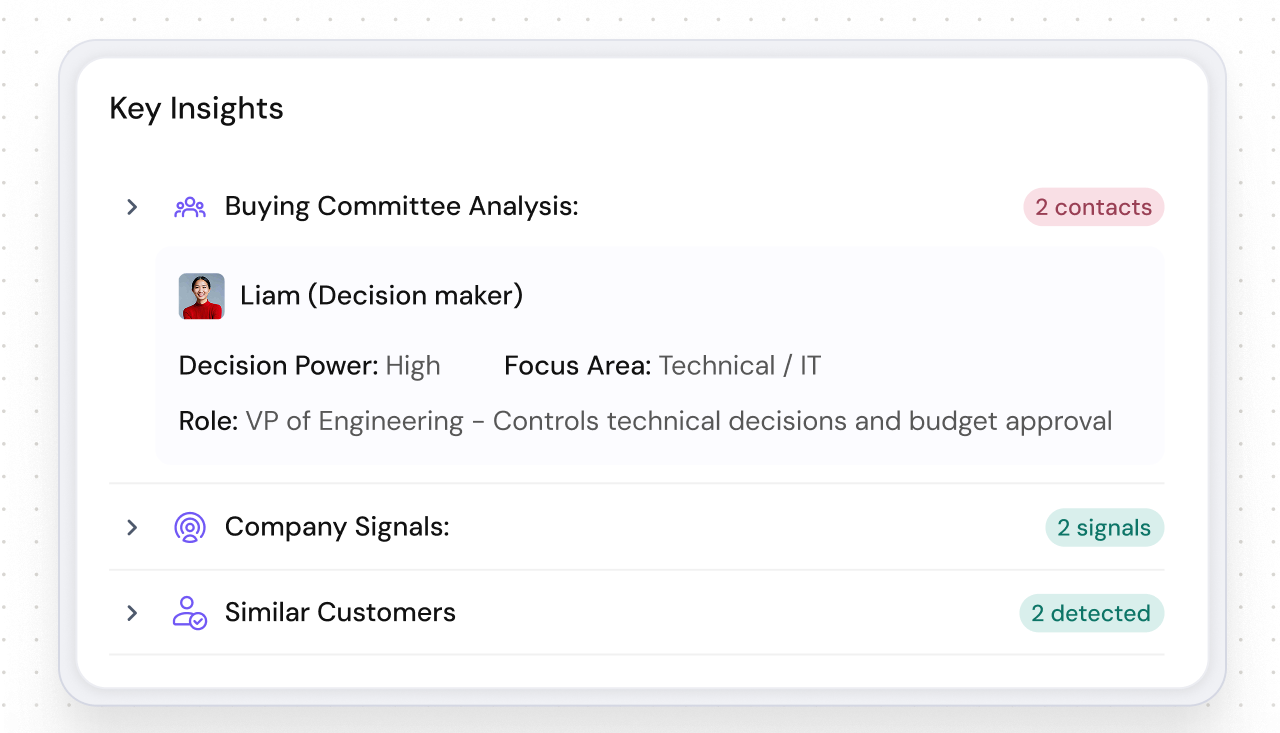
SparrowCRM is worth a direct comparison. It's an AI-native CRM built specifically for B2B sales teams at this size, with deal scoring, buying committee analysis, and sequence automation included natively rather than gated behind the top tier.
Experience AI-powered sales workflows firsthand

How to negotiate Attio pricing
Attio does not publish a discount schedule, but negotiation is both possible and expected — especially for teams committing to multi-seat or multi-year deals. Most teams never ask, which is the actual reason most teams pay list price.
When to push for a discount
- Before your annual renewal, this is the highest-leverage moment. You have an active relationship and a credible churn risk.
- When you're onboarding 10+ seats at once, volume commitments justify a direct conversation with their sales team.
- When evaluating against a competitor, having a real alternative quote in hand changes the dynamic immediately.
- When signing a multi-year deal, two-year commitments typically unlock additional rate reductions beyond the standard annual discount.
What leverage actually works
If you’re negotiating Attio pricing, go in with specific buying information rather than simply asking for a discount. Your team size, annual vs. monthly commitment, expected growth, and the alternatives you’re considering give the sales team useful context for discussing your plan.
For larger teams, it’s also worth asking whether Attio can offer custom pricing or terms rather than assuming the published per-user price is the final quote.
The potential savings become more meaningful as your team grows. For example, a 10% discount on a 15-user Pro annual subscription would save about $1,422 per year at the current $79/user/month annual price.
If you’re evaluating Enterprise or have a larger sales organization, ask for a custom quote and compare the total annual cost, not just the per-user price. Avoid assuming a specific discount range until Attio provides an actual offer.
Looking for a more affordable Attio alternative?
If Attio’s pricing becomes difficult to justify as your team grows, it’s worth comparing the total cost and what you get at each price point. Here are three alternatives worth considering:
CRM | Starting price | Best for | Why consider it over Attio? |
SparrowCRM | $0 Free / $19/user/month Growth | AI-powered sales teams | Lower entry price with AI-powered sales execution, deal intelligence, and automation |
Pipedrive | $14/user/month annually | Visual sales teams | Lower starting price with a straightforward pipeline-focused CRM |
Folk | $24/user/month annually | Outbound & relationship-led sales | Lower-cost option for prospecting, relationship management, and lightweight outreach |
If you want to compare these and other options in more detail, see our Attio alternatives guide.
Start free with AI copilot and unlimited records.
Final thoughts: Is Attio worth the price?
Attio is a genuinely good CRM. The data model is flexible, the UX is fast and clean, and the free tier is more functional than most. For early-stage teams under 20 seats, especially those who qualify for the startup program, it delivers strong value against anything else in the market at comparable pricing.
The calculus shifts as you scale. Above 30 seats on Pro, the annual commitment is a meaningful budget line. When you add the tooling gaps that active outbound teams need to fill separately, the total cost of ownership exceeds what the headline number suggests.
The honest framing: Attio is an excellent CRM foundation. Whether it's the right CRM for your revenue motion depends less on the product and more on your team size, outbound intensity, and how much of your sales intelligence you want built natively versus assembled from multiple tools.

Frequently Asked Questions (FAQs)
Related Articles

05 May, 2026
Pipedrive pricing (2026): Plans, add-ons, hidden costs, and honest verdict

20 Apr, 2026
HubSpot pricing explained: plans, real costs, and what to watch out for (2026)
23 Aug, 2025