Strategic sales leadership in the AI era: What to automate and what still needs a human

By Michael Bell
Last updated on Sep 15, 2026
Explore our people in the sales community spotlight with Michael Bell, a sales leader who shares about their strategic sales leadership lessons.
People in Sales is a community hosted by SparrowCRM. The Spotlight Series is a recurring feature inside that community, where we talk to sales leaders about their work and sales experiences.
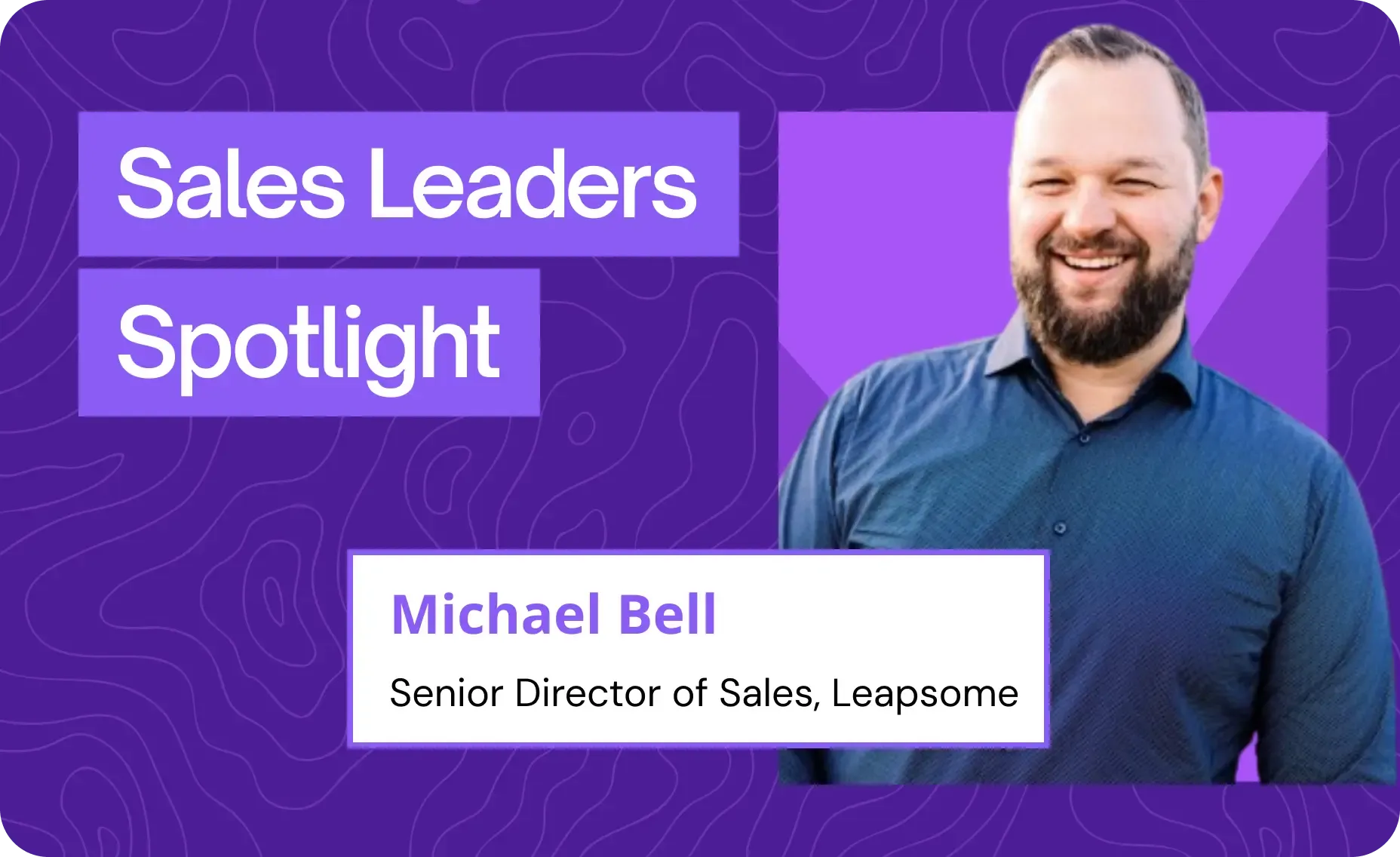
Our next spotlight features Michael Bell, who runs North American sales at Leapsome, a people enablement platform. He spent 12 years at ADP as a rep and associate sales manager. He then joined Benevity as a New York enterprise account executive, working with brands like Pfizer, Marsh McLennan, Sony Electronics, and Colgate-Palmolive, before moving into a mid-market leadership role.
What are your biggest lessons on sales leadership?
Michael's lessons on sales leadership start with hiring, not managing. He credits the line itself to other leaders he has learned from.
“You can teach skill, but you can't teach will.”
He looks for people who are intrinsically motivated and know what they want. His test is simple. Ask a candidate who is responsible for their development. If the answer is the manager or enablement, that is a red flag. He wants reps who own their own career path, then tell him what help they need. Those are the people already learning new methods and adopting AI on their own.
How are you building an AI sales playbook for your team?
Leapsome has no end-to-end AI sales playbook. That is deliberate.
“Right now we're just picking out different pockets of the sales process or the buying journey that can take a lot of time and that we can automate.”
Deals sitting in the earliest pipeline stage get weekly suggested next steps, pushed straight to the rep. The rep decides whether to act. For later-stage deals, AI drafts the multi-threading outreach that executives proof and send themselves. The sales rep stays in the loop at every point that touches a buyer.
It is closer to targeted sales workflow automation than a full rewrite of the sales cycle.
Want the full story? Watch the spotlight on Michael Bell
Which AI tools for lead scoring and next steps are you using?
The AI tools for lead scoring and next-step suggestions run on a stack his team assembled rather than bought.
“We're using Claude Cowork to do the next steps. What we do is we just connect to our HubSpot read-only and then see what's happened in the deal process.”
They built a skill that references their sales playbook in Notion, then posts the output directly into a Slack channel for account executives to act on. Alongside that, they enrich and score inbound leads, so reps spend their hours on the right leads.
What trends are shaping B2B selling right now?
Michael sees plenty of optimism about AI. He also sees buyers pulling in the other direction.
“AI can automate things, but it can't automate human relationships and people still want that.”
Because his product impacts people across the organisation, buyers often want to hear from a real person before making a decision. He’s found that showing up as a team, rather than having a single account executive lead the conversation, can improve the chances of closing a deal. He’s also noticed that interest in in-person events is picking up again. Leapsome recently hosted book launches for its VP of People in Berlin and New York, and both events were packed.
What sales problems are you tackling in 2026?
The biggest sales problem for him is pipeline coverage. Inbound is still strong, but it has a ceiling.
“We're not going to grow at the rate that we want by just relying on an inbound motion.”
How to overcome sales challenges with a predictable outbound motion?
Inbound can get expensive, especially when it relies heavily on ads and leaves you at the mercy of algorithm and model changes you can’t control. His response has been to build out an SDR function while also having account executives take a more strategic approach to outbound.
One tactic is already showing results: reaching out to people who interacted with Leapsome over the past four years but never became customers. Some of those contacts have since moved to new companies, where the same product is now relevant to them.
For him, this isn’t just a sales-team problem. It’s something the whole company needs to think about as part of its broader sales strategy.
Where do you draw the line between sales automation and losing the human touch?
He draws the line based on what actually gets results.
“If everybody's doing the same AI play, then you're just drowning in a big ocean that everybody else is doing and you're not standing out at all.”
His inbox and LinkedIn are already packed with messages that follow the same format and cadence. So he uses AI for the early stages of the funnel, like picking up intent signals and automatically following up when someone starts booking a demo but drops off.
But when a deal starts looking serious, a real person steps in. And when it comes to bringing in completely new meetings, it’s still humans picking up the phone, not AI dialers.
How do you coach your reps to engage the real decision maker?
On mid-market and enterprise deals, the economic buyer is rarely on the first call.
“One of the things that we look to do is test the champion that we're meeting with. So can they get other people from their team, including that economic buyer, to be engaged in the process?”
The tests are pretty straightforward. Can the champion get the NDA signed? Can they bring other stakeholders into the demo? Are people actually opening the Trumpet microsite the team uses as a buyer’s room?
Reps are also trained to focus on the business impact instead of just walking through features. From there, they ask two simple questions: Has a budget been set aside for this? And if so, whose budget would it come from?
Which tools are helping you work smarter today?
For Michael, working smarter starts with working faster.
“Wisprflow is a voice-to-text automation tool where I don't have to type anymore throughout my workday. I think I'm doing 140 words per minute now.”
Gong handles call recordings, forecasting, and deal reviews, and the team leans on its AI layer heavily. Claude Cowork builds the skills behind their automations. None of it is exotic.
The pattern is picking sales tools that remove typing, note-taking, and recall from the day, then giving that time back to conversations.
What sales advice would you give to new salespeople and new leaders?
Sales advice for new salespeople
His advice to people starting in sales is pretty much the same advice he gives to people who want to become leaders:
“Don't wait until you get the title to do the job.”
At its core, sales is about getting someone to take action. You don’t need a sales title to prove you can do that. Maybe you’ve convinced people to sign up for a volunteer event, helped get a team together, or persuaded someone to buy a product or service. They’re all examples of the same skill: influencing someone to take action.
Making the shift to strategic sales leadership
For individual contributors who want to move into leadership, his advice is to start acting like a leader before getting the title. Take on stretch projects, run team huddles, and share what’s working with others.
The real challenge comes when you become responsible for the bigger picture. A salesperson can have a great quarter while the company as a whole struggles. A leader doesn’t have that luxury. Good sales leadership means looking beyond what can close today and asking whether the customer will succeed, whether the customer success team can support them, and whether the deal is likely to renew.