SALES STRATEGY
What is value-based selling? A complete framework for B2B sales teams

By Geethapriya
Last updated on Jul 23, 2026
Explore this blog to understand what value-based selling means, why it drives revenue growth, and how to apply a proven value-selling framework in real B2B sales conversations.

Today's buyers care less about product features and more about the business outcomes a solution can deliver. Value-based selling focuses on understanding customer challenges, demonstrating measurable ROI, and showing why your solution is worth the investment. In this guide, you'll learn what value-based selling is, how it works, and how to use it to close bigger deals and build long-term customer relationships.
What is value-based selling?
Value selling is a sales strategy. It leads with calculated business outcomes: cost savings, time savings, competitive advantage, and risk mitigation, rather than product features or price. It solves buyer problems through measured impact. It does not rely on product capabilities that buyers must interpret on their own.
Approach | Core focus | Requires a quantified outcome |
Consultative selling | Strong discovery questions | No |
Solution selling | Matching a product to a stated need | No |
Value-based selling | A measured business outcome tied to price | Yes |
Value-based selling shares roots with consultative selling and solution selling. It adds one requirement neither includes: a number attached to the outcome before the pitch is built.
This is why the approach fits B2B SaaS, technology, finance, and retail deals. In these deals, a champion must justify the purchase to a budget committee or an executive sponsor. They rarely approve it alone.
Value-based selling vs feature selling and price selling
Three approaches dominate B2B sales conversations: feature selling, price selling, and value-based selling. Each produces a different buyer experience and a different type of deal.
Approach | Focus | Buyer experience | Typical outcome |
Feature selling | Product specs and capabilities | Buyer compares checklists across vendors | Deals stall on feature parity; price becomes the tiebreaker |
Price selling | Lowest cost or biggest discount | Buyer negotiates hard and expects concessions | Thin margins, weak loyalty, easy to underprice by a competitor |
Value-based selling | Buyer's business outcome, quantified | Buyer sees a clear return before signing | Higher win rates, less discounting, stronger renewals |
Feature and price still surface in value-based deals. They act only as support for a return the buyer has already agreed on. A strong unique selling proposition sharpens that return by giving the rep one clear point of difference to anchor it to.
⚠️ Common Mistake
Focusing on price before establishing the value your solution delivers.
Organizational benefits of value-based selling
Value-based selling produces measurable, team-wide gains beyond individual call quality. This holds most for teams of two to fifty people without a dedicated enablement team. Go-to-market leaders increased spend on customer value in sales training over the past year. This moved the framework from optional to standard practice for growing sales teams.
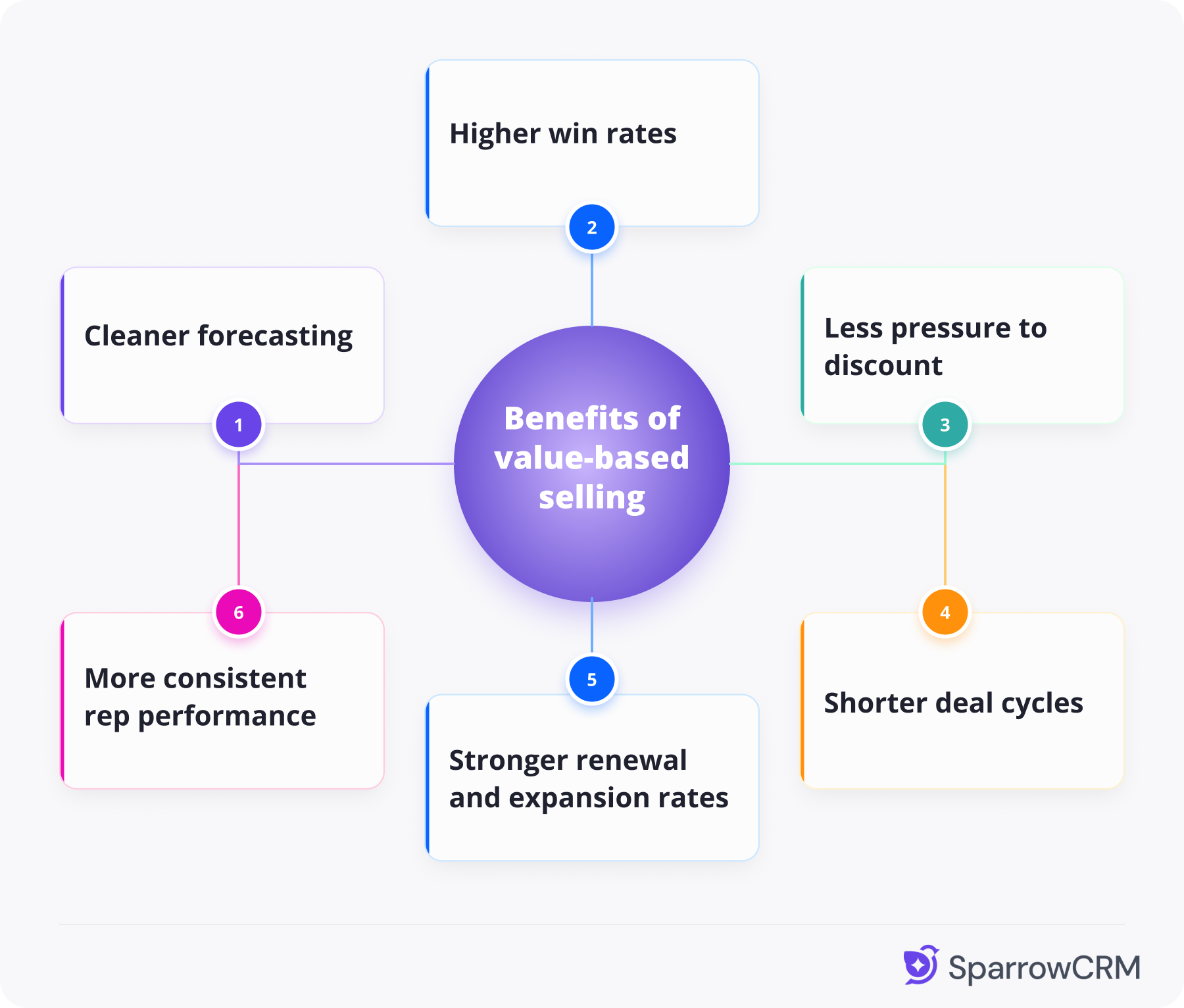
- Higher win rates: deals built around a proven return close more often than deals built around features.
- Less pressure to discount: once a buyer agrees on the return, a rep can negotiate from strength instead of fear of losing the deal.
- Shorter deal cycles: a quantified business case moves through a buying committee faster than a feature comparison.
- Stronger renewal and expansion rates: a measured outcome can be checked again at renewal, which supports the next purchase decision.
- More consistent rep performance: a repeatable framework closes the gap between a team's top rep and the rest. It does not depend on individual charisma.
- Cleaner forecasting: deals with a documented business case are easier for managers to score and trust in a pipeline review.
How Value-Based Selling Drives Revenue Growth?
- Improves customer retention: The original value promised during the sale becomes a benchmark for renewals, making renewal discussions more about results than price.
- Creates expansion opportunities: Demonstrated business outcomes make it easier to upsell or cross-sell additional products and services over time.
- Reduces discount dependency: Reps who clearly communicate business impact can defend pricing and maintain healthier margins.
- Makes sales more consistent: Standardized value-based selling frameworks help every rep replicate successful sales conversations.
- Relies on the right sales insights: To quantify value effectively, reps need visibility into customer pain points, buying intent, stakeholder involvement, and engagement levels.
- Scales with AI-powered CRM: Tools like SparrowCRM's buying intent signals and buying committee analysis help sales teams identify customer value drivers automatically, making value-based selling.
Your First 100 AI Credits and 3 Free Users Are On Us
The value selling framework: 6 steps that work in B2B sales
A value-selling framework requires six steps. They apply equally to a five-seat startup purchase and a multi-year enterprise contract.
1. Research before you reach out
Reps who know a prospect's industry, size, funding stage, and likely pain points ask sharper questions from the first call. Research should target the buyer's exact situation, not a generic industry summary. A VP of Sales at a 20-person company faces different pressure than one at a 200-person company. Opening questions should show that difference right away.
2. Lead discovery with business outcomes, not features
Discovery should ask what happens if the problem stays unsolved for two more quarters. It should not ask what features the buyer wants. This one change produces the raw material for a business case.
It shows the current cost of the problem, who feels that cost, and the value of fixing it. Discovery should also map the buying committee early. Budget holders, day-to-day users, and executive sponsors usually value different outcomes.
3. Quantify the problem in the customer's language
The problem must be sized using the buyer's own numbers, not industry averages. A specific figure carries more weight than a generic stat. Six hours a week lost to manual deal-stage updates is one example. This step usually means asking the buyer directly for numbers.
Useful ones include close rates, average deal size, hours lost to a manual task, or the cost of a missed renewal. A team of ten reps, losing five hours each week, adds up to 50 hours. That is a number a finance stakeholder can act on. The output should be one sentence stating the size of the problem in dollars or hours.
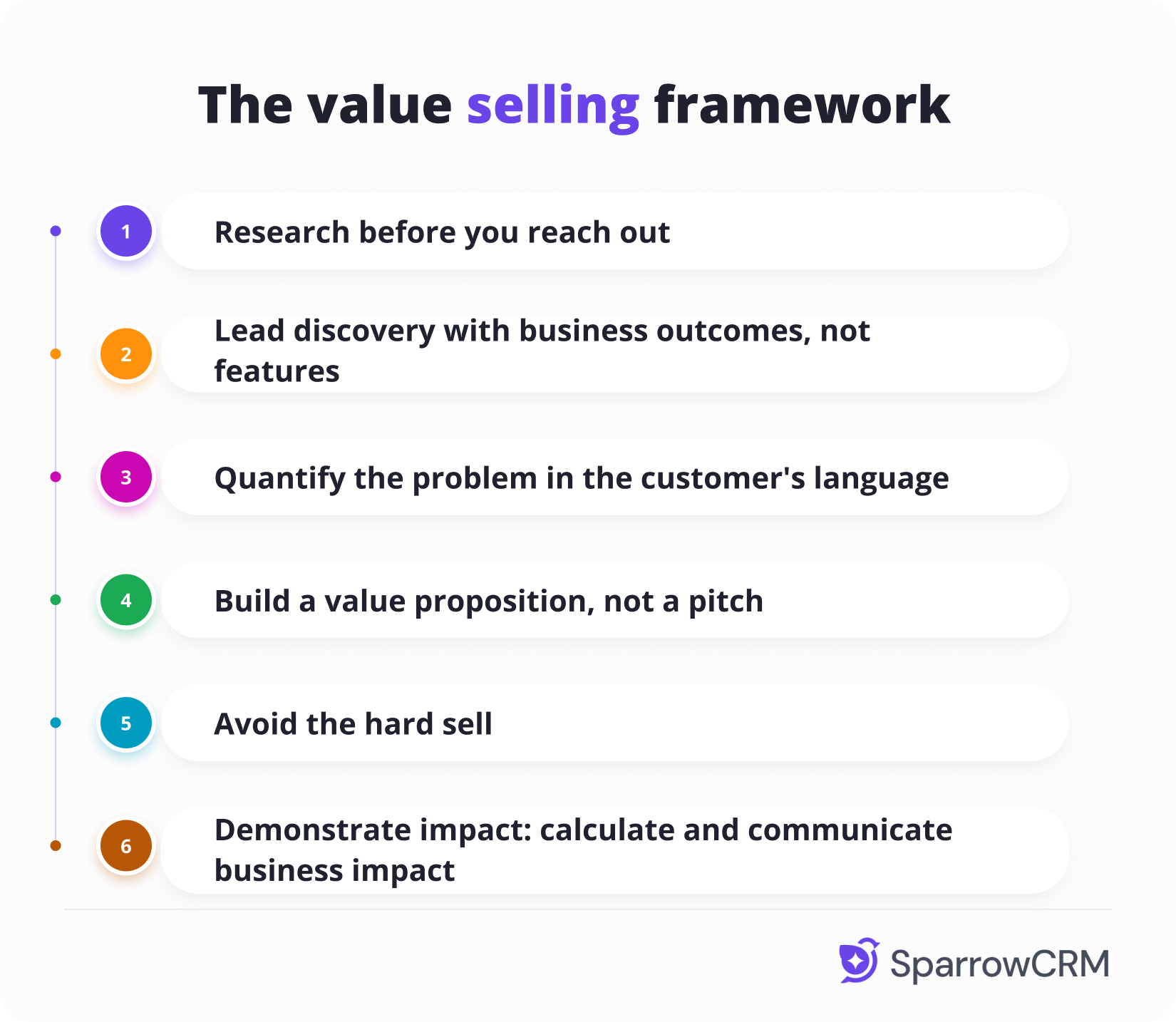
4. Build a value proposition, not a pitch
A value proposition connects the product straight to the number found in discovery. It does not describe product capabilities on their own. Deal scoring, for example, should be framed against two deals a buyer's team lost last quarter to weak follow-up. It should not be shown as a standalone feature. Every slide, demo moment, and follow-up email should trace back to that one number.
5. Avoid the hard sell
Value-based selling depends on trust. The buyer must believe the number is accurate. It must be specific to their own situation. False urgency, pressure to skip stakeholders, and packages sized beyond what the buyer's numbers support all break that trust. Urgency should come from the buyer's own cost of waiting, not from a rep-made deadline.
6. Demonstrate impact: calculate and communicate business impact
The final step means calculating and communicating business impact. State it in terms a finance stakeholder understands right away: cost savings, hours returned, revenue protected, or risk avoided over a set period. A one-page summary works better than a slide deck for this.
It should show current cost, expected impact, and time to impact. Impact should be checked again at renewal using the original numbers. Proven sales closing techniques turn that trust into a signed deal.
🤖 AI Tip
Modern AI CRMs can automatically summarize customer pain points, stakeholder priorities, and next best actions, helping sales reps deliver more relevant value propositions.
Value-based selling examples in B2B SaaS
Value-based selling applies the same pattern across deal types: size up the cost of the problem, then build the pitch around the return.
Buyer profile | Problem quantified | Pitch anchor |
Recruiting agency, 15 reps | Warm candidates went cold; roughly 3 lost placements per quarter, near 45,000 dollars | Revenue lost to cold leads, not contact management features |
Early-stage startup, 5-person outbound team | Manual data transfer cost about 4 hours a week across the team | Hours reclaimed for selling time, not the automation feature itself |
Financial services team, 25 reps | Missed follow-ups on renewal-risk accounts cost two renewals last quarter | Revenue protected by earlier risk flags, not a dashboard feature |
Common Value-Based Selling Mistakes to Avoid
- Skipping discovery and jumping straight to a demo: Without understanding the buyer's challenges, there's no quantified problem to solve.
- Using generic industry statistics: Buyers trust insights based on their own data more than broad market averages.
- Switching to hard selling when deals stall: High-pressure tactics can undermine the trust built through value-based conversations.
- Focusing on only one stakeholder: A business case should address the priorities of the entire buying committee, not just a single decision-maker.
- Ignoring value after the sale: Failing to track and revisit promised outcomes makes renewal and expansion conversations more difficult.
- Presenting the value proposition too early: Sharing value before completing discovery often results in a generic pitch instead of a personalized business case.
Final Thoughts
Value-based selling shifts the conversation from what your product does to what your product helps customers achieve. Instead of competing on features or price, it focuses on measurable business outcomes that matter to buyers.
By uncovering customer challenges, quantifying their impact, and connecting your solution to clear ROI, sales teams can close larger deals, shorten sales cycles, and build stronger long-term relationships. In today's B2B buying environment, where multiple stakeholders evaluate every purchase, demonstrating value isn't just an advantage—it's the foundation of successful selling.
The most effective sales teams make value-based selling a repeatable process, using customer insights, data, and the right sales tools to deliver consistent results across every deal.