SALES STRATEGY
Sales conversion rate: Formula, measurement, and how to improve it

By Geethapriya
Last updated on Jul 20, 2026
Explore this blog to learn how the sales conversion rate is calculated, what benchmarks apply by industry, and which factors actually move the number.

Geethapriya
Updated on Jul 20, 2026
Sales conversion rate tells you how many of the leads entering your pipeline actually turn into paying customers. It sounds like a simple percentage, but most teams calculate it inconsistently and benchmark it against the wrong industry.
This blog walks through the formula, real benchmarks by category, what causes conversion rates to stall, and the specific changes that raise them.
TL;DR
Sales conversion rate formula: how to calculate it
Sales conversion rate measures the percentage of leads that become paying customers within a defined sales process. It is calculated as the number of sales divided by the number of leads, multiplied by 100.
Number of sales ÷ Number of leads × 100 = Sales conversion rate
Example:
A team that receives 100 qualified leads and closes 15 deals has a 15 percent conversion rate. A team processing 500 leads and closing 27 deals converts at 5.4 percent.
A related metric, lead value, shows the monetary worth of each prospect: value of sale divided by number of leads. A $1,000 product converting 1 of 10 leads produces a 10 percent conversion rate and a $100 lead value. Converting 2 of the same 10 leads doubles both figures.
What counts as a conversion differs by business model. E-commerce tracks completed purchases. B2B teams often track multiple conversion points, including demo requests, proposal submissions, and signed contracts. Whichever definition you use, keep it consistent across every reporting period, or the trend line stops meaning anything.
What is a good sales conversion rate?
Acceptable conversion rates vary by business model, industry, and deal complexity. The benchmarks below are broken out by category rather than blended into one number.
.png?2026-07-20T09:00:56.790Z)
B2B benchmarks
- General B2B lead-to-customer conversion runs 2 to 5 percent, though enterprise software often lands at 1 to 3 percent due to longer decision cycles.
- Professional services with shorter sales cycles typically reach 5 to 8 percent.
- Stage-specific conversion is more useful than one blended funnel number: 15 to 25 percent from qualified lead to opportunity, 20 to 30 percent from demo to proposal, and 25 to 40 percent from proposal to closed deal.
- Pipeline stage transitions vary too: lead to marketing-qualified-lead runs 20 to 25 percent, MQL to sales-qualified-lead drops to 12 to 18 percent (the steepest drop-off in most funnels), SQL to opportunity falls between 10 and 12 percent, and opportunity to closed-won converts at 6 to 9 percent.
E-commerce benchmarks
- The overall average sits under 2 percent across all e-commerce sites, with the global average closer to 1.4 percent and the broader multi-vertical average near 2.6 percent.
- Desktop conversion (3.2 percent) still outperforms mobile (2.8 percent) for most retailers.
Industry-specific benchmarks
- Legal services lead most B2B categories at 7.4 percent, followed by HVAC services at 3.1 percent and staffing and recruiting at 2.9 percent.
- Software development and B2B SaaS both convert around 1.1 percent, reflecting longer, higher-consideration buying cycles.
- Skincare and food and beverage convert highest among retail categories, while luxury and jewelry convert lowest, often under 1 percent, reflecting high-consideration purchase behavior.
Get 3 Free CRM Seats for Your Sales Team

Factors that impact conversion rate in sales
Four variables drive most of the gap between a strong conversion rate and a weak one.
1. Lead quality and qualification
- Leads matching your ideal customer profile convert at meaningfully higher rates than unqualified prospects pulled in on volume alone.
- Lead scoring models that prioritize prospects by fit and intent are linked to ROI increases of up to 70 percent.
- Without a qualification layer in place, an estimated 1 to 6 percent of raw leads convert to paying customers.
2. Sales process efficiency
- Responding to a lead within five minutes produces conversion rates up to 100 times higher than a 30-minute delay.
- Contacting a lead within one hour makes qualification roughly seven times more likely than waiting longer.
- Disjointed handoffs between marketing and sales, or between reps, are where most pipeline leakage happens.
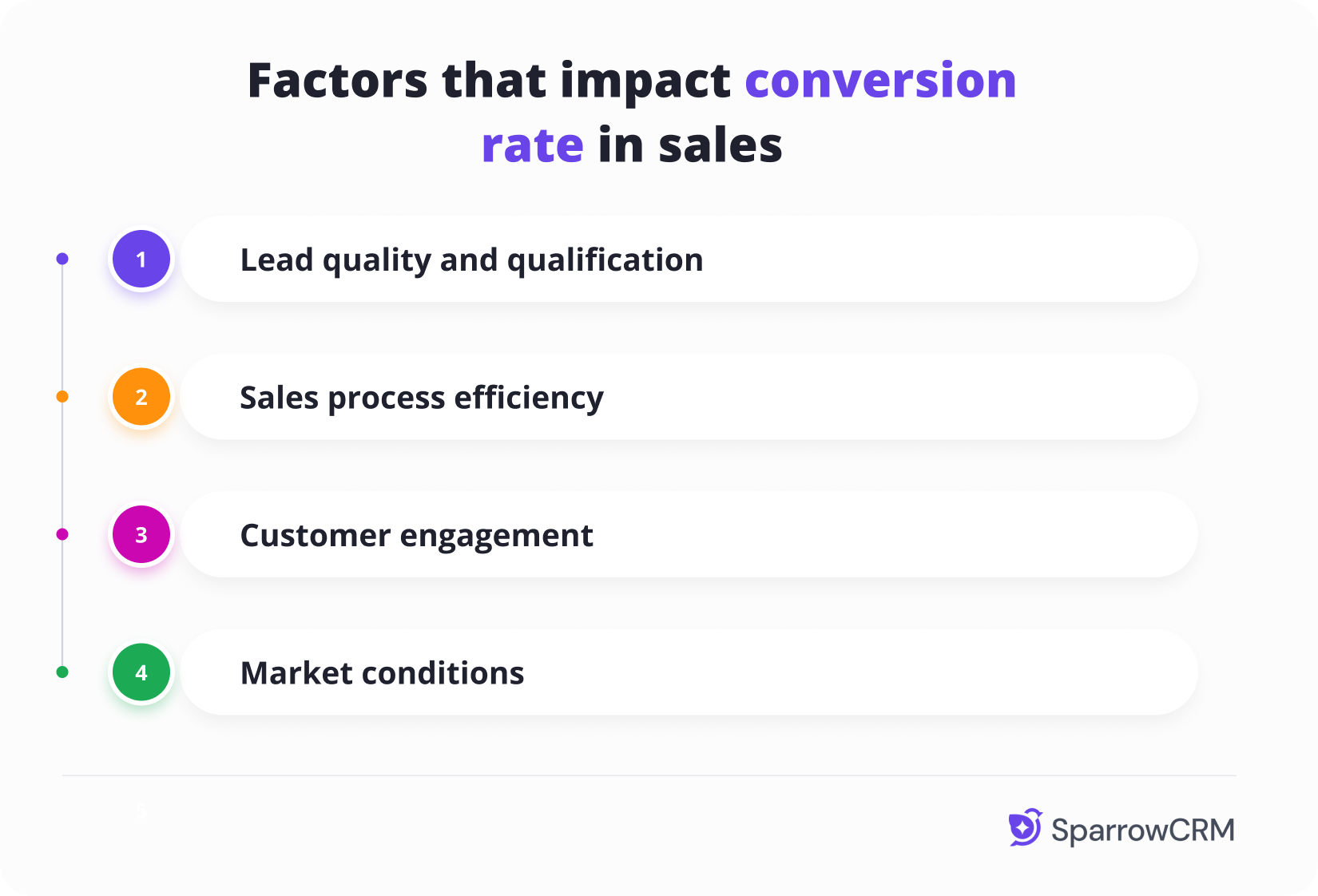
3. Customer engagement
- Personalized calls-to-action convert 202 percent better than generic ones.
- Personalized content generates three times more leads at 62 percent lower cost.
- Multi-channel outreach combining email, phone, and social converts two to three times better than any single channel alone.
4. Market conditions
- Seasonality, competitive pressure, and unclear positioning all move conversion rate independent of anything the sales team does differently.
- Products with a clearly stated problem-solution fit consistently outconvert those with vague value propositions, regardless of feature parity.
How to Improve Sales Conversion Rate
To improve conversion performance, you need targeted interventions across multiple operational areas.
1. Personalize your sales outreach
Tailored communication that addresses specific prospect needs outperforms generic messaging by a wide margin. Personalized calls-to-action convert 202% better than default versions. Targeted content gets three times more leads at 62% lower costs.
2. Optimize your sales funnel stages
Systematic funnel analysis identifies bottlenecks where prospects disengage. Organizations that achieve strong alignment report 25% increases in lead conversion through improved team collaboration and a 40% improvement in lead handoff efficiency between departments.
3. Use CRM and sales analytics tools
Centralized platforms provide unified visibility into prospect interactions and pipeline movement. Sales dashboards deliver up-to-the-minute metrics that enable decisions based on analytics. Automation reduces manual tasks and allows representatives to focus on revenue-generating activities.
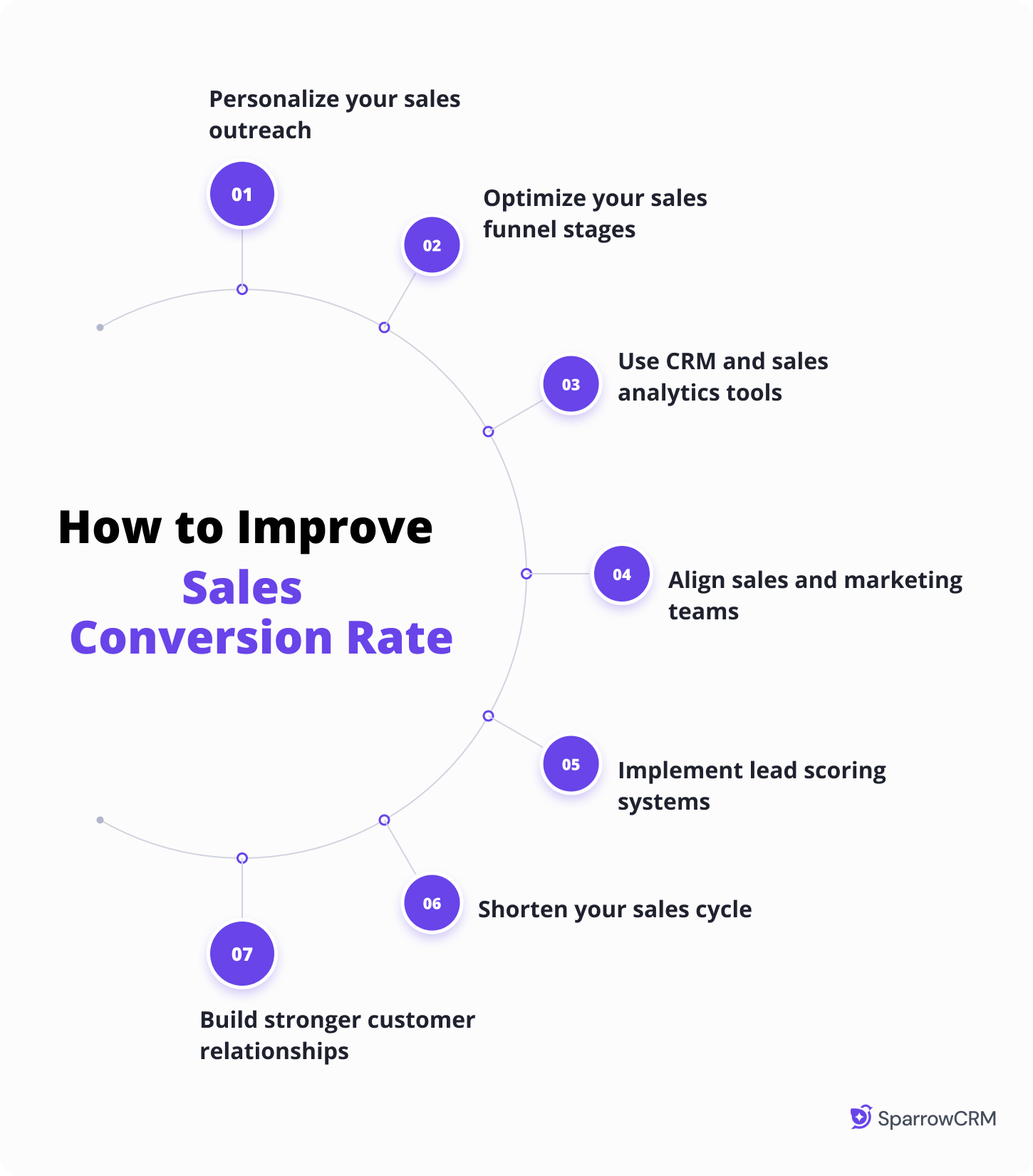
4. Align sales and marketing teams
Organizations that prioritize sales-marketing alignment prove nearly three times more likely to exceed customer acquisition targets. Shared revenue goals and unified customer definitions eliminate siloed operations.
5. Implement lead scoring systems
Predictive models that rank leads by conversion probability enable teams to prioritize high-intent prospects. Companies with strong lead scoring generate 77% more ROI.
6. Shorten your sales cycle
When you reduce cycle length, you accelerate revenue realization. Sales representatives at companies using CRM can shorten cycles by 8-14%.
7. Build stronger customer relationships
Trust-based relationships convert more than transactional interactions. Representatives who listen and demonstrate empathy build confidence that accelerates decision-making.
Sign Up Free and Get 100 AI Credits
Final thoughts
Sales conversion rate is only useful when you know which number you are looking at: a blended funnel rate, a stage-specific rate, or an industry benchmark. Track it consistently, compare it against the right peer group, and use it to fix the process rather than judge the team. Once the conversion rate is reliable, it becomes an input worth feeding into your sales forecasting rather than a number reviewed once a quarter.

Geethapriya
Geethapriya is a Growth Marketer and Business Researcher who researches and writes about CRM, sales, marketing, and customer engagement. Her work focuses on understanding industry trends, customer and sales challenges, and how businesses can use technology to build more effective growth processes.