LEAD MANAGEMENT
Lead scoring: a complete guide to qualifying and prioritizing prospects

By Ganesh Ravi Shankar
Last updated on Sep 30, 2026
Explore this blog to understand how lead scoring works, which model fits your sales motion, and how to build a system that sends only your best prospects to sales.

Ganesh Ravi Shankar
Updated on Sep 30, 2026
61% of B2B marketers send every lead straight to sales. Only 27% of those leads are actually qualified.
That gap is expensive. Sales reps spend time chasing contacts who will never buy. Marketing argues the leads are fine. Neither team trusts the other's numbers.
Lead scoring fixes that. It gives both teams a shared, objective way to define what a good lead looks like, and it routes each prospect to the right next step at the right time.
This guide breaks down everything you need to know: what lead scoring is, which models work best for B2B, how to build a system from scratch, and how AI is making the whole process smarter and faster.
TL;DR
What is lead scoring?
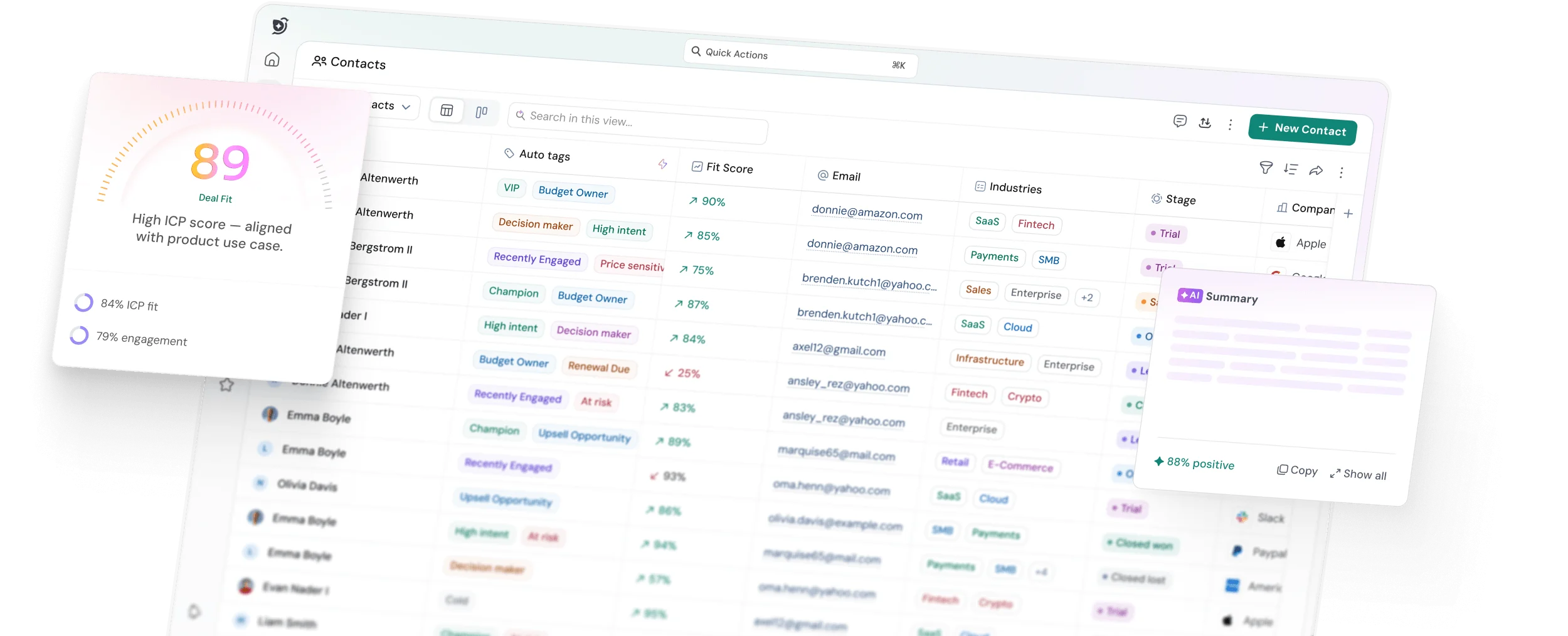
Lead scoring is a method for ranking prospects by how likely they are to buy. You assign numerical values to specific characteristics and actions, then use the combined score to decide who goes to sales and who goes into a nurture sequence.
The concept is straightforward. A lead who fits your ideal customer profile and visits your pricing page twice in one week is a stronger prospect than someone who downloaded a single ebook three months ago and never came back.
Lead scoring makes that distinction automatic and consistent.
The lead scoring methodology you choose shapes how your model is built and maintained. Some teams use rules-based scoring with fixed point values that they set manually. Others use machine learning to update scores dynamically. The right approach depends on your data, your sales cycle, and how mature your RevOps function is.
Explicit vs. implicit data
Every scoring model draws from two data types:
- Explicit data is information that leads provide directly. Job title, company size, industry, location. This tells you whether someone fits your ideal customer profile.
- Implicit data is behavioral. Website visits, email opens, content downloads, demo requests. This tells you how interested they are right now.
The best lead scoring systems use both. A senior decision-maker who never engages with your content is not as valuable as a manager who has visited your pricing page four times this week.
How do scores accumulate?
Most systems use a 0-100 scale. Points add up as prospects take actions or match profile criteria. Common point assignments look like this:
Action or attribute | Points | Signal type |
|---|---|---|
Demo request | +50 | High intent |
Pricing page (3 visits in one week) | +30 | High intent |
Webinar attendance (75%+ of session) | +25 | Mid intent |
Case study download | +20 | Mid intent |
Blog visit | +5 | Low intent |
Personal email address (B2B context) | -20 | Disqualifier |
Competitor employee domain | -50 | Hard disqualifier |
When a lead crosses a score threshold, it triggers a workflow. Marketing qualified leads (MQLs) go into automated nurture sequences. Sales qualified leads (SQLs) land directly in a rep's queue.
Why lead scoring matters for B2B sales teams?
Lead scoring is not just a qualification filter. In B2B, especially, lead scoring b2b teams rely on goes deeper than demographics. It accounts for long sales cycles, multiple stakeholders, and the fact that the person who fills out the form is rarely the person who signs the contract. It changes how sales and marketing operate together.
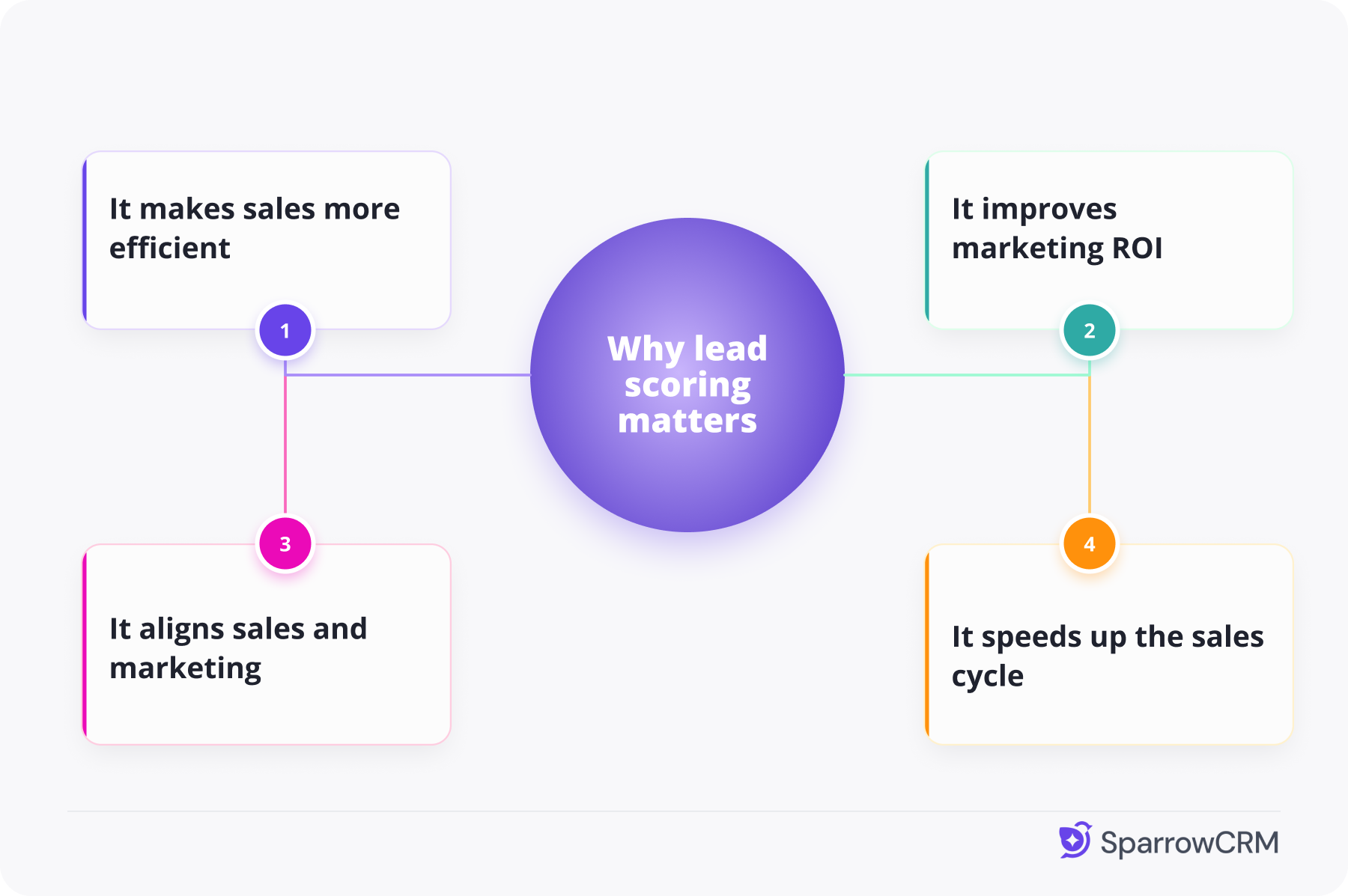
1. It makes sales more efficient
Without lead scoring, sales reps spend roughly 9% of their week on prospecting and lead prioritization with poor results. Organizations that implement lead scoring route only 32-34% of form submissions directly to sales reps. The rest go into nurture until they show real intent.
Fewer leads, better quality. Reps close deals faster because they're not chasing contacts who were never going to buy.
2. It improves marketing ROI
Companies using lead scoring report a 77% increase in ROI for lead generation. The average conversion rate from prospect to customer sits at 1-6% without scoring. With scoring, it climbs to 15-20% for qualified leads.
One SaaS company reported a 27% sales increase after switching to AI-based predictive scoring. A consulting firm improved revenue by more than 18% using a manual scoring model. The common thread is that scoring forces teams to define quality before measuring it.
3. It aligns sales and marketing
Lead scoring forces both teams to agree on what a good lead looks like before anyone sends it anywhere. That shared definition ends the classic argument where marketing says leads are great, and sales says they're not.
Survey data shows 53% of organizations saw improved alignment between sales and marketing after implementing lead scoring. An additional 43% found qualified leads they would have missed without a scoring system.
How can AI improve lead scoring and targeting?
AI can make lead scoring more dynamic by analyzing more signals than a traditional rules-based model.
- Finds conversion patterns: Analyzes historical conversion, firmographic, and engagement data to identify signals that may be missed manually.
- Updates scores dynamically: Adjusts lead scores as buyer behavior and engagement change.
- Prioritizes high-intent leads: Identifies contacts and accounts showing stronger signals of purchase intent.
- Improves targeting: Helps sales teams focus outreach on prospects that match their ICP and show meaningful engagement.
The result is a scoring system that adapts to buyer behavior instead of relying entirely on fixed rules.
4. It speeds up the sales cycle
Your odds of reaching a new lead drop by more than 10 times if you wait longer than one hour after they express interest. Lead scoring solves this by flagging hot leads the moment they cross a qualification threshold, rather than waiting for a weekly pipeline review.
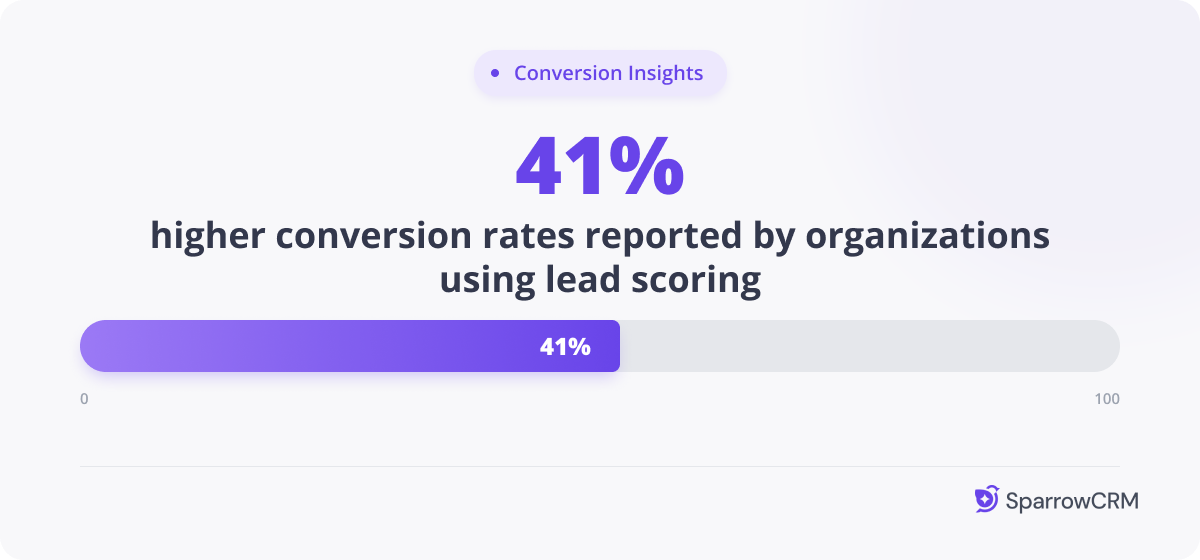
Organizations using lead scoring report 41% improved conversion rates and 32% more sales-ready leads entering their pipeline.
Lead scoring models explained
Different businesses need different approaches. The model you choose depends on your sales cycle, your data, and how mature your marketing and sales operations are.
1. Demographic and firmographic scoring
This model scores leads based on who they are. Job title, company size, industry, geography, and technology stack are the most common inputs.
For a B2B SaaS company targeting mid-market, a CFO at a 200-person company might score +30 for seniority and +20 for company size. A junior analyst at a startup might score +5 for seniority and -10 for company size, being too small for the product.
Firmographic scoring is the starting point for most B2B teams. It tells you whether a lead is in the right category. It does not tell you whether they're ready to buy.
2. Behavioral and engagement scoring
Behavioral scoring measures what leads do. Pricing page visits, demo requests, content downloads, email click-throughs, and webinar attendance. These actions reveal buying intent at a specific point in time.
The key principle here is recency. A pricing page visit from yesterday is worth far more than a whitepaper download from six months ago. Behavioral scoring should reflect this by applying score decay logic (more on this in best practices).
Bottom-funnel content like case studies and ROI calculators signals stronger intent than top-funnel content like blog posts. Weight them accordingly.
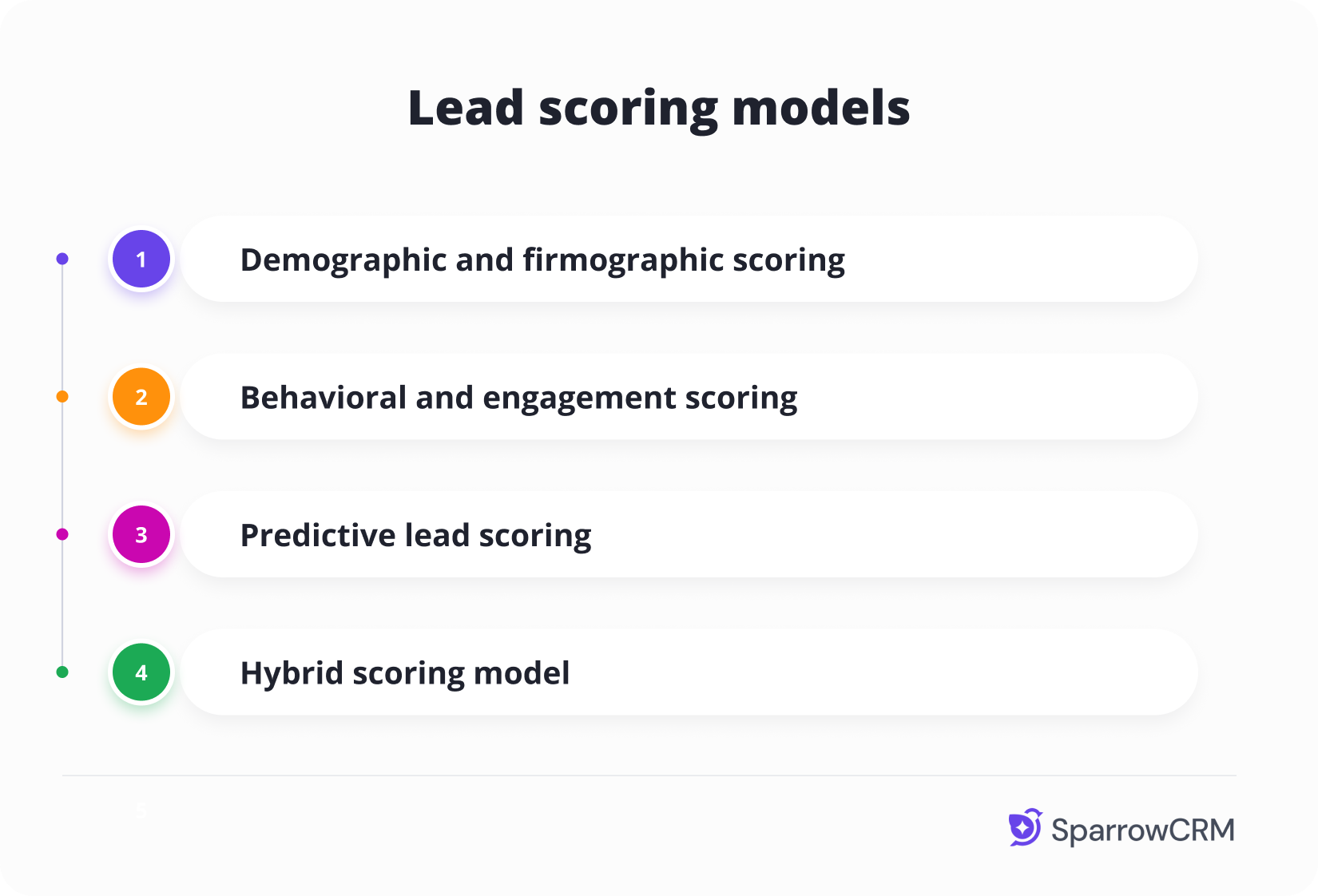
3. Predictive lead scoring
Predictive scoring uses machine learning to analyze historical conversion data and identify patterns that human analysts would miss. Rather than relying on rules you set manually, the model learns which combinations of attributes and behaviors predict conversion.
The result is a score that adapts over time. As your sales data grows, the model gets more accurate. It can surface signals you never thought to include in a manual model, like the time of day a lead typically engages or how their behavior compares to your 50 most recent closed deals.
Predictive scoring works best when you have at least several hundred closed deals in your CRM and clean historical data. Early-stage teams without sufficient deal volume are better served by a rules-based model until the data exists to train a predictive one.
4. Hybrid scoring model
Most mature B2B teams use a hybrid approach that combines firmographic fit with behavioral engagement. This gives you two separate dimensions to work with:
- High fit, high engagement: Sales-ready. Follow up immediately.
- High fit, low engagement: Right profile, wrong time. Nurture until they show intent.
- Low fit, high engagement: Active but not a buyer. Disqualify or redirect.
- Low fit, low engagement: No action required.
This prioritization matrix prevents two common mistakes: sending the right-profile lead to sales before they're ready, and wasting time on an active browser who will never become a customer.
How is AI changing lead scoring?
Traditional lead scoring relies on rules that humans write and maintain. You decide which actions earn which points. You update the model when you notice it's drifting. That process works, but it is slow and often lags reality by weeks or months.
AI-native lead scoring changes the underlying logic. Instead of scoring leads against a fixed ruleset, machine learning models score leads against patterns derived from every closed deal in your CRM.
1. What AI-native scoring does differently
An AI model does not need you to guess which signals matter. It analyzes thousands of data points across behavioral interactions, firmographic records, and engagement history to find correlations that predict conversion.
It updates automatically. If your buyer profile shifts because you move upmarket, the model picks that up in the data and adjusts scores without you rewriting rules. This is the biggest operational advantage over manual scoring.
It also handles nuance that manual models miss. A procurement manager at a 500-person company who visits your integration documentation three times in a week may score higher in a predictive model than a VP who requested a demo once and went quiet, even though the demo request carries more manual weight.
2. AI for buying committee scoring
In B2B deals, one contact rarely makes the buying decision alone. The average deal involves multiple stakeholders, each with different roles and different buying signals.
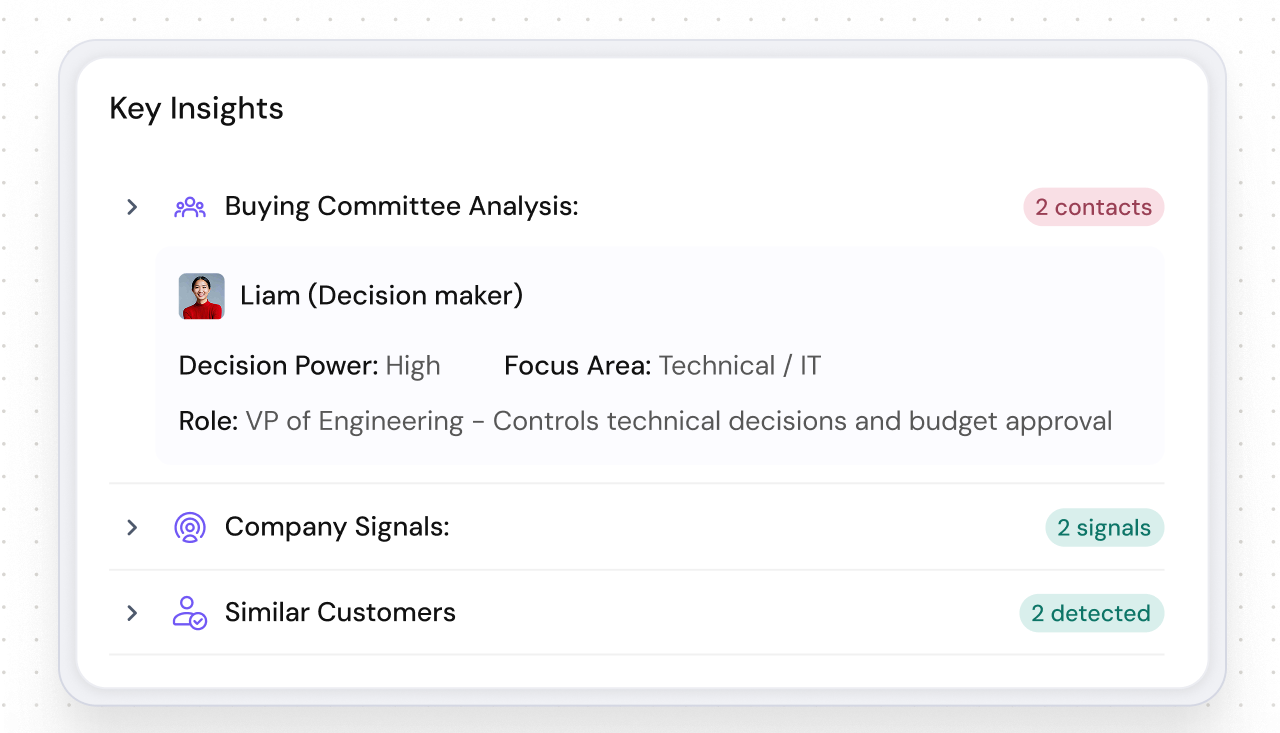
AI-native CRM platforms can score at the account level, not just the contact level. They track engagement across all stakeholders in a deal, identify who has gone silent, and surface the account when buying committee activity drops below a threshold.
Let SparrowCRM Show You Which Leads Matter Most
3. What the data says
The results of AI-based scoring are measurable. Companies report a 27% increase in sales after switching to predictive scoring. Grammarly saw 30% higher MQL conversions and 80% more account upgrades. HES FinTech achieved 40% more weekly loans using machine learning-based lead prioritization.
AI scoring is not a replacement for a clear ICP and well-defined qualification criteria. It amplifies them. The model is only as good as the historical data it trains on.
How to build a lead scoring system step by step
Building a lead scoring system is a cross-functional project. Sales, marketing, and, if possible, a RevOps or CRM administrator should all be involved.
Step 1: Define your ideal customer profile
Your ideal customer profile (ICP) is the foundation of your scoring model. Before you assign a single point value, you need to agree on what your best customers look like.
Start by analyzing your top 20-30 closed deals. Look for common attributes: company size, industry, job title of the buyer, sales cycle length, and deal value. Then talk to the reps who closed those deals. Ask them what signals they saw early on that told them the deal would close.
The answers to that question are your highest-weight scoring attributes.
Step 2: Identify scoring attributes
Build two separate lists: one for demographic and firmographic attributes, one for behavioral signals.
For demographics and firmographics, pull from your ICP: job title, seniority level, company size, industry, geography, and technology stack. For behaviors, list every action a prospect can take with your business: page visits, content downloads, email engagement, demo requests, event attendance, and product trial activity.
Rank each attribute and behavior by how strongly it correlates with conversion in your historical data. That ranking determines your point values.
.png?2026-06-24T07:40:56.043Z)
Step 3: Assign point values
Calculate the conversion rate for each attribute using your CRM data. Divide the number of customers who had that attribute by the total number of leads who had it. Compare that rate to your baseline conversion rate.
If your baseline is 10% and leads who request demos convert at 60%, the demo request is worth six times your baseline signal. Assign points proportionally. This gives you a scoring model grounded in your actual sales data rather than industry benchmarks that may not apply to your business.
Include negative point values for disqualifying factors. Competitor employees, personal email addresses in a B2B context, job titles that indicate no buying authority, and geographic locations outside your serviceable market.
Step 4: Set MQL and SQL thresholds
Sales and marketing need to agree on the score thresholds that define each qualification stage. A common starting point is 50 for MQL and 75-100 for SQL, but these numbers should come from your own conversion data, not industry averages.
Test your thresholds against historical deals. If at least 90% of your closed-won opportunities scored above your SQL threshold in the 30 days before they closed, your threshold is calibrated. If fewer than 70% did, your threshold is too high, or your point values are off.
Document the thresholds in a shared SLA between sales and marketing. Both teams should sign off on what each score band means and what the expected follow-up action is.
Step 5: Implement and automate in your CRM
Most CRM platforms include built-in lead scoring functionality. Dedicated lead scoring software like Marketo, HubSpot, and Pardot also offers standalone scoring engines that integrate with your CRM. Configure your scoring rules by mapping attributes and behaviors to point values. Set up automated workflows that trigger when contacts cross score thresholds.
Key automations to build from day one:
- Assign SQL leads to a sales rep immediately when they cross the threshold
- Create a follow-up task with a 24-hour SLA for every new SQL
- Move MQL leads into an appropriate nurture sequence based on their profile
- Alert the rep when a nurtured lead resurfaces with new high-intent activity
- Apply score decay monthly so stale engagement does not inflate scores
For more on connecting lead scoring to a broader lead management workflow, see the full guide.
Lead scoring examples (B2B)
Abstract frameworks are useful. Real examples are more useful. Here are two B2B scenarios that show how lead scoring works in practice.
Example 1: SaaS company targeting mid-market
A 28-person SaaS company sells project management software to operations teams at companies with 100-500 employees. Their ICP is a VP of Operations or Head of Operations at a tech company in the US.
Their scoring model looks like this:
Criterion | Points | Category |
|---|---|---|
VP or Head of Operations job title | +30 | Firmographic |
Company size 100-500 employees | +20 | Firmographic |
Tech industry | +10 | Firmographic |
Demo request submitted | +50 | Behavioral |
Pricing page (2+ visits) | +25 | Behavioral |
Case study download | +15 | Behavioral |
Personal email address | -20 | Negative |
A company with fewer than 50 employees | -15 | Negative |
MQL threshold: 60 points. SQL threshold: 85 points.
Before scoring, the team was routing every form fill to sales. Reps complained constantly about lead quality. After implementing this model, only 34% of leads reached a sales rep. Close rate improved by 22% within two quarters.
Example 2: B2B fintech targeting enterprise
A fintech company sells compliance software to legal and finance teams at companies with 500+ employees. The problem: a junior analyst fills out the form, scores well on behavior, but the economic buyer is a CFO or General Counsel who has never engaged with marketing content.
Their solution was to score at the account level, not just the contact level. Any account with a demo request from one contact PLUS an ICP-fit profile from a senior stakeholder (identified through intent data or LinkedIn enrichment) scores as a high-priority account, regardless of which individual contact initiated the conversation.
This approach reduced time-to-close by 18% because reps started reaching out to the right stakeholders from the first call rather than discovering the actual buyer two weeks in.
Lead scoring best practices
A scoring model that goes stale is worse than no model. These practices keep your system accurate and useful over time.
1. Use negative scoring
Most teams focus on awarding points. The filter that actually protects rep time is negative scoring. Deduct points aggressively for disqualifying signals:
- Competitor employee domain: -50 points
- Personal email in a B2B context: -20 points
- Job title with no buying authority (intern, student): -30 points
- Geography outside your service area: -25 points
- Email unsubscribe: -25 points
A lead can have one negative attribute and still convert. The point is to ensure your model weighs disqualifiers heavily enough that high negative scores surface clearly in your pipeline review.
2. Apply score decay
A lead who scored 80 points six months ago is not the same as a lead who scored 60 points last week. Without score decay, old activity inflates scores and sends stale leads to sales.
Apply a 25% monthly decay to behavioral scores when there is no new activity. Page visits and email opens should decay to zero over 30-60 days. Demo requests and trial signups can hold their value for up to 90-180 days. Firmographic fit scores do not decay; they get refreshed through data enrichment when a company changes size, industry, or team structure.
3. Review your model quarterly
Scoring models drift. Your buyer profile changes. New products attract different segments. Market conditions shift.
Set a quarterly review on the calendar with both sales and marketing. Track MQL-to-SQL conversion rate by score band. If leads scoring 60-75 convert to opportunities at the same rate as leads scoring 90+, your point values are misaligned. Adjust them.
Keep a changelog. Every modification to the scoring model should be documented with a date and the reason for the change. Without this, you cannot diagnose why conversion rates move.
4. Align on thresholds in a shared SLA
Score thresholds mean nothing unless both teams have agreed on them in writing. A shared SLA should define what each score band means, what the expected action is, and what the response time commitment is for each stage.
An MQL SLA might say: "Marketing will only pass leads scoring 50+ to sales. Sales will accept or reject each MQL within 48 hours and document the reason for any rejection." That feedback loop is what allows you to refine the model over time.
Which CRM offers built-in AI for lead scoring?
Several CRMs now offer built-in AI or predictive lead scoring. Some options include:
- Salesforce: Einstein Lead Scoring analyzes historical conversion patterns to score current leads.
- HubSpot: AI-assisted lead scoring uses historical contact data to help identify relevant scoring criteria.
- Microsoft Dynamics 365: Predictive lead scoring uses historical data and lead attributes to identify leads more likely to convert.
- SparrowCRM: Uses AI-driven signals such as ICP fit, engagement, and buying intent to help sales teams prioritize leads and identify accounts showing stronger purchase signals.
The right option depends on the data available, scoring model, and level of automation your sales team needs.
Lead scoring audit checklist
Use this checklist every quarter. If you answer no to more than three questions, your model needs recalibration.
- ICP definition: Has your ideal customer profile been updated in the last 6 months?
- Point values: Are your point values based on actual conversion data, not assumptions?
- Negative scoring: Does your model actively deduct points for at least 5 disqualifying factors?
- Score decay: Is behavioral score decay applied monthly to contacts with no new activity?
- Threshold validation: Do at least 80% of closed-won deals score above your SQL threshold in the 30 days before close?
- MQL rejection rate: Is the sales rejection rate for MQLs below 20%? Above that signals a calibration problem.
- Sales feedback loop: Does sales provide structured feedback on lead quality at least once per quarter?
- Changelog maintained: Is every model change logged with a date and reason?
- CRM automation: Are score threshold automations running correctly in your CRM? Test them monthly.
- Alignment confirmed: Have both sales and marketing signed off on the current MQL and SQL definitions in writing?

.webp?2026-09-14T15:44:03.253Z)