SALES STRATEGY
30-60-90 day sales plan: A complete guide for new sales reps

By Geethapriya
Last updated on Jul 8, 2026
Explore this blog to build a structured 30-60-90-day sales plan that gets you productive faster, with real examples, phase-by-phase goals, and a free template you can use right away.

- What is a 30-60-90 day sales plan?
- The three phases explained
- Who uses 30-60-90 day sales plans?
- Why new sales reps need a 30-60-90 day plan
- How to build a 30-60-90 day sales plan
- What to include in each phase of your plan
- 30-60-90 day sales plan example for new reps
- Best practices and common mistakes to avoid
- Final thoughts
Starting a new sales role means learning fast while everyone around you is watching how quickly you ramp up. Without a plan, that pressure turns into wasted weeks and guesswork about what actually matters.
A 30-60-90-day sales plan fixes that. It breaks your first three months into three clear phases, each with its own goals, so you always know what to focus on next instead of figuring it out as you go.
This guide covers what the plan looks like, why it works, how to build your own, and a real example you can use as a starting template.
TL;DR
A 30-60-90-day sales plan splits your first 90 days into three phases: learning, doing, and owning.
Reps with a structured plan ramp up faster and are far less likely to leave within their first year
Build your plan with SMART goals, clear success metrics, and regular check-ins with your manager.
See what a strong plan actually looks like, with real targets for each 30-day period.
What is a 30-60-90 day sales plan?
A 30-60-90 day sales plan is a document that sets goals for your first three months in a new role. It breaks your first 90 days into three 30-day phases, each with clear targets for days 1-30, 31-60, and 61-90. Instead of guessing your way through your first quarter, you know exactly what to focus on. Most companies build this plan during final interviews or within your first week on the job.
The plan works because it ties your personal goals to your team's goals. When everyone works toward the same targets, you get clarity and direction from day one instead of drifting through your first few months.
“As a Business Development Representative, the first 30 days are all about activity. After a new hire learns the company and the product, we look at pure activity, how many calls or emails are they engaging in weekly. By day 60, we begin to look at effectiveness”
The three phases explained
The plan splits your first 90 days into three stages. Each stage builds on the one before it. You move from learning to doing to owning.
Phase 1 (Days 1-30): Learning and foundation
Your first month is about watching, learning, and settling in. Spend this time understanding your tools, your company's policies, and how your team works day to day. Build relationships early and learn the processes that support your job.
Your goals should center on understanding your company's mission and values. Learn how to add value in your role and get clear on what your manager expects. You'll attend orientation, shadow experienced reps, review policies, and set up the tools you need.
Phase 2 (Days 31-60): Implementing and practicing
Month two is where you start contributing. Set goals around finishing tasks, joining team meetings, and helping with project work. Keep building relationships with key people, and start tracking how your work affects team metrics.
This phase marks your shift from learning to doing. You apply what you picked up in month one to real work. You take on more responsibility and start showing up in team results. Your relationships also grow beyond your immediate team.
Phase 3 (Days 61-90): Executing and optimizing
By day 90, your goals shift toward ownership. Focus on making your role more efficient and suggesting improvements to how your team works. You might lead a small project, track your own metrics, and start spotting chances for long-term growth.
This final phase is about performance and leadership. You move from doing assigned tasks to proposing better ones. You show initiative. By the end of this phase, you should be adding clear value and working with more independence.
Who uses 30-60-90 day sales plans?
Every industry and job level can use a 30-60-90 day plan. HR teams across many fields build them for employees at every stage.
New hires use these plans to understand their job and build momentum fast. The structure helps you adapt to a new culture and supports long-term retention by setting you up to succeed from day one.
Sales managers use the same framework when they step into leadership or onboard a new team member. The plan helps a manager learn team dynamics, set up communication habits, and establish a performance baseline.
Existing employees use 30-60-90-day plans during promotions or territory changes. Companies use structured planning frameworks like this specifically to guide new territories or roles, since it lays out clear goals and tasks for each stage.
Job candidates sometimes build these plans during interviews to show they understand the role. Presenting a draft plan shows a hiring manager you've done your homework and can move fast once hired.
Performance improvement plans also lean on this structure. It creates a focused path forward after a rough review, helping you close skill gaps and re-engage with clear, short-term goals.
Get your free 30-60-90 day sales plan template
Why new sales reps need a 30-60-90 day plan
Starting a new sales job is overwhelming. You're learning the product, the CRM, your customer types, and your targets, all while everyone around you seems to already know the ropes. Without structure, this pressure leads to mistakes and early burnout. A 30-60-90 day plan removes that guesswork.
1. Structured onboarding and faster ramp-up
Getting new reps productive fast is one of the toughest challenges sales teams face. According to The Bridge Group's SaaS AE Metrics research, average ramp-up time for SaaS companies grew 32 percent, from 4.3 months in 2020 to 5.7 months in 2025. That's nearly half a year before a new hire starts driving revenue.
Companies with strong onboarding get new hires selling productively much faster than teams without a formal plan. Reps with proper support learn faster and stay longer.
The alternative is costly. A large share of new sales reps leave within their first year due to lack of support. Without a clear framework, you're left guessing what to prioritize and whether you're even meeting expectations. That slows everything down.
2. Clear expectations from day one
A 30-60-90 day plan removes the guesswork about what success looks like. You know exactly where to spend your time and energy. This keeps you from spreading yourself too thin, and it gives you a clear 30-day window to check your progress.
Building this plan together builds trust between you and your manager early on. You both agree on priorities and timelines from the start. You're not left wondering if you're doing the right things.
Clear goals also create accountability. Your leadership can track your progress against shared standards, which keeps your work aligned with company goals from day one.
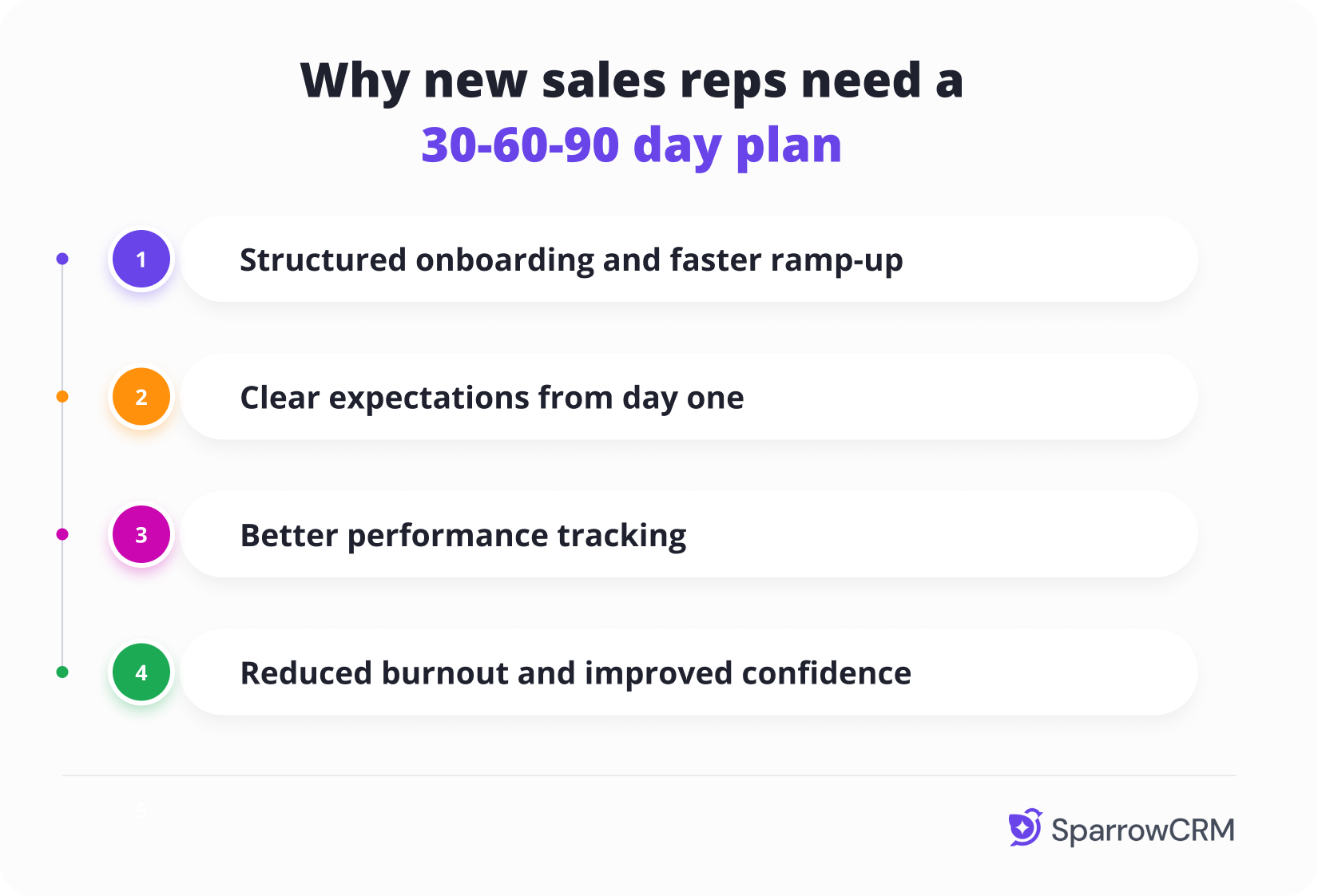
3. Better performance tracking
Progress becomes easy to measure once you have milestones at 30, 60, and 90 days. Managers can track real sales metrics, like meetings booked, pipeline built, and deals closed, instead of relying on vague check-ins.
The plan creates natural checkpoints. Problems get caught at day 30 or 60, not day 180 when it's too late to fix them. Regular check-ins with your manager give you room for feedback and course correction.
Tracking also reveals patterns over time. You'll see which activities actually produce results and where you need more coaching.
4. Reduced burnout and improved confidence
A three-month plan sets a pace you can sustain. Breaking the "first 90 days" into three smaller phases prevents the information overload that leads to early burnout.
Confidence builds through small wins. Finishing Phase 1 goals, shadowing experienced reps, and getting positive feedback all prove you can handle the role. These early wins cut down the self-doubt that hits most new hires.
The payoff is real. A DePaul University study found losing a sales rep costs a company an average of $97,690 once you add up recruiting, training, and lost sales. Better onboarding protects that investment by helping new reps succeed instead of leaving early.
Start Your Sales Journey Strong With SparrowCRM

How to build a 30-60-90 day sales plan
Building a strong plan takes real preparation, not just filling in a template. Here's how to do it right.
1. Research your company and market
Start with the foundation. Research your company's values and goals before picking specific targets. Understand how your role supports the bigger picture.
Look at your competitive landscape. Talk to your customer success team, since they hear customer pain points every day. Check press mentions, social posts, and reviews to see how others view your company.
Study your target market too. Learn about your ideal customers: their industries, company size, funding, and location. Understand the challenges they're facing, whether that's growth pressure or hiring bottlenecks.
2. Set SMART goals for each phase
Your goals need to be specific, measurable, achievable, relevant, and time-bound. Write "complete product training and score 80 percent on the certification test within 30 days," not "learn the product."
Each phase needs its own goals. Days 1-30 might focus on finishing training modules or making a set number of outreach attempts. Days 31-60 could target closing a certain number of deals, and Phase 3 goals shift toward revenue and process improvements.
Our guide to SMART sales goals has more real examples if you want to see this framework applied across different roles, not just onboarding.
Break your big revenue goal into smaller activity targets. Use last year's data to figure out what's realistic. Setting a timeline adds urgency and keeps your effort focused.
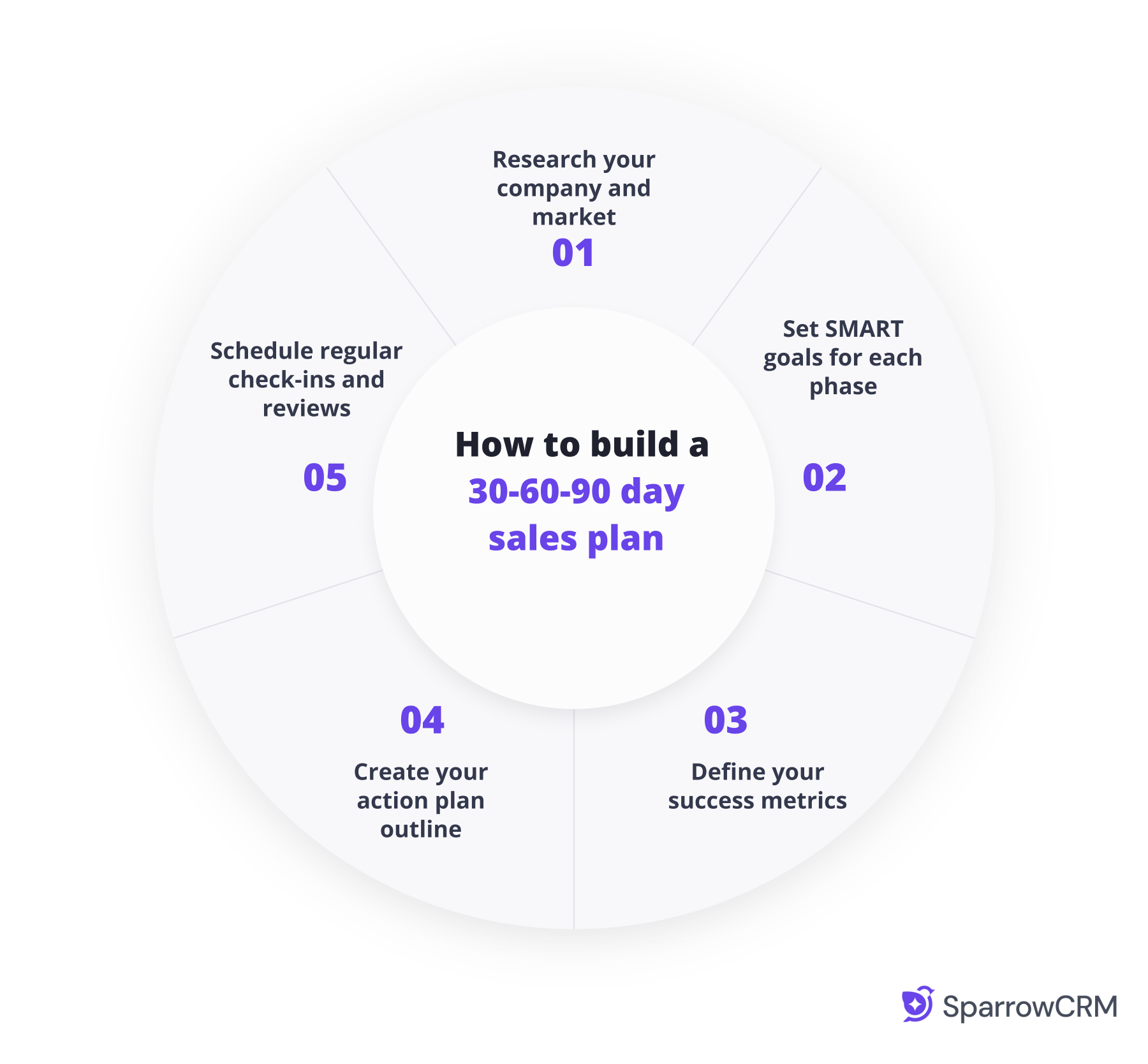
3. Define your success metrics
Decide what you'll track in each phase. Phase 1 should track learning goals, such as completing training or mastering your CRM. Phase 2 should track outreach, meetings booked, and prospect engagement. Phase 3 should track closed deals and revenue.
Clear metrics give you accountability and real data to check your progress. Decide how often you'll track these numbers and what tool you'll use to store them.
4. Create your action plan outline
Split your plan into the same three phases. Phase 1 covers learning your company, product, and market. Phase 2 covers applying what you learned, finding leads, and building relationships. Phase 3 covers reviewing what worked, what didn't, and refining your approach.
Your outline can be as simple or detailed as you need.
Template: Use the framework above as your starting point, or download our free 30-60-90 day sales plan template to fill in your own goals, metrics, and check-in dates for each phase.
5. Schedule regular check-ins and reviews
Regular check-ins help you catch problems early and fix them before they grow. Schedule weekly meetings with your manager to review progress. By Phase 3, sit down and assess your overall performance using real feedback and data.
Reviewing your numbers regularly tells you whether your plan is working or needs adjusting. This keeps your plan useful instead of letting it sit untouched.
What to include in each phase of your plan
Each phase needs specific activities and deliverables. Knowing exactly what to focus on prevents wasted effort and builds the right foundation for long-term success.
Days 1-30: Learning and foundation
Your first month is about absorbing, not producing. Complete all onboarding and training, aiming for a 90 percent or higher pass rate on any product certification. Learn your company's mission on your own and with your manager, so you understand how your role fits the bigger picture.
Shadow at least five calls from your top-performing reps. Watch closely how they handle objections and run discovery calls, and take detailed notes. This kind of observation teaches you faster than any training video. Ask for access to call recordings so you can review them more than once and spot patterns in what works.
Give your CRM your full attention until you hit 100 percent profile completion with your pipeline set up correctly. Learn to pull reports, update deal stages, log activities, and set reminders.
A CRM like SparrowCRM logs call activity and updates pipeline stages automatically, which makes it easier for new reps to hit that 100 percent completion goal without manual data entry. Poor CRM habits formed early are hard to break later.
Build a list of your top 20 target accounts with key contacts identified. Study the competitive landscape, and review past wins and losses in your CRM to spot patterns.
Create a personal reference sheet covering common objections and competitor comparisons. Schedule meetings with at least five people outside your team, in marketing, customer success, or product, to understand how leads move through your company.
Days 31-60: Implementing and practicing
Month two is about execution. Launch your prospecting routine: aim for 30 calls and 15 personalized emails a day, adjusted for your role and territory. Our guide to cold calling tips can help you sharpen your approach before you start dialing.
Your goal is to book 10-15 qualified discovery meetings while building $50,000-$100,000 in sales pipeline value, adjusted for your average deal size.
Run your first solo demos, even small ones, to build comfort presenting. After your first 10 discovery calls, review what worked and what didn't with your manager.
If you want a framework for structuring those calls well, our discovery call guide walks through the questions that convert best. Test two different pitch styles and track which one books more second meetings; this kind of testing helps you find your own selling style.
Sit in on pipeline reviews and forecast meetings to see how senior reps qualify deals and handle stalled ones. Meet with a senior rep to understand your tracking system and how to read pipeline health. Keep a simple log of your sales activities so you can spot patterns in your own approach.
Days 61-90: Executing and optimizing
The final month proves you can operate on your own. Close your first 2-3 deals and share those early wins with leadership. Review which scripts converted best, which customer types responded well, and where deals stalled in your pipeline.
Write down your refined approach in a personal playbook so you can repeat what works. Present your pipeline status and lessons learned to your manager. Keep your pipeline coverage at least three times your quota, so your funnel stays healthy beyond the current quarter.
Look at your company's existing sales strategies and learn how to apply them. Make at least one sale entirely on your own, without help from a manager or leads from a colleague. Closed deals that came from your own relationships become proof points when you prospect new accounts, so document them well.
30-60-90 day sales plan example for new reps
Here's what a strong plan looks like in practice, with real numbers that separate strong performers from reps who struggle to gain traction.
Phase 1 example: First 30 days
Complete product training and score at least 80 percent on your certification test. Shadow experienced reps for at least 5 field days and watch real customer interactions. Use your CRM data to map 50-100 target accounts across your territory.
Schedule meetings with 5 or more people across marketing, customer success, and product. Sit in on 3 client meetings as an observer to see how deals move forward. Build your own prospect list and finish 100 percent of your onboarding modules.
By day 30, deliver a mock presentation to your manager without notes. Show your CRM skills by logging your practice activities correctly.
Download your free 30-60-90 day sales plan template
Phase 2 example: Days 31-60
Launch outbound sequences targeting 8-10 in-person meetings a week, adjusted for how dense your territory is. Make 100 calls and book 15 meetings during this phase. Build a pipeline worth at least $50,000 in qualified opportunities.
Run 10 product demos on your own and track your conversion rate. Sign your first contract, worth at least $5,000. Set up 3 meetings that came from your own cold-calling efforts, not from marketing or referrals.
Track your qualification rate and aim for 20-30 percent of your presentations turning into qualified opportunities. Complete 30 or more meetings with prospects in your best-performing segments.
Phase 3 example: Days 61-90
Close 3-5 deals worth $25,000-$40,000 in total revenue. Aim for a 25 percent conversion rate across your pipeline. Keep your pipeline coverage at 3x your quota heading into next quarter.
Generate $30,000 or more in closed revenue and track customer satisfaction after each sale, aiming for 90 percent satisfaction. Make at least one sale entirely on your own, with no help from a manager or a colleague-sourced lead.
Present your 90-day results to your manager, including your wins, pipeline health, and what you learned about your territory.
Best practices and common mistakes to avoid
How well you execute your plan decides whether it actually works or just collects dust. A few habits separate reps who succeed from reps who struggle.
Do: Focus on revenue-driving activities
Prioritize actions that build pipeline and close deals. Your plan needs enough detail to describe your goals, tactics, timelines, and the resources you'll use. Specify when, where, and how each step happens. This cuts confusion and builds accountability.
Do: Track your progress
Track the sales metrics that actually tell you whether your plan is working. Weekly or monthly check-ins help you spot problems early and stay aligned with your goals. Keep your plan flexible enough to handle surprises, since markets and customer needs shift.
Don't: Set unrealistic goals
Base your goals on real data, not guesswork. Vague targets make it impossible to track progress or measure success. Teams that only focus on short-term wins in Phase 1 often skip the groundwork they'll need for Phases 2 and 3.
Don't: Skip the learning phase
Skipping research means missing the pain points and trends that shape how you sell. Without that groundwork, you'll struggle to connect with prospects in a real way.
Don't: Ignore feedback from your manager
Ignoring feedback makes it harder to improve your plan. Regular check-ins and honest conversations keep your plan useful and relevant.
Final thoughts
A solid 30-60-90 day sales plan turns an overwhelming first quarter into a series of small, achievable wins. The time you spend upfront on research and goal-setting pays off across your entire sales career.
This structure gives you what you need to ramp up faster and build real confidence through early wins. By day 90, you'll be a productive member of your team. Treat this plan as something you update often, not a document you write once and forget.
Start building your plan before your first day on the job. Work with your manager to refine it, and commit to following it. That clarity will set you apart from peers who go through onboarding without any direction at all.

Frequently Asked Questions (FAQs)
Related Articles

12 Apr, 2025
Sales Strategy Secrets: What Top Performers Won't Tell You [2025 Guide]

19 Apr, 2025
10 Essential Sales Goals Examples for 2025 [With 5 Winning Strategies]

25 May, 2026