SALES PIPELINE
How to build a sales pipeline that actually helps reps close faster

By Ganesh Ravi Shankar
Last updated on Aug 13, 2026
Explore how to build and manage a sales pipeline that keeps deals moving, improves pipeline visibility, and helps your team close more consistently.

Ganesh Ravi Shankar
Updated on Aug 13, 2026
Your sales pipeline is the difference between hitting quota predictably and scrambling to close deals at the last minute. B2B sales cycles now stretch 120 to 180 days for mid-market deals.
Teams running structured pipeline reviews have reported 12-18% win rate lifts. This piece will show you how to build a sales pipeline that helps your reps prioritize the right opportunities and move deals forward faster. You'll close more deals consistently.
Key takeaways
A well-structured sales pipeline is the foundation for predictable revenue growth and faster deal closure. Here's what you need to know to build one that actually works:
- Define 5-7 clear pipeline stages with verifiable exit criteria based on buyer actions, not seller activities, to prevent deals from advancing on optimism alone.
- Maintain a 3:1 to 4:1 pipeline coverage ratio (three to four dollars in qualified pipeline per dollar of quota) to ensure consistent revenue achievement.
- Clean pipeline data weekly and automate follow-ups; 80% of sales need five+ follow-ups, yet 92% of reps stop after four attempts.
- Focus on qualified opportunities first; sales teams waste 50%+ of their time on poor prospects with only 1-6% of leads becoming customers.
- Implement structured pipeline reviews to achieve 12-18% win rate lifts and reduce sales cycles by 23% on average through better qualification.
- Address the 72% of deals that stall in mid-to-late stages by setting time-based reviews and clear next steps after every customer interaction.
What is a sales pipeline?
A sales pipeline is a visual representation of where each prospect stands in your sales process. It tracks the specific actions your reps need to take to move deals from original contact through to close.
Sales pipeline vs Sales funnel
Sales pipeline | Sales funnel |
Faces inward, focusing on the sales team's workflow. | Faces outward, focusing on the buyer's journey. |
Answers: What do I need to do next to advance this opportunity? | Answers: How are potential customers moving toward a purchase? |
Tracks the status and progress of individual deals. | Tracks conversion rates and drop-offs across stages. |
Helps sales reps understand what action to take next. | Helps teams understand where prospects lose interest. |
Focuses on deal management and sales activities. | Focuses on buyer experience and overall conversion. |
Usually follows defined sales stages to show deal progression. | Shows how the number of prospects decreases at each stage. |
Useful for managing individual opportunities and sales workflows. | Useful for analyzing overall sales performance and conversion. |
The Cost of slow-moving deals
Speed affects your bottom line directly. Sales teams lose 27% of potential revenue due to pipeline mismanagement. The risk of losing deals increases a lot when they sit too long in one stage. Longer sales cycles mean delayed revenue and a higher probability of losing projected income in the process.
Sales velocity measures how quickly prospects move through your pipeline and generate revenue. This metric reflects both the health and productivity of your sales team while showing areas where your process could be improved. A higher sales velocity indicates steady revenue generation, while lower velocity suggests delays or inefficiencies in closing deals.
Formula of Sales Velocity
Sales Velocity = (Number of Qualified Opportunities × Average Deal Size × Win Rate) ÷ Average Sales Cycle Length
What you need before building your sales pipeline
Before you map out sales pipeline stages or load prospects into your CRM, you need the right foundation. These prerequisites will give your pipeline a reflection of both business goals and the reality of how your customers buy.
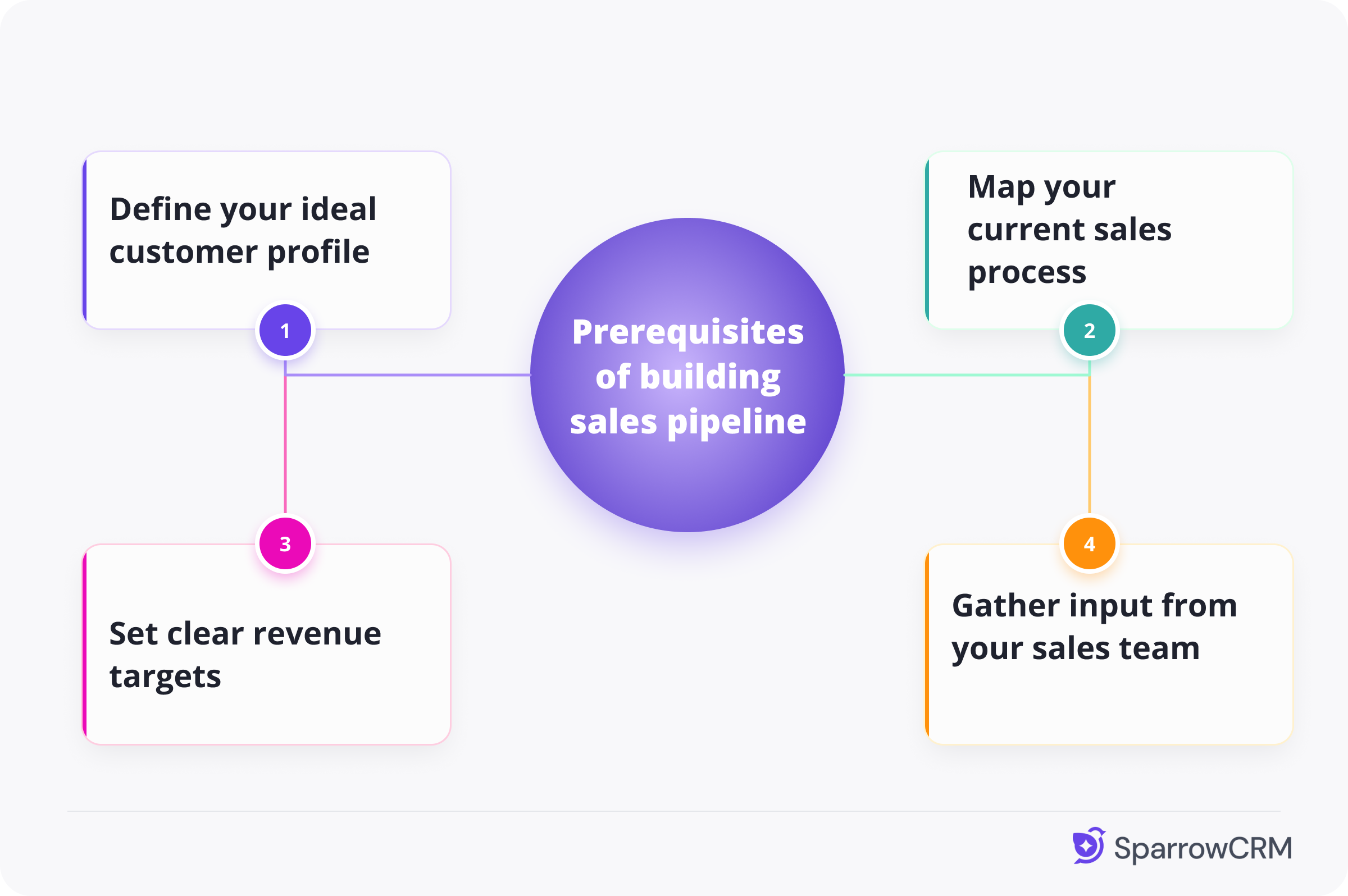
1. Define your ideal customer profile
An ideal customer profile gives your team focus. With one, reps can prioritize accounts that are a true fit and make prospecting more efficient and informed. Without one, sellers chase every conversation and burn cycles on deals that will never close.
Document firmographics such as company size, industry, and location to create an ICP. Include budget ranges, common pain points, and buying signals for your target customer. Your CRM data, market interviews, and customer surveys can serve as inputs. Review available information to create a profile that your sales, marketing, and customer success teams can line up on.
2. Map your current sales process
Understanding your customer experience will give your pipeline a reflection of reality. Map where and how buyers interact with your company to design a pipeline that standardizes the sales experience and removes roadblocks before they appear.
Outline three to five common touchpoints in a typical deal. Examples include visiting your website, requesting a demo, evaluating a proposal, and reviewing terms with stakeholders. Establish seller actions that correspond to each step as you build your pipeline, like sending a nurture email, scheduling a demo, or answering FAQs around the proposal. This way, you'll have activities that line up with what your buyer expects at each step.
3. Set clear revenue targets
A sales pipeline is a tool to help you reach and exceed revenue goals. Pipeline activity becomes an exercise in busywork rather than a driver for growth if you don't tie it back to clear targets.
Start with your annual revenue target. Then use your average deal size and historical win rates to calculate how many opportunities you'll need at each stage. Every step of your pipeline has a purpose with clearly set revenue goals, and your team knows what they're working toward.
4. Gather input from your sales team
Your sales team provides valuable frontline insights into behaviors, objections, and motivations of existing customers. Regular reviews help you spot and remove stale deals, check data hygiene, and verify that reps follow stage activities.
Make pipeline health management a habit with weekly one-on-ones or team reviews, where managers and reps walk through opportunities in the pipeline together. This discipline creates shared accountability and keeps forecasts accurate for small companies while processes remain consistent even as deal volume increases.
$0 per seat/month. Start with 3 seats.

How to build a sales pipeline: Step-by-step
Building your pipeline requires methodical execution in five interconnected steps. Each builds on the previous one to create a system that reflects how deals progress through your sales process.
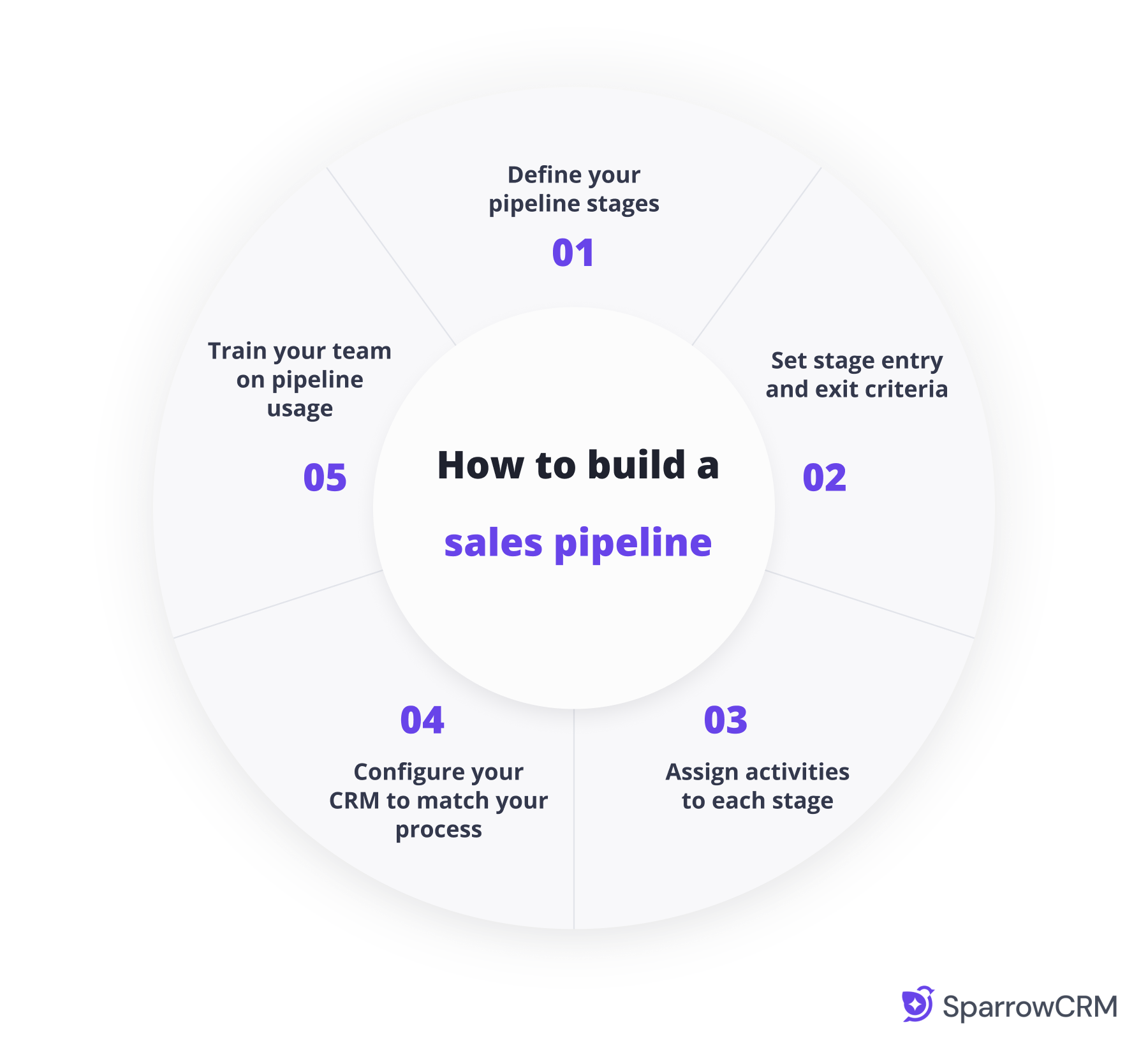
Step 1: Define your pipeline stages
Your pipeline stages should mirror meaningful moments in the buyer's decision process rather than internal checkpoints. Most sales pipelines follow a pattern: prospecting, lead qualification, demo or meeting, proposal, negotiation and commitment, contract signing, and post-purchase. These represent the typical experience from initial interest to closed deal.
Five to seven stages hit the sweet spot for most B2B organizations. Too few stages and you lose visibility into where deals stall. Too many and your team drowns in administrative overhead. Line up stages to buyer milestones, not seller activities. "Solution reviewed and requirements verified" indicates real progression, while "demo completed" tracks what your rep did only.
Step 2: Set stage entry and exit criteria
Exit criteria are the specific conditions a deal must meet before advancing to the next stage. Without them, reps move deals forward based on optimism rather than evidence, and your pipeline inflates with opportunities that aren't real.
Strong exit criteria focus on verifiable buyer actions. "Prospect confirmed budget allocated for Q2" works. "Had a good conversation" doesn't. Moving from discovery to evaluation requires stakeholders mapped, success criteria defined, and an evaluation timeline agreed, for example. This prevents premature stage advancement.
The stages become decorative if reps can move deals to any stage without verifying criteria. Your CRM should require specific fields to be populated before a stage change saves.
Step 3: Assign activities to each stage
With stages defined, identify the corresponding sales activities for each. Tasks include cold calling, email outreach, social selling, and following up on marketing leads during prospecting. Qualification involves conducting initial calls, using discovery frameworks, and asking questions that reveal budget and authority.
Assign specific responsibilities to your sales team to ensure clarity. Reps know what actions move deals forward when you delegate tasks that line up with each stage. This coordination keeps multiple opportunities progressing without confusion.
Step 4: Configure your CRM to match your process
Your CRM becomes the command center for pipeline execution. Create the pipeline with your defined stages, then set up required fields at each stage that enforce your exit criteria. Configure automation for stage changes so deals progress when conditions are met.
Build dashboards for pipeline visibility that show deal distribution, stage duration, and revenue forecasting. Set up reports for conversion rates between stages and average deal value. This configuration turns your CRM into more than a database; it becomes the engine that powers consistent deal progression.
Step 5: Train your team on pipeline usage
Training ensures everyone interprets stages in a similar way and logs activities with consistency. Explain the reasoning behind stage definitions so reps understand the buyer experience logic. Demonstrate how to update deals without creating administrative burden.
Show how accurate data benefits individual reps through better forecasting and coaching. Walking through real examples during training helps reps see how small data mistakes create bottlenecks later. Establish accountability for data quality and make updating opportunities part of the selling process itself rather than treating it as an administrative task completed afterward.
Sales pipeline best practices that help reps close faster
You've done half the work once you set up your pipeline. The other half is managing it with practices that keep deals moving and reps focused on what matters.
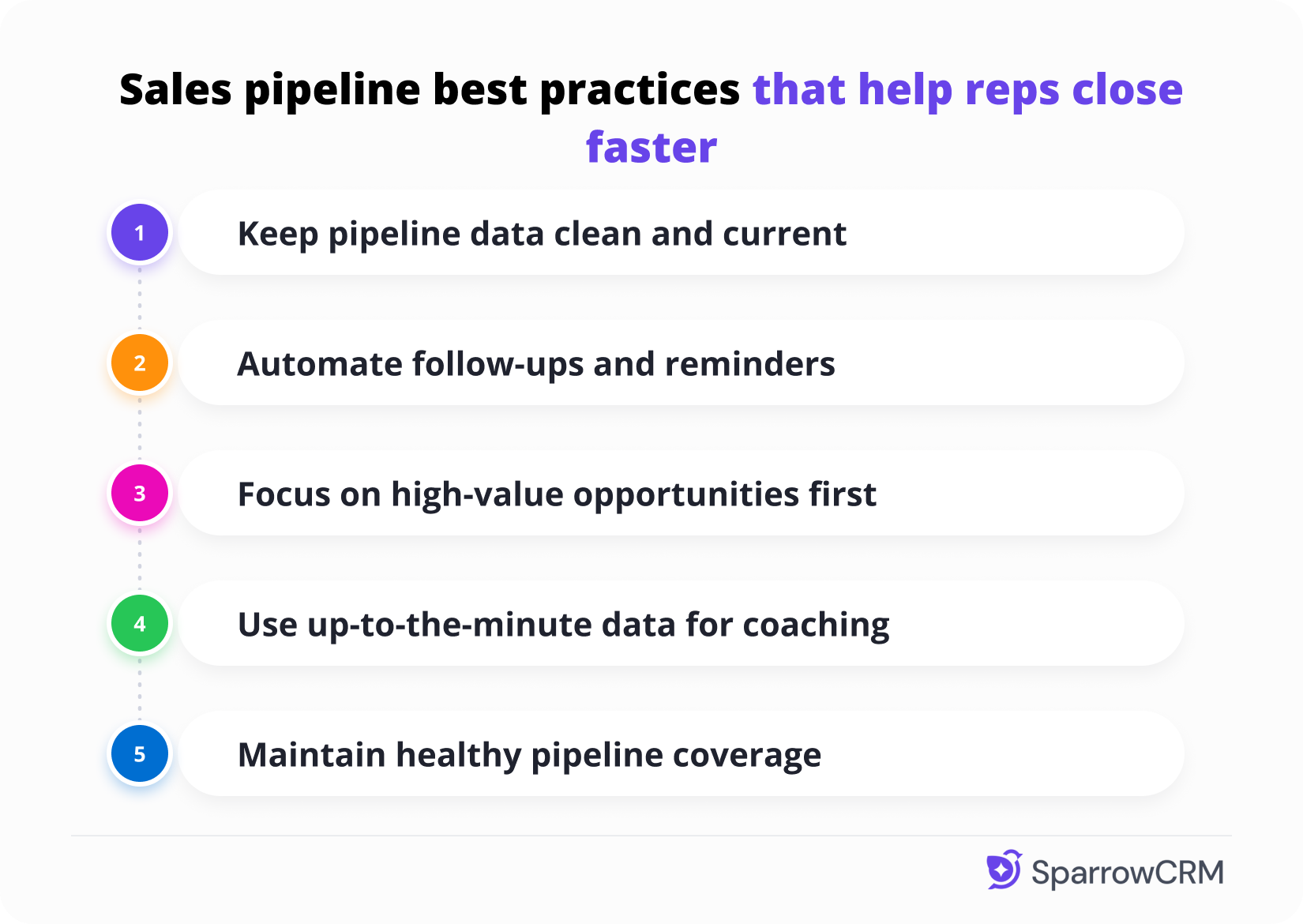
1. Keep pipeline data clean and current
Data quality affects forecast accuracy and decision-making. The problems are systemic: 76% of organizations report less than half their CRM data is accurate, and 68% struggle with incomplete data. Bad data creates bad forecasts and misallocated resources. It wastes effort on deals that were never real.
Make weekly pipeline hygiene part of your routine. Remove stale deals and update close dates and deal values. Add notes from recent conversations. Establish validation rules that prevent incomplete records from advancing between stages.
2. Automate follow-ups and reminders
Most deals require persistent outreach. Research shows 80% of sales need at least five follow-ups, yet 92% of reps stop after four or fewer attempts. Reps get busy, and leads slip through. Manual follow-up creates this gap.
Automation solves this inconsistency. Teams using automated follow-up tools save 4-6 hours every week while achieving 10-25% higher email reply rates. Your CRM should trigger follow-ups based on prospect actions or time delays. Every lead gets consistent attention this way.
3. Focus on high-value opportunities first
Not all opportunities deserve equal attention. Prioritize accounts showing genuine buying signals like recent funding or executive changes. Active solution research is another strong indicator. Signal-based prospecting generates a higher-quality pipeline than generic volume outreach.
4. Use up-to-the-minute data for coaching
Coaching driven by current activity data produces measurable results. Organizations using up-to-the-minute AI coaching see win rates improve 8 to 12 percent within three months. Managers who base feedback on actual conversation patterns and deal progression give reps applicable guidance they can apply right away. This beats relying on gut feel.
5. Maintain healthy pipeline coverage
Pipeline coverage measures whether you have enough opportunities to hit revenue targets. Most B2B sales teams need a 3:1 to 4:1 pipeline coverage ratio, which serves as the industry gold standard. This means you maintain three to four dollars in qualified pipeline for every dollar of quota.
Common pipeline mistakes that slow down deals
Even experienced teams make predictable errors that clog their sales pipeline and extend deal cycles. These patterns help you course-correct before opportunities go cold.
1. Letting stalled deals sit too long
Research shows 72% of all new sales opportunities stall in the middle to late stages of the pipeline. Deals sit in the same stage for more than 60 days without customer action. This creates a phantom pipeline that inflates forecasts but delivers no revenue. The root cause traces back to 55% of US sales leaders reporting lost revenue due to undefined sales processes. Clear time-based reviews prevent stalled deals from accumulating and masking the true health of your pipeline.
2. Poor lead qualification standards
Sales teams waste more than 50% of their time chasing poor prospects. The average conversion rate from prospects to qualified leads hits only 10%. Just 1-6% of leads end up as customers. This low conversion stems directly from poor lead quality in queues that sales teams work with. Unqualified leads drain resources and hurt both productivity and team morale.
3. Inconsistent stage definitions among reps
Your pipeline becomes unreliable for forecasting when reps interpret the same stage differently. One rep moves a deal to proposal after verbally mentioning pricing. Another waits until formal review. This inconsistency makes stage distribution meaningless as a management tool.
4. Lack of clear next steps
Deals lose momentum when calls end without mutual agreement on what happens next. Opportunities drift, and buyers lose confidence in your process without specific, dated next actions.
Final thoughts
Right now, you have everything you need to build a sales pipeline that drives revenue. Start by defining clear stages that match your buyer's trip, then set criteria that prevent deals from advancing on hope alone.
Make pipeline reviews a weekly habit rather than a quarterly scramble. Clean data and automated follow-ups separate teams that hit quota from those firefighting at month-end. Real-time coaching makes the difference.
Fix the common mistakes mentioned above and focus on qualified opportunities. Your sales velocity will improve. In fact, the fastest-closing teams don't just manage their pipeline. They treat it as their most valuable asset.