AI & AUTOMATION
AI nudges in sales: how real-time prompts help reps close more deals

By Ganesh Ravi Shankar
Last updated on May 26, 2026
Discover how AI nudges turn your CRM from a passive database into a real-time sales coach that tells reps exactly when to act.
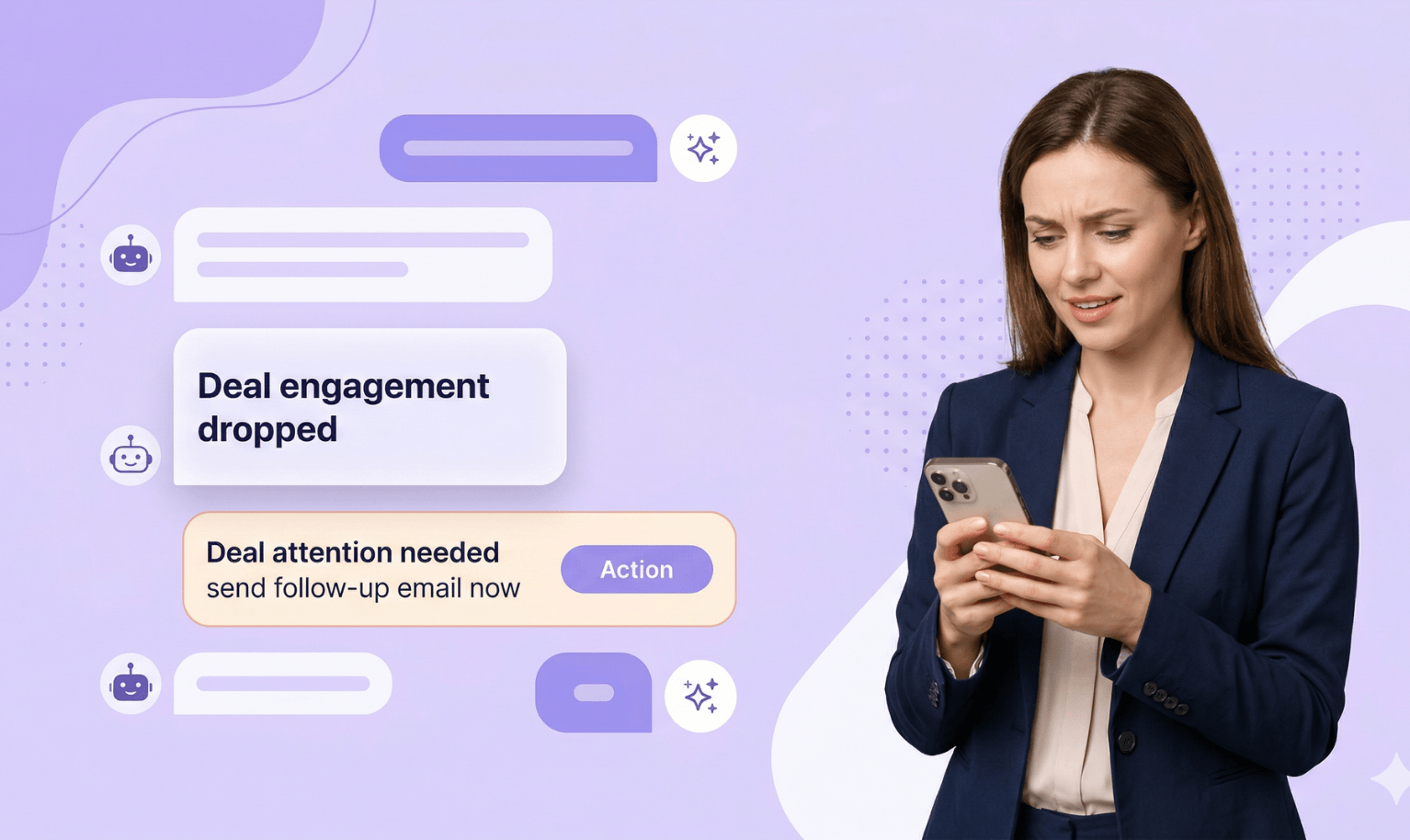
Your CRM holds a lot of data. But most of the time, it just sits there, waiting for someone to dig in.
AI nudges change that. Instead of storing information, they surface it at exactly the right moment: before a call, during an email draft, or when a deal starts going quiet. They turn a passive database into an active sales coach.
This article breaks down what AI nudges in sales actually are, how they work inside a CRM, and what they look like in real B2B scenarios. If you want to understand the broader shift toward proactive, AI-driven selling, start with our guide on agentic CRM.
Why traditional CRMs fall short
Most CRMs are built around data capture, not decision support. Your team logs calls, records deal stages, and updates contact fields, but the system never tells anyone what to do next.
That gap is where deals get lost. A rep misses the follow-up window. A buyer goes quiet, and nobody catches the signal. A competitor gets mentioned in a meeting transcript, and the rep moves on without addressing it.
AI nudges close that gap. They monitor the signals your team cannot track manually and surface them in real time, so reps act on information, not instinct.
What are AI nudges in sales, and how do they work?
At their core, AI nudges are automated prompts generated from behavioral and engagement data. They are built on the concept of nudge theory, the idea, popularized by behavioral economists Richard Thaler and Cass Sunstein, that small contextual cues reliably influence decision-making without removing choice. In a sales CRM, nudge theory meets machine learning.
The system watches for patterns across emails, calls, meetings, deal stages, and website activity, then generates specific guidance when those patterns appear.
How it works, step by step
- Data ingestion: the CRM tracks engagement signals: email open rates, call durations, meeting attendance, deal stage velocity, competitor mentions in transcripts
- Pattern recognition: the AI compares current activity against historical data to identify risk, opportunity, or optimal timing
- Nudge generation: a specific, actionable prompt is surfaced in the rep's interface: "Follow up today, this contact's engagement has dropped 40% in the last 5 days."
- Rep action: the rep acts on the nudge, and the outcome feeds back into the model, making future nudges more accurate
AI nudges vs sales automation: What's the difference?
This is one of the most common points of confusion. Here is how they differ:
AI nudges | Sales automation | |
Trigger | Dynamic — based on live signals | Static — based on time or stage rules |
Output | A recommendation to the rep | An action executed automatically |
Human involvement | The rep decides whether to act | Happens without rep input |
Personalisation | Adapts to individual contact behaviour | Applied uniformly to a segment |
Example | "This lead visited pricing 3x — reach out today" | Auto-sends follow-up email 3 days after first contact |
Both have their place. Sales automation handles volume. Nudges handle nuance, the judgment calls that require context, relationship intelligence, and timing.
Where AI nudges make the biggest impact in B2B sales
Before sales calls
The best reps prepare before every call. AI nudges eliminate the prep work, surfacing what matters most about a contact before the conversation starts.
A rep opening a contact record before a demo might see: "This contact is a Technical Evaluator. Last meeting flagged budget concerns. Decision-making power: Low. Consider looping in the CFO before this call."
That is not a generic reminder. It is deal-specific intelligence drawn from emails, meeting transcripts, and CRM activity, exactly the kind of context SparrowCRM's buying intent score and buyer profile features are built to surface.
During active deal progression
As deals move through the pipeline, AI nudges flag friction before it becomes a loss. Common nudge triggers include:
- Engagement score drops, a previously active contact goes quiet
- Competitor names detected in email threads or meeting transcripts
- Deal age exceeds the typical close time for that stage
- Key decision-maker not yet engaged, single-threaded deal risk
Each of these is a solvable problem, but only if someone catches it in time. Nudges make sure they do.
For sales managers and team leads
AI nudges are not just rep-facing. They help managers prioritise coaching conversations, spot pipeline risk at scale, and identify which deals need attention before a pipeline review.
Instead of reviewing 40 deals manually, a manager might receive a nudge summary: three deals at risk due to low engagement, two deals with unaddressed competitor mentions, and one deal where no decision-maker has been contacted in 14 days.
In outreach and prospecting
During cold outreach and sales sequence execution, AI nudges signal optimal timing and personalisation opportunities:
- Best contact time for this prospect: Tuesday to Thursday, 10 to 11 AM based on past response patterns.
- This contact has visited your pricing page twice this week. Move them to the top of your call list.
- Similar contacts in this segment respond 35% better to video content than text emails.
Examples of AI nudges in B2B sales
Example 1: Spotting a warm deal before it goes cold
A SaaS AE closes a discovery call and logs notes. Three days later, they have not sent a follow-up. Meanwhile, the contact has visited the pricing page twice.
An AI nudge fires: "High engagement detected, contact revisited pricing twice. Reach out today to maintain momentum." The rep sends a targeted email referencing the pricing discussion. The deal moves forward.
Without the nudge, the rep might have sent a generic check-in a week later or missed the window entirely.
Example 2: Handling a competitor mention
A mid-pipeline meeting transcript is processed. The AI detects two mentions of a competitor by name.
A nudge surfaces: "Competitor mentioned 2x in last meeting. Suggested next step: send differentiation one-pager before your next call."
This is exactly what SparrowCRM's call intelligence and competitor mention tracking are built for, surfacing the signal from transcripts automatically, so nothing slips through.
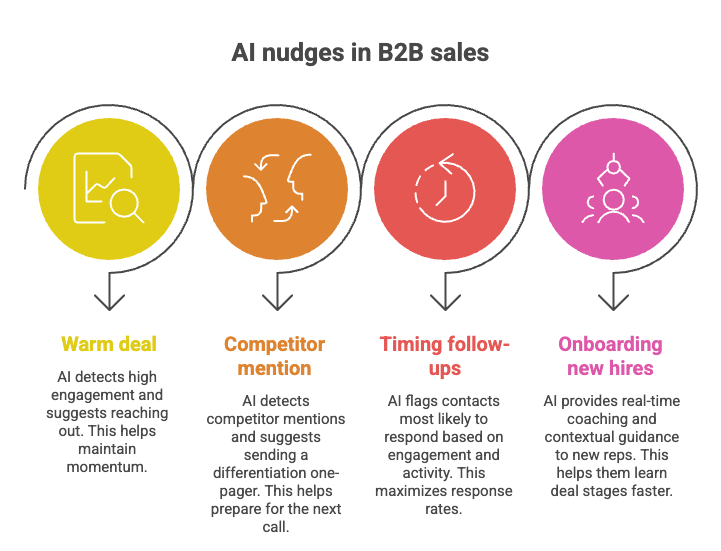
Example 3: Timing follow-ups for maximum response rate
A rep is working a list of 30 prospects. Rather than sending follow-ups at arbitrary intervals, the nudge system flags the three contacts most likely to respond today, based on past engagement timing, role, time zone, and recent website activity.
See how AI-driven sales campaigns extend this logic across full outreach sequences.
Example 4: Onboarding new sales hires
New reps get AI nudges that coach them through deal stages in real time. Instead of shadowing managers for weeks, they receive contextual guidance at the point of action: "You are entering the negotiation stage. Key risk: budget concern raised in last call, no champion identified yet."
This shortens ramp time significantly without requiring manager intervention on every deal.
How SparrowCRM's AI nudges work in practice
SparrowCRM builds nudge-style intelligence across every layer of your CRM contacts, companies, and deals. It is a core part of what makes agentic CRM fundamentally different from a traditional record-keeping system.
Here is how the key nudge-type capabilities break down:
SparrowCRM feature | What it nudges you to do | Where it appears |
Next Actions | AI-generated to-do list based on deal stage, engagement signals, and recent activity | Contacts, Companies, Deals |
Buying Intent (0-100) | Prioritise high-intent accounts; prepare smarter follow-ups before momentum drops | Contacts, Companies, Deals |
Best contact time | Reach out on the day, time, and channel with the highest historical response rate | Contacts |
Competitor mentions | Respond to competitive pressure before it shifts the deal — with exact transcript quotes | Contacts, Companies, Deals |
Risk Factors | Surface blockers early: low engagement, budget concern raised, single-threaded deal | Contacts, Companies |
Deal won/lost analysis | Extract lessons from closed deals — health timeline, AI loss analysis, transcript excerpts | Deals (lost stage) |
See how SparrowCRM's AI nudges surface the signal at the right moment
The psychology behind why AI nudges work
AI nudges are effective because they are designed around how humans actually make decisions, not how we think we do. Three principles from behavioral economics explain why:
The default effect
People tend to follow the path of least resistance. When the CRM surfaces a specific next action, most reps take it. The nudge sets the default — and defaults are powerful.
Salience
We act on what is in front of us. A nudge puts critical information at the moment of decision, not buried in a CRM field five clicks away.
Timely feedback
Behavioral change happens faster when feedback is immediate. AI closes the loop between rep action and outcome signal in real time, so reps learn what works faster.
The bottom line on AI nudges in sales
Most sales teams are not losing deals because their reps lack skill. They are losing them because the right information arrived too late, or never arrived at all.
AI nudges solve the timing problem. They watch your CRM data continuously and surface the signal your rep needs at the exact moment it matters: the pricing page visit, the competitor mention, the engagement drop, the deal that has been quiet for too long. Not in a weekly report. Not in a pipeline review. Right now, in the record the rep already has open.
The shift this creates is not about replacing human judgment, it is about giving human judgment something concrete to work with. A rep who knows a contact has visited pricing twice today makes a better call than one working off a 3-day-old task reminder. That is the entire value proposition.