SALES STRATEGY
High ticket sales: strategies, process, and examples to close more expensive deals

By Geethapriya
Last updated on Jul 30, 2026
Explore this blog to learn what high-ticket sales are, the eight-stage process reps use to close six- and seven-figure deals, and the frameworks, skills, and metrics that keep long sales cycles from stalling.

High-ticket sales involve more than selling expensive products or services. As deal values increase, so do the number of stakeholders, the length of the sales cycle, and the need to build trust throughout the buying process.
Winning these deals requires a structured approach, from qualifying the right prospects to managing complex negotiations and demonstrating clear business value. In this guide, you'll learn what high-ticket sales are, how the process works, the strategies and skills that drive success, and the key metrics to track.
What are high-ticket sales?
High-ticket sales involve selling high-value products or services, typically priced between $1,000 and $100,000. These deals often require multiple conversations, careful evaluation, and input from several decision-makers before a purchase is made.
Common examples include enterprise software, consulting services, commercial real estate, industrial equipment, and high-end business services.
What makes a sale “high ticket”?
A high-ticket sale isn't defined by price alone. While higher deal values are a common characteristic, what truly makes a sale "high ticket" is the complexity of the buying process. As the investment increases, buyers take more time to evaluate options, involve additional stakeholders, and expect clear evidence of business value before making a decision.
Standard sales | High ticket sales |
|---|---|
Short sales cycle | Long buying cycle |
One decision maker | Multiple stakeholders |
Lower risk | Higher perceived risk |
Product-focused | Outcome-focused |
Quick decisions | Multiple meetings |
Research consistently shows that high-value B2B purchases involve larger buying committees and longer sales cycles. As more stakeholders participate in the decision, sales teams must align different priorities, answer more questions, and build consensus before a deal can move forward.
Sign Up & Unlock 3 Free User Seats
High-Ticket Sales Process
High-ticket sales rarely close after a single conversation. They involve a structured process that helps buyers evaluate risk, gain internal approval, and make confident purchasing decisions. While every deal is different, most successful high-ticket sales follow these eight stages.
1. Identify Ideal Buyers
Every high-ticket sales process begins with identifying the right prospects. A well-defined ideal customer profile (ICP) includes factors such as company size, industry, budget, business goals, and the challenges your solution is designed to solve. It should also account for trigger events—such as rapid growth, digital transformation, or new funding—that indicate a business is ready to buy.
Focusing on accounts that closely match your ICP allows sales teams to spend more time on qualified opportunities and less time pursuing prospects that are unlikely to convert.
2. Qualify Leads Properly
Qualification is an ongoing process, not a one-time checklist. As opportunities progress, sales teams need to confirm that buyers have the budget, authority, business need, and timeline to move forward.
Several qualification frameworks are commonly used depending on the complexity of the deal.
Framework | Best For | What It Evaluates |
|---|---|---|
BANT | Simpler sales with fewer stakeholders | Budget, Authority, Need, Timeline |
MEDDICC | Enterprise and complex B2B sales | Metrics, Economic Buyer, Decision Criteria, Decision Process, Identify Pain, Champion, Competition |
SPICED | Consultative selling | Situation, Pain, Impact, Critical Event, Decision |
The right framework helps sales teams identify genuine opportunities early and focus their efforts on deals with the highest chance of success.
3. Understand Business Problems
Discovery is one of the most important stages of a high-ticket sale. Instead of jumping into a product demonstration, use discovery conversations to understand the buyer's business challenges, goals, and priorities.
Ask open-ended questions, identify the impact of the problem, and understand what success looks like for the customer. The more clearly you define the problem, the easier it becomes to position your solution as the right fit.
.png?2026-07-30T05:47:57.723Z)
4. Build Trust
High-ticket purchases involve significant investment, so buyers need confidence before making a decision. Building trust requires more than a persuasive sales pitch; it requires evidence.
Customer success stories, case studies, ROI calculations, testimonials, and reference calls all help reduce perceived risk. Transparent communication and realistic expectations throughout the sales process also strengthen buyer confidence.
5. Handle Multiple Stakeholders
Unlike smaller purchases, high-ticket deals often involve several decision-makers, each with different priorities and concerns.
Stakeholder | Primary Concern | What Builds Confidence |
|---|---|---|
Economic Buyer | Return on investment | Financial impact and business value |
Technical Buyer | Security and integration | Technical documentation and implementation details |
End Users | Ease of use | Product demonstrations and customer references |
Procurement | Pricing and contract terms | Commercial clarity and vendor reliability |
Understanding each stakeholder's priorities allows sales teams to tailor conversations and build consensus across the buying committee.
6. Present Business Outcomes
Once stakeholder needs are understood, shift the conversation from product features to measurable business outcomes. High-ticket buyers invest in results rather than functionality alone.
Demonstrate how your solution can deliver value by improving key business outcomes, such as:
- Increasing revenue through higher conversion rates or larger deal sizes.
- Reducing costs by eliminating manual work or consolidating software.
- Improving productivity by saving time and streamlining workflows.
- Reducing business risk through better compliance, data accuracy, or forecasting.
7. Negotiate Without Relying on Discounts
Negotiation is about creating value for both parties, not simply reducing the price. Frequent discounting can weaken your positioning and reduce the perceived value of your solution.
Instead, focus on demonstrating ROI, offering flexible payment terms, or including implementation support where appropriate. Any concessions should be tied to a mutual agreement, such as a longer contract term or a faster decision timeline.
8. Close and Expand
Winning the deal is the beginning of the customer relationship, not the end. A successful onboarding experience helps customers realise value quickly and creates opportunities for long-term growth.
A strong post-sale strategy should include:
- Structured onboarding to ensure successful adoption.
- Upselling once customers have achieved measurable results.
- Proactive renewal planning well before the contract expires.
- Account expansion by identifying new teams, departments, or use cases within the organisation.
Long-term customer success strengthens retention, increases lifetime value, and creates opportunities for future growth.
Best High-Ticket Sales Strategies
A structured sales process provides the foundation, but consistently closing high-ticket deals requires the right habits and approach. These strategies help sales teams build trust, strengthen relationships, and improve their chances of winning complex, high-value opportunities.
1. Personalise Every Interaction
Avoid using the same pitch for every prospect. Research each account before reaching out by understanding its industry, recent company developments, leadership changes, and business priorities. Tailored conversations demonstrate that you understand the buyer's unique challenges and make your outreach far more relevant.
2. Adopt a Consultative Selling Approach
High-ticket buyers expect more than a product demonstration—they want a trusted advisor. Focus on understanding their goals, identifying underlying business challenges, and recommending solutions that deliver measurable outcomes rather than simply highlighting product features.
3. Build Credibility with Social Proof
Large purchasing decisions involve significant risk, so buyers look for evidence before committing. Case studies, customer testimonials, review sites, industry awards, and recognisable customer logos help establish credibility and reassure buyers that your solution has delivered results for others.
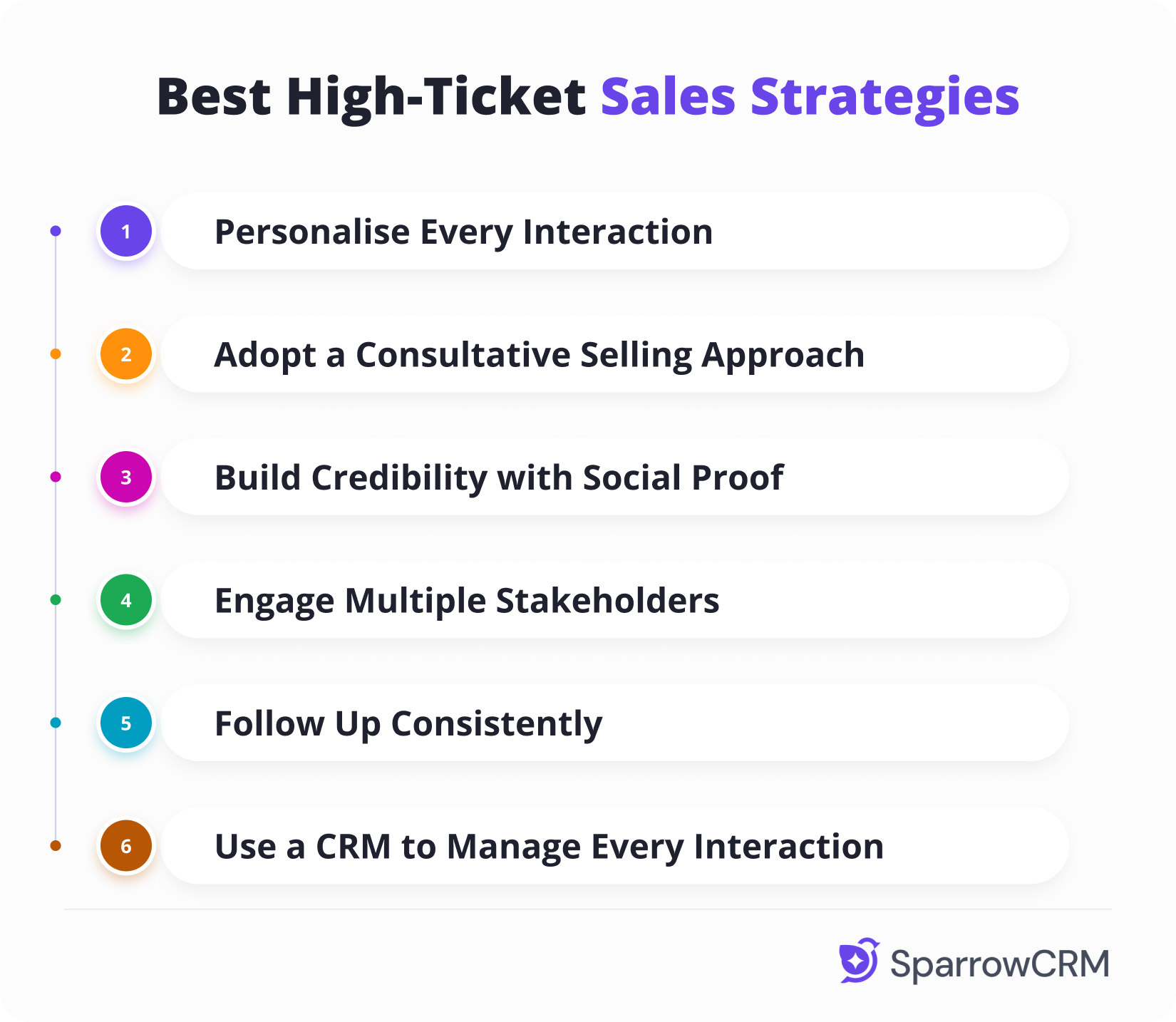
4. Engage Multiple Stakeholders
High-value deals rarely depend on a single decision-maker. Build relationships across the buying committee by engaging business leaders, technical teams, end users, and procurement throughout the sales cycle. This reduces the risk of deals stalling if one contact becomes unavailable or loses influence.
5. Follow Up Consistently
High-ticket sales often take weeks or even months to close. Rather than sending occasional check-ins, follow a structured follow-up plan that delivers value at every stage. Sharing relevant resources, addressing new questions, and maintaining regular communication helps keep opportunities moving forward.
6. Use a CRM to Manage Every Interaction
Long sales cycles generate a large amount of information, from discovery notes and stakeholder conversations to objections, next steps, and follow-up commitments. Tracking these interactions in a CRM ensures nothing is missed, improves collaboration across the sales team, and provides complete visibility into every opportunity as it progresses through the pipeline.
High-Ticket Sales Skills
A well-defined sales process can improve consistency, but closing high-ticket deals ultimately depends on the skills of the salesperson. Because these opportunities often involve long sales cycles, multiple stakeholders, and complex negotiations, the following skills are essential for success.
- Active listening: Listen beyond the buyer's words to uncover their underlying concerns, priorities, and business challenges.
- Negotiation: Balance the needs of both parties while protecting the value of your solution instead of relying on discounts.
- Objection handling: Treat objections as opportunities to clarify concerns, provide reassurance, and strengthen the buyer's confidence.
- Discovery: Ask thoughtful, open-ended questions to understand the buyer's goals, pain points, and decision-making criteria.
- Business acumen: Understand how your solution impacts revenue, costs, operations, and broader business objectives.
- Presentation skills: Tailor presentations to different stakeholders by focusing on business outcomes rather than product features.
- Relationship building: Develop trust with decision-makers, influencers, and end users throughout the buying process.
- Time management: Stay organised and maintain momentum across long sales cycles while managing multiple high-value opportunities simultaneously.
💡 Did you know?
High-ticket ecommerce stores typically see conversion rates between 0.5% and 1.5%, compared to the ecommerce average of 2% to 4%. While fewer visitors convert, each sale generates significantly higher revenue, making customer trust and personalised engagement far more important.
High-Ticket Sales Examples
High-ticket sales exist across many industries, but they all share one thing in common: they involve significant investment, multiple stakeholders, and a longer decision-making process. Here are some common examples.
Example | Typical Deal Profile | Why It's Considered High Ticket |
|---|---|---|
Enterprise CRM | £50,000 annual contract, six stakeholders, four-month sales cycle | Multiple teams must evaluate and approve the purchase before procurement signs off. |
Leadership Consulting | Multi-month transformation programme sponsored by senior executives | Success depends on trust, expertise, and long-term business outcomes rather than a tangible product. |
Industrial Machinery | High-value capital investment involving engineering and finance teams | The financial commitment is significant, and the cost of choosing the wrong solution is high. |
Commercial Insurance | Multi-year policy involving brokers, finance, and risk management | Buyers carefully evaluate coverage, compliance, and long-term financial risk before making a decision. |
Cybersecurity Platform | Enterprise deployment involving IT, security, legal, and compliance teams | Multiple stakeholders must assess security, integration, and regulatory requirements before approval. |
Common Challenges in High-Ticket Sales
High-ticket sales can be rewarding, but they also present unique challenges that require careful planning and consistent execution. Some of the most common obstacles include:
- Long sales cycles that delay revenue and require ongoing engagement with prospects.
- Budget approvals that involve multiple reviews before funding is secured.
- Stakeholder alignment where different departments have competing priorities and expectations.
- Late-stage competition as buyers continue evaluating alternative solutions throughout the sales process.
- Loss of momentum when key decision-makers leave the organisation or communication slows.
- Complex negotiations involving procurement, legal, finance, and commercial teams before contracts are finalised.
Metrics to Track in High-Ticket Sales
Closing high-ticket deals isn't just about increasing revenue—it's about understanding how efficiently your sales process performs. Tracking the right metrics helps sales teams identify bottlenecks, improve forecasting, and measure long-term success.
Metric | Why It Matters |
|---|---|
Win Rate | Measures how effectively your team converts qualified opportunities into closed deals. |
Sales Cycle Length | Shows how long it takes to move a deal from first contact to signed agreement. |
Average Deal Size | Indicates whether you're consistently closing higher-value opportunities or relying on discounts to win business. |
Pipeline Velocity | Measures how quickly qualified deals progress through each stage of the sales pipeline. |
Proposal-to-Close Rate | Reveals how often proposals convert into customers and whether opportunities are being advanced at the right time. |
Customer Acquisition Cost (CAC) | Evaluates whether the cost of acquiring a customer remains profitable for high-value deals. |
Customer Lifetime Value (LTV) | Measures the long-term revenue generated from a customer through renewals, upsells, and account expansion. |
Final Thoughts
High-ticket sales are built on trust, strategy, and consistency, not pressure or quick wins. While every deal is unique, following a structured sales process helps you navigate longer sales cycles, engage the right stakeholders, and demonstrate measurable business value at every stage.
By identifying the right prospects, qualifying opportunities effectively, building strong relationships, and tracking the right metrics, sales teams can improve win rates and create a more predictable, scalable sales process. The goal isn't just to close bigger deals—it's to build long-term customer relationships that drive sustainable growth.